

High Intent Leads: How to Spot Buyers Ready Now
High Intent Leads: How to Spot Buyers Ready Now

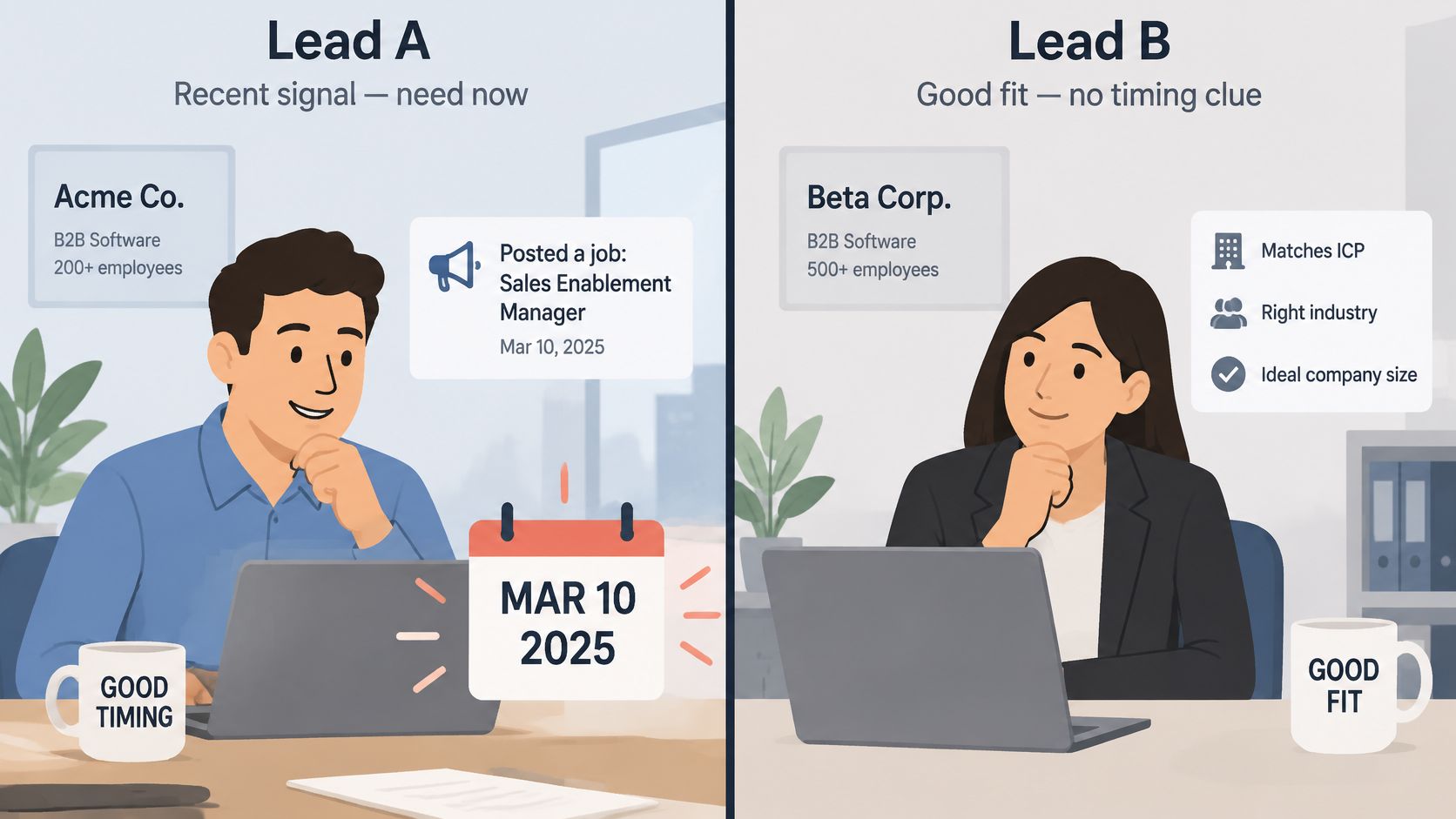
A company that matches your size, sector and region is often the wrong person to contact this week. Timing and dated evidence should decide who gets attention, not a static fit score. A fit-only record tells you the company looks like a buyer. A high intent lead tells you something specific just happened that may create a need for what you sell.
That difference is what separates a list from a conversation. Early-stage founders and small sales teams in the UK, US, Europe and India do not have spare hours to work every plausible account. Spend those hours on accounts that have shown a reason to talk now.
Table of Contents
- What Makes a Lead High Intent
- Buying Signals That Show a Need Right Now
- Checking the Contact and the Buying Group
- How to Rank Leads by Timing and Evidence
- Why Response Speed Decides Outcomes
- How to Approve a First Message That Fits the Signal
- Confirm Your Ready Leads This Week
What Makes a Lead High Intent
A high intent lead is a company or person showing a dated, specific sign that it may need what you sell now. A fit-only match has the right size, sector and location, and has shown nothing recent.
Think of a fit match as a list of addresses in the right postcode. A high intent lead is the customer who has just walked into the shop and asked which product suits them. You still have to serve them well. You no longer have to guess whether anyone is shopping.
Intent has three parts.
- A specific need. The activity points at a problem you can name, not a vague interest in your category.
- Recent evidence. You can point at a public event with a source and a date.
- A person linked to that need. The role you contact is close to the work the signal describes.
Intent is a likelihood, not a promise. A signal gives you a reason to talk. It does not hand you a sale, a budget or a signed order.
Signal-first prospecting starts from that observed activity and only then checks fit. You do not begin with a database of lookalike companies and hope one of them is in market.
Run this test on any lead before it hits the top of the queue. Can you name the signal, its source and its date? If you cannot, it is a fit match and it should rank lower.
What buyer research changes about that test
Buyers form preferences early, which is why an early public signal matters. A 2025 6sense study of nearly 4,000 buyers making purchases of at least $25,000 found that buyers had already identified an average of 3.6 vendors on the first day of their buying journey, against an average final shortlist of 5.1. The same study reported that 94% of buyers had ranked their shortlist by preference before engaging a seller.
A separate 2025 buyer research note from 6sense puts the first-contact point at about 61% of the journey in 2025, down from 69% previously. A signal can appear well before any vendor is shortlisted. Wait for a formal enquiry and you may be talking to a buyer who already has a favourite.
Buying Signals That Show a Need Right Now
Use this table as the working reference for which buying signals deserve a look this week. The windows are working guidance, not measured averages. One signal is a reason to look closer, not proof of a purchase.
| Signal | What it suggests | Useful for roughly | Verify before outreach |
|---|---|---|---|
| Job post for the role you sell to | A team is building capacity for the problem | While the role stays open | Role is still open and the hiring team fits your buyer |
| Funding round announced | Budget and a reason to invest now | A few months after the announcement | Round date and whether the funds relate to your area |
| Someone asking for recommendations on LinkedIn | A stated need and openness to suggestions | Days | Post date, and whether the poster is the buyer or an adviser |
| New decision-maker in role | A new owner of the problem often reviews suppliers | The first months in the role | Start date and role title confirmed |
| Open public tender | A stated requirement with a deadline and eligibility rules | Until the closing date | Scope, deadline and supplier requirements |
| Company news about expansion or a new site | Growing workload and new needs | Weeks | News date and a clear link to your problem |
| Comment on a competitor or creator post | Interest in the problem, not yet a need | Days | Comment is about your topic, not a complaint about a rival |
The two signals with the clearest timing
An open public tender is the sharpest of the set. It states a requirement, a deadline and a procurement process. Say a facilities team publishes a tender for outsourced helpdesk support with a closing date three weeks away. You are not guessing that they might buy support software. They have written the need down, named the rules and set a clock. Check the lot structure, the supplier requirements and whether your offer fits the scope before you write a word.
A hiring post is the next strongest everyday signal for most B2B teams. A live advert for a finance controller suggests a reporting problem is being worked on now, not in some future planning cycle. Confirm the role is still open and that the hiring team is the buyer you sell to. A post for a junior analyst in a different function is not the same lead.
Practical rule: Two different signals on one account within a few weeks make a stronger case than one signal on its own.
The other rows still earn a place, with tighter limits. A funding announcement can mean budget and a growth plan, but only if the round date is real and the money relates to your area. A LinkedIn request for recommendations is a stated need with a short life, often a few days, and the poster may be an adviser rather than the buyer. A new decision-maker often reviews suppliers in the first months, once you have confirmed the start date and title. Expansion news is useful for weeks when the new site clearly creates the problem you solve. A comment on a competitor or creator post shows interest. Treat it as a prompt to research, not as a need.
Public tenders also matter for smaller suppliers, and the UK figures are specific. Open Contracting's review of UK procurement data for February 2026 shows that SMEs and voluntary, community and social enterprises made up 67% of bidders, up from 54% in March 2025, and that 61% of contracts awarded through open tenders went to at least one SME, against 36% of direct awards. Those figures cover UK public procurement only. Do not treat them as a private-sector rule.
Checking the Contact and the Buying Group
A good signal with a bad contact wastes the week and can hurt delivery. Run three checks in this order before anyone lands in a sending queue.
Confirm the company and the role
The poster, the hiring manager or the tender's named buyer should be the person you contact, or should lead you to them. Match the company on the signal to the company on the contact record. Then match the role to the problem. A marketing manager commenting on a finance tool is not automatically your buyer. If the visible person is a user rather than the owner of the decision, use them as a route into the account, not as the only name on the list. A short guide to who the decision-makers usually are helps you sort user, budget holder and sponsor before you write.
Confirm the email status
A verified email has passed a mailbox check. A catch-all, unknown or doubtful result stays out of the sending queue until it is resolved. Do not treat a role address or a stale mailbox as the same thing as a confirmed work address.
Google's Gmail sender guidance says a negative reputation for a shared IP address can reduce delivery rates, and it recommends Postmaster Tools when you send through an email service provider. Sending to invalid mailboxes costs you more than one lost contact. It can drag down delivery for the messages that were worth sending.
Confirm the date
Save the source and the date with the lead. If a date for a public signal was not saved, the lead should say so instead of guessing. An undated signal ranks lower until you have checked it. A "new in role" note with no start month is not ready to approach.
One name is not the buying group
A 2025 Demandbase study reports that 72% of B2B purchases involve complex buying groups. One post or job advert shows organisational activity. It does not prove the author holds the budget.
Keep four roles in mind and do not collapse them into one person.
- User. Feels the problem day to day and can describe it.
- Budget holder. Can say yes to spend.
- Procurement contact. Runs a tender or a vendor process when one exists.
- Internal champion. Will argue for you when you are not in the room.
A verified email proves the mailbox exists. It does not prove the person is the right buyer, or that the company is ready to become one of your paying customers.
Pair the mailbox check with dated evidence, such as a tender, a hiring post, a funding note, company news or a public request for help. If any of those three checks fails, leave the lead in research.
How to Rank Leads by Timing and Evidence
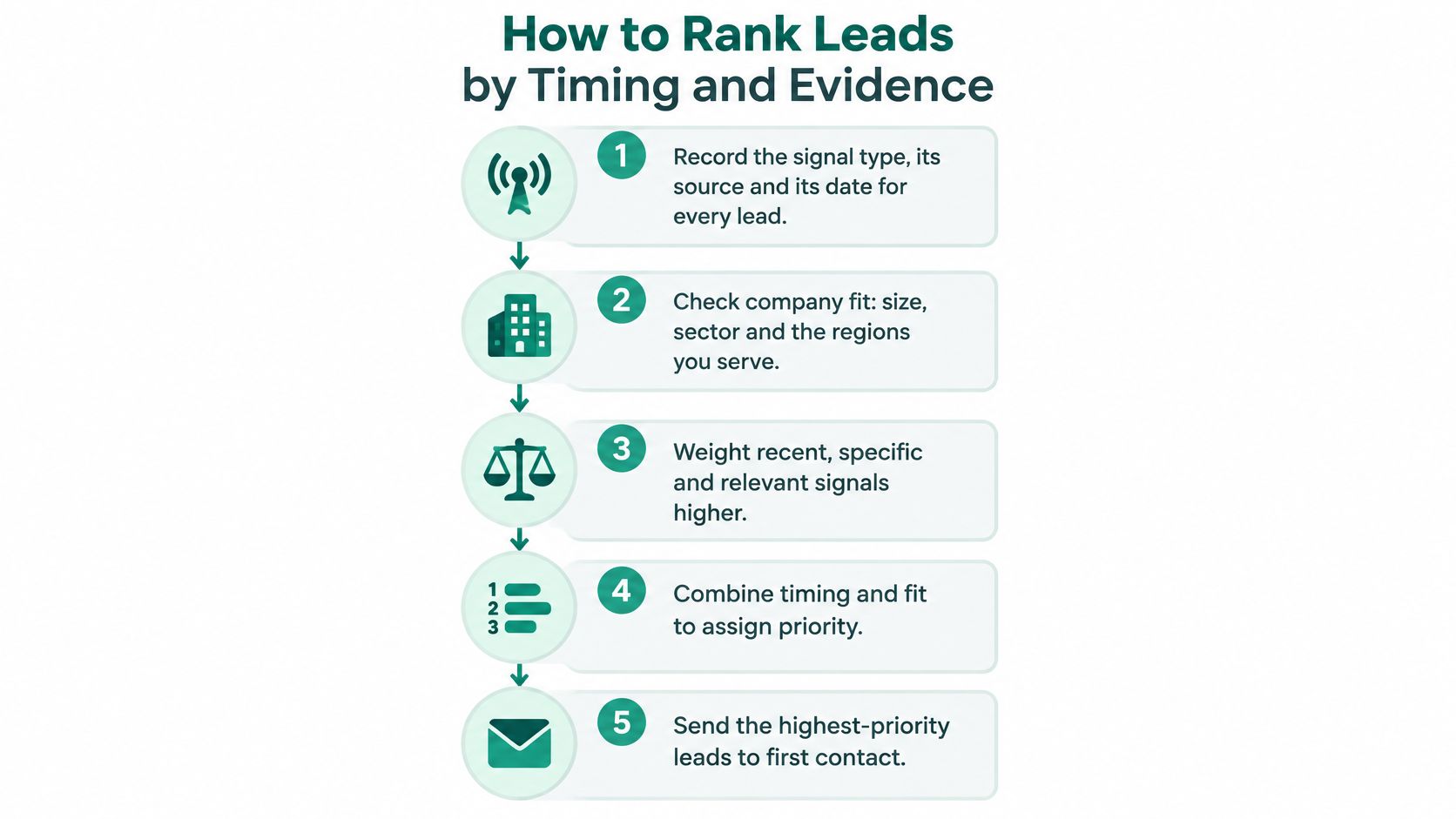
Rank by evidence first and fit second. A perfect industry match with no recent activity should not jump a smaller company that asked for help yesterday.
Five steps before you assign a tier
- Record the signal. Write the signal type, its source and its date on every lead. Public sources include LinkedIn, job boards, company news, registers and tenders, and the source belongs on the row. If several searches find the same person, merge the duplicates so each person appears once with every signal attached.
- Check company fit. Size, sector and the regions you serve still matter. They decide whether the account can buy, not whether it should be first.
- Weight the signal. Recent, specific and action-oriented events outrank general interest. A request for help that names your problem outranks a company that merely sits in the right industry.
- Confirm the role. The person should sit close to the buying decision. A high score on one signal does not confirm budget, so this check always comes before the tier is final.
- Sort the lead. Put it in one tier and take the action that tier allows. Ready accounts sit on top. Do not let a large "also found" pile crowd them out.
| Tier | Typical evidence | Suggested action |
|---|---|---|
| Ready to approach | Recent, specific signal plus a confirmed role | Approach this week |
| Strong match | Clear fit with an older or less specific signal | Approach after the ready queue |
| Keen leads to explore | Interest signal with no clear need | Research before contact |
| Partners | Companies that serve the same buyer | Consider a referral or partnership |
| Also found | Fit only, no signal | Park and review again later |
How the tiers behave in a real week
Ready to approach is a narrow set. A controller role that is still open, plus a confirmed finance lead, belongs here. So does a tender inside its closing window when your offer matches the scope. You approach these this week, after the contact checks.
Strong match is a clear fit with an older or softer signal. The funding round was real, but it landed a few months ago, or the expansion news is relevant without a named project. Work this queue only after the ready accounts have a first touch.
Keen leads to explore showed interest without a clear need. A comment on a creator's post in your space is the typical case. Research the account before you contact anyone. A generic pitch here burns a name you might need later.
Partners sell to the same buyer without competing with you. A referral or a joint introduction is the sensible move, not a sales sequence.
Also found is fit with no signal. Park it and look again when a dated event appears. Leads can sit in All, Ready to approach, Strong match, Keen leads to explore, Partners and Also found, with the ready ones kept on top so the week stays honest.
Do not finalise a tier until step 4 is done. A loud signal and the wrong role is still the wrong conversation.
Why Response Speed Decides Outcomes
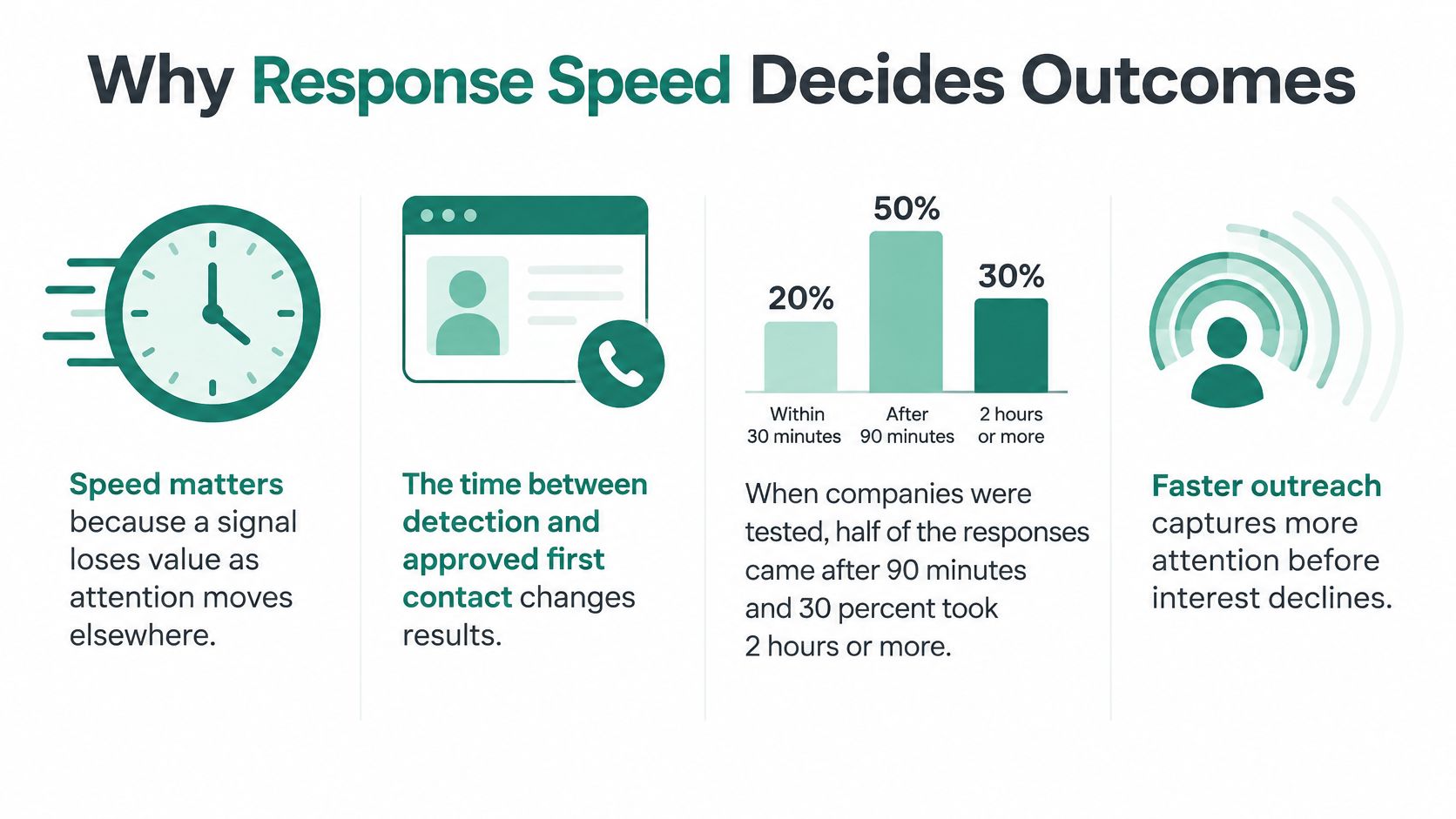
A signal loses value as the prospect's attention moves on. The hours between detection and your approved first contact are part of the result, not an admin detail.
The historical numbers are blunt. A Harvard Business Review study published in 2011 audited 2,241 U.S. companies by submitting test leads through their websites. Among companies that responded within 30 days, the average response time was 42 hours. Only 37% responded within one hour, and 23% never responded. In a separate analysis of 1.25 million sales leads from 29 business-to-consumer and 13 business-to-business companies, organisations that contacted a lead within one hour were nearly seven times more likely to qualify it than those that waited an additional hour, and more than 60 times more likely than those waiting 24 hours or longer.
A later MIT and InsideSales analysis of more than 15,000 leads and 100,000 call attempts across six companies reported that calling within five minutes rather than 30 minutes increased the odds of contact by 100 times and the odds of qualification by 21 times. These studies mostly cover inbound leads, not public-signal outreach. They show direction. They do not guarantee a lift on every tender, job post or LinkedIn request.
| Study | Measure | Reported result |
|---|---|---|
| Harvard Business Review audit, 2011 | Average response, companies that replied within 30 days | 42 hours; 37% replied within one hour; 23% never replied |
| Lead response analysis, 1.25 million leads | Contact within one hour versus waiting an extra hour | Nearly 7 times more likely to qualify |
| Lead response analysis, 1.25 million leads | Contact within one hour versus 24 hours or longer | More than 60 times more likely to qualify |
| MIT and InsideSales analysis, 15,000+ leads | Call within 5 minutes versus 30 minutes | 100 times the odds of contact; 21 times the odds of qualification |
The operating rule
Each new lead arrives with the reason it matters now. Act on that reason the same day when the tier is Ready to approach. Draft from the dated evidence, then approve the message yourself. Speed without a true claim is just a faster mistake.
Measure the hours from signal observation to approved first touch for ready leads, and review that figure every week. Pair it with contact validity, reply rate and signal category. A practical note on velocity in the pipeline is the right place to keep that weekly check honest.
If a signal is older than the window in your table, do not delete it. Move the lead to Strong match and work it after the ready queue. Age reduces priority. It does not erase a real event.
How to Approve a First Message That Fits the Signal
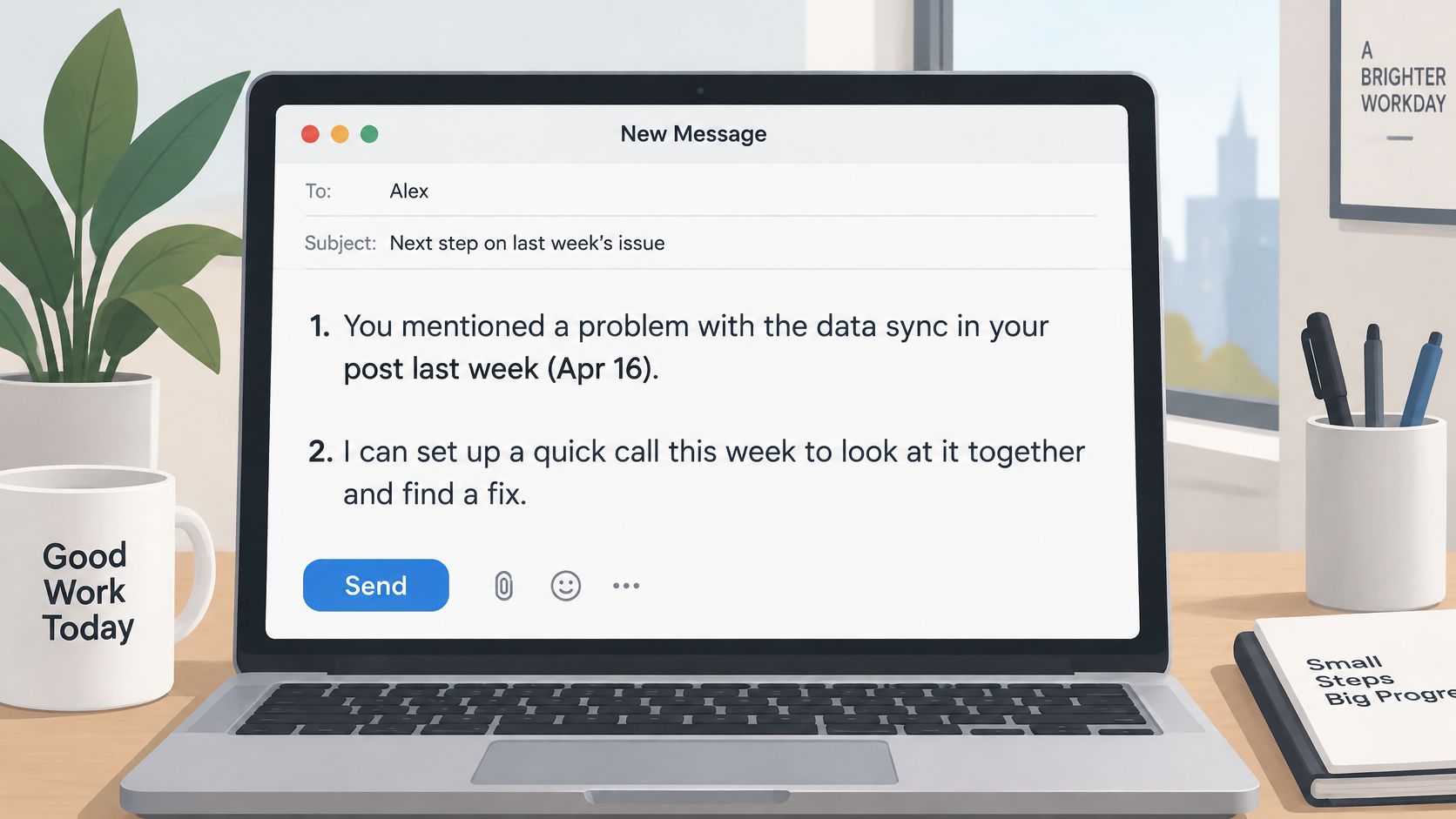
A first message should be short enough to check in one read, and specific enough that it could not be sent to the next company on the list.
Use three lines.
- Name what they did, and when. Point at the post, the role, the tender or the news item, with a time you can defend.
- Say what you do, in one sentence, tied to that problem. No company history.
- Ask one low-commitment question. A question they can answer without booking a call.
Here is an illustration, not a result from a live account.
You posted last Tuesday about month-end reports taking your team three days. We help finance teams cut that close with cleaner source data. Is the delay mainly in the export, or in fixing the numbers afterwards?
The test and the approval path
If the first line would fit any company in the sector, rewrite it. "Noticed you're growing" fails that test. "Your tender for managed print, closing on the 18th" passes it.
The path stays with you.
- The outreach agent writes each first line based on what the person said or did.
- You read, change and approve every first message before it is sent.
- Nothing goes out until you approve the campaign and then approve sending.
- Sending happens only through your own Smartlead account, after those two approvals.
Before you approve, check three things on the page in front of you. The date must be accurate. The source must be the one on the lead. The claim in line one must match what the source says. If any of the three is soft, edit or hold the message. A fast, wrong opener costs more than a day's delay.
Confirm Your Ready Leads This Week
Work the week in four steps, and keep the ready queue in front.
- Paste your website. The setup reads what you sell and who buys it, then you approve the summary. There are no forms and no onboarding call.
- Review the ranked leads. For each one, check the signal, its source and its date. Anything without those three drops down a tier.
- Reveal contact details only for the leads you pick. You should not pay for a name you will not use. A verified email still needs the role check before it is worth a credit. Read how email verification limits what that status can prove.
- Cap the day, then approve. Approve the ready queue first and cap the number of new contacts per day, so loosely matched accounts do not crowd out timely ones. The message goes out only through your own Smartlead account, after you approve it.
Results depend on your offer, your market and your follow-up. No outcome is promised here. A clean queue and a same-day first touch give you a fair test. They do not guarantee paying customers.
Paste your website at signalvan.com to see who's ready to buy this week.
SignalVan finds companies already showing public buying signals, checks the decision-maker's contact, and drafts a first message you approve before anything is sent through your own Smartlead account. If timing and evidence should decide this week's outreach, start with the accounts that have a dated reason to talk. Visit SignalVan and paste your website to see who is ready now.
Keep reading

Excel Export Data: How to Keep Your Formatting Intact
Excel Export Data: How to Keep Your Formatting Intact

Marketing Software for Agencies: Top Picks for 2026
Marketing Software for Agencies: Top Picks for 2026

Lead Generation Software: 10 Tools That Find Real Buyers
Lead Generation Software: 10 Tools That Find Real Buyers
Start with your website.
See your first leads, with the reason each one is there.