

Cold Email Follow-Up Templates: 7 Versions for 2026
Cold Email Follow-Up Templates: 7 Versions for 2026
The first email went out three days ago. No reply. The prospect may have missed it, the timing may be wrong, or the topic may sit with someone else. Silence rarely gives a clear answer, so sending the same reminder again rarely helps.
Use cold email follow-up templates matched to the likely reason for silence. A large-scale 2019 analysis of 12 million outreach emails reported that only 8.5% received any response in the cold email statistics summary, and the same analysis states that adding a single follow-up could increase the response rate by as much as 65.8%. Those figures do not guarantee results. List quality, relevance and deliverability still decide the outcome.
The seven templates below cover a buried email, a weak first angle, a dated buying signal, a busy reader, a useful resource, the wrong contact and the close. Each one includes copy to adapt and checks to complete before approval. Start with the moment, not the template library.
Table of Contents
- 1. The Bump One-Line Check-In Follow-Up
- 2. The New Angle Value-Led Follow-Up
- 3. The Signal Reference Follow-Up
- 4. The Single Question Follow-Up
- 5. The Resource Share Follow-Up
- 6. The Referral Redirect Follow-Up
- 7. The Breakup Email Final Follow-Up
- How the seven follow-up templates differ by timing, length and goal
- Match Each Follow-Up to the Reason for Silence
1. The Bump One-Line Check-In Follow-Up
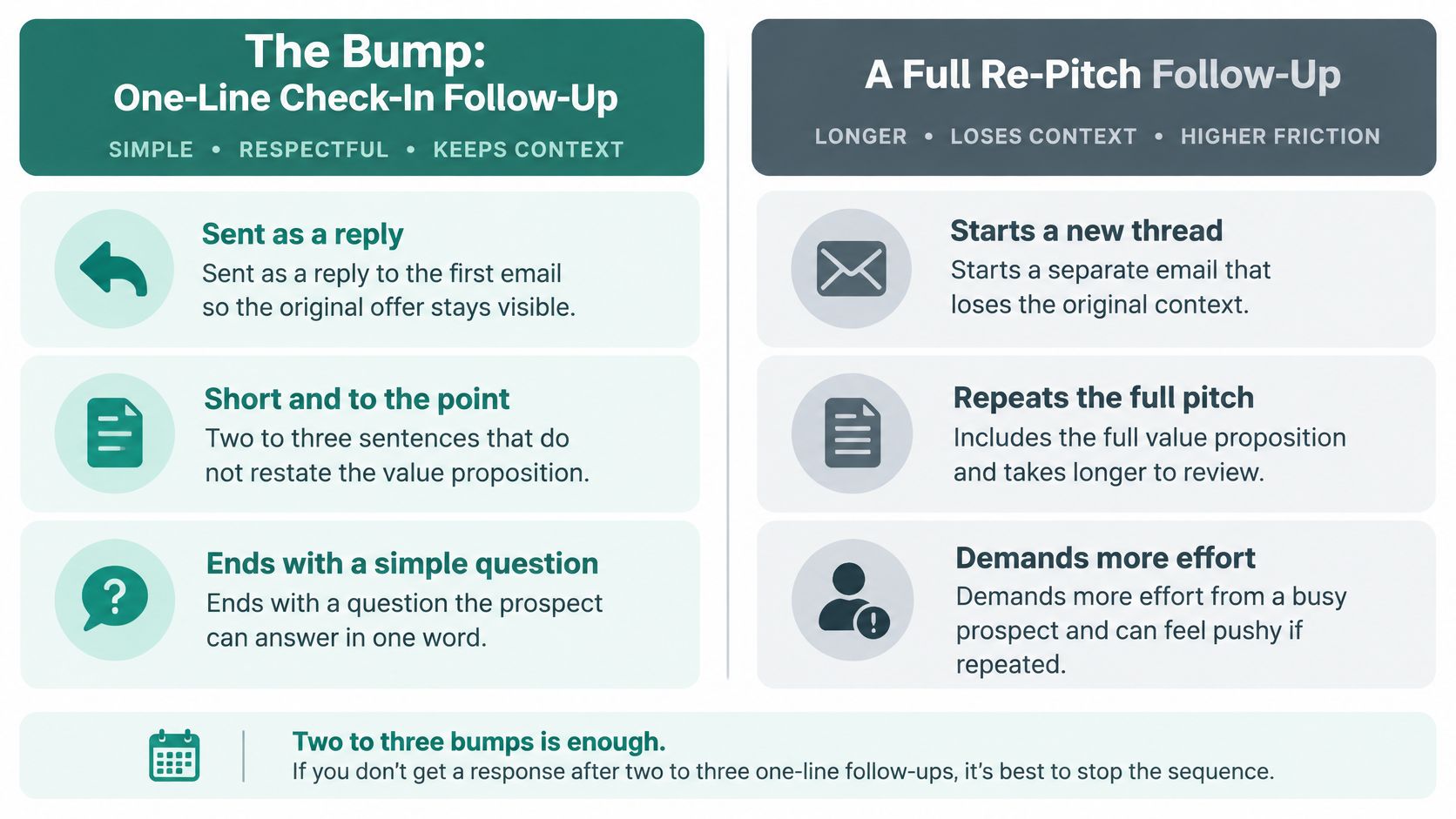
The bump is the shortest useful follow-up. It replies to the original email, keeps the subject line unchanged and leaves the first message visible in the thread. The prospect does not need to search for context. The follow-up also does not repeat the pitch.
Use it when the first email was relevant and specific, but may have been buried. Send it a few working days later. Do not use it when the first message was vague, sent to the wrong role or based on weak evidence. A bump cannot repair a poor reason for contact.
Copy to Adapt
Hi [First name], bringing this back to the top of your inbox in case it was buried. Is [specific problem] on the list this quarter, or is later better?
The question gives the reader two easy answers. It asks about a named problem rather than a meeting. That matters when the goal is to learn whether the topic is live before asking for time.
- Reply in thread: Keep the original subject and context visible.
- Check the address: Confirm the verified email before every follow-up.
- Limit repetition: Stop after two bumps without a reply and log the outcome.
- Protect sequence speed: Review follow-up pauses alongside velocity in pipeline rather than judging one email alone.
In Smartlead, the bump normally works as the first follow-up step. Review the copy, the contact and the send window before approval. Nothing should go out just because the sequence reached step two.
2. The New Angle Value-Led Follow-Up
A new angle gives the prospect a different reason to reply. The first email may have focused on cost, speed or risk. The follow-up can focus on another outcome that matters to the same team. It should not restate the first claim in stronger words.
This version suits an ignored email, not a refusal. Pick one concrete problem drawn from the sector, role or public company information. Name that problem before naming the offer. Three new benefits in one email reads like a brochure and makes the reply harder.
Copy to Adapt
Hi [First name], the last note focused on [first topic]. Teams in [sector] often also ask about [second topic]. If that applies at [company name], a short outline can show how a similar team approached it. Would that be useful?
Personalisation has to change the substance, not only the greeting. In 2025, Superhuman reported that personalized follow-ups achieved an approximately 18% response rate, compared with 9% for generic templates. Treat that as directional. The useful lesson is that a prospect-specific angle gives the reader something to judge.
Use a new subject line for a new point. Say, for example, the first email covered reporting time. The follow-up could cover missed handoffs between sales and delivery. Both relate to the same service, but each speaks to a different daily problem.
Do not invent internal knowledge. Words such as often and may keep the claim honest. If no credible second angle exists, use the single question or resource version instead.
3. The Signal Reference Follow-Up
The signal reference links the follow-up to a dated, observable event. Buying signals can include hiring, funding, a new appointment, a public request for help, company news or an open tender. In signal-first prospecting, the event supplies a reason to contact the company now rather than selecting names from a static list.
Name the signal in one neutral sentence. Then state the problem it may indicate and ask one question. Do not claim to know internal plans, budgets or deadlines from a public post. A hiring notice shows hiring. It does not prove the company needs a particular supplier.

Copy to Adapt
Hi [First name], two roles in [function] were posted last month. That growth can make [specific need] harder to manage. If it is on the list, support is available for [specific outcome]. Worth a short conversation this quarter?
Check the evidence date before approval. A signal from several weeks ago may already be resolved, while a very recent one may need a shorter and plainer message. SignalVan lead records show the reason for approaching each prospect, so the source and date can be checked against the draft.
Prioritise companies where the signal, role and offer line up. The order set out in prospect rankings helps prevent strong copy being spent on weak-fit accounts. If the signal is stale or only loosely connected to the offer, remove the reference or do not send the follow-up.
4. The Single Question Follow-Up
The single question follow-up asks one thing and stops. It works for busy readers who scan quickly and postpone longer replies. The aim is a short answer about priority, ownership or current process. The aim is not a meeting.
Choose a question the prospect can answer from current knowledge. Timing and priority are usually easier than budget. A question that needs internal checking, figures or approval creates work and often gets parked. Two questions create the same problem.
Copy to Adapt
Hi [First name], is [specific problem] something [company name] is actively looking at this year, or is it parked for now?
That copy gives two clear positions. Either answer helps the sender. Active means a relevant next step can follow. Parked means the sequence should end and the lead can be logged for a later review if circumstances change.
- Keep the subject plain: Quick question on [topic] is enough.
- Remove attachments: Links and files distract from the reply.
- Avoid false urgency: Pressure does not make a parked problem active.
- Measure the right reply: Separate positive answers, objections and automatic responses.
Follow-ups also need separate measurement. In 2025, Bliro reported an average response rate of 4.9% for campaigns using follow-up emails, compared with 3% for campaigns without follow-ups. Do not use that gap as a forecast. Compare delivered replies and positive replies within the same list, signal type and market.
5. The Resource Share Follow-Up
The resource share gives value before asking for time. It can be a one-page checklist, a short method note, a template or a concise case outline. The resource must connect to the problem already raised. A broad guide sent to every prospect is easy to ignore.
Describe the content in one sentence. The reader should know what the page covers, how long it takes to use and why it fits the current situation. Use one link at most. Do not attach files to cold email, because attachments add friction and can create delivery or security concerns.

Copy to Adapt
Hi [First name], a one-page checklist on [specific task] may help with [specific problem]. It is here: [your link]. Happy to cover any question it raises.
Say a consultancy follows up with an operations lead after a hiring signal. A checklist for handing work from a founder to a new manager fits that moment. A general company brochure does not. Relevance matters more than design polish.
Practical rule: Send only material that can be checked, explained and defended in a reply.
Deliverability checks still apply. Current sender guidance summarised in lemlist email sender requirements requires SPF and DKIM authentication, DMARC alignment, and one-click unsubscribe support for large-volume email. A useful link does not excuse misleading sender details or a hidden opt-out.
Follow a resource with a short question only after enough time to read it. Do not claim the prospect opened or clicked unless the tracking is reliable and relevant.
6. The Referral Redirect Follow-Up
The referral redirect is for the wrong-person problem. The contact may reply that another team owns the topic, or the role itself may show that ownership sits elsewhere. Asking for a meeting at that point wastes goodwill. Ask who owns the area and make forwarding easy.
Thank the contact first. Then provide a short summary that can be pasted into an internal message. Keep the summary focused on the problem and outcome, not a full sales pitch. The new recipient still needs a direct reason to engage.
Copy to Adapt
Hi [First name], thanks for the reply. Who owns [specific area] in the team? For forwarding, the short version is support with [outcome] for teams facing [problem].
Do not ask the original contact to sell the idea internally. That is too much work for a cold request. A name, role or forwarded thread is a good result. Log it so the same person is not contacted again by mistake.
Role titles alone can mislead. Ownership may sit with operations, finance, a founder or a team lead depending on company size. The breakdown of who are the decision-makers is useful before selecting the next contact.
Use a verified email for the new person before sending. Check that catch-all or unknown results are labelled rather than treated as confirmed. A referral improves relevance, but it does not verify an address or establish a lawful basis for contact.
Do not keep emailing the wrong contact after a redirect. Stop that thread, record the referral and start a separate, approved message only if the new contact fits.
7. The Breakup Email Final Follow-Up
The breakup email is the last approved touch. It gives the prospect a clean exit and a way back later. Send it when the sequence has already tried a check-in, a different angle and a dated signal. It also fits when the contact was plausibly the wrong person and no better owner emerged.
Do not send it as pressure. Do not send it after a fresh buying signal, a referral to a real owner or an explicit opt-out; those moments need a different action or a full stop. If the copy says the follow-ups end, they end.
Copy to Adapt
Hi [First name], no reply yet, so I will stop following up for now. If [specific problem] becomes a priority later, reply here and I can reopen it. Thanks for your time.
Some prospects reply here because the choice is finally simple: talk now or close the thread. Treat a clear no, a parked quarter or a wrong-owner note as useful list data. Silence is also an outcome. Log it and suppress the person from later steps.
Follow-up steps can account for a large share of replies, so finishing the sequence is reasonable. Endless contact is not. Set the stop condition before launch and record replies, positive replies, bounces, unsubscribes and meetings by step. When outreach runs through your own Smartlead, keep this as the final step and send only after the campaign approval and the sending approval. A clean close protects sender reputation and keeps a later, signal-based approach believable.
How the seven follow-up templates differ by timing, length and goal
| Item | Suggested timing | Typical length | Main goal |
|---|---|---|---|
| The Bump: One-Line Check-In Follow-Up | A few working days after the first email | 2 to 3 sentences | Resurface the original email |
| The New Angle: Value-Led Follow-Up | Mid-sequence | 3 to 5 sentences | Add a different reason to reply |
| The Signal Reference Follow-Up | When a dated buying signal is recent | 4 to 6 sentences | Tie the message to observed timing |
| The Single Question Follow-Up | Mid-sequence | 2 to 3 sentences | Start a short exchange |
| The Resource Share Follow-Up | After a reply or interest signal, or mid-sequence | 3 to 5 sentences | Give something useful without a meeting ask |
| The Referral Redirect Follow-Up | When the contact is not the decision-maker | 2 to 4 sentences | Reach the right person |
| The Breakup Email: Final Follow-Up | Final step in the sequence | 2 to 3 sentences | Close the loop politely |
Match Each Follow-Up to the Reason for Silence
Silence has different causes. Use the bump when a relevant email was probably buried. Use a new angle when the first problem did not connect. Use a signal reference only when the event is recent, dated and clearly linked to the offer.
Use the single question to test priority. Use a resource share when useful material can answer a real concern without demanding a call. Use the referral redirect when the contact does not own the problem. Close with the breakup email and stop.
Before approval, check the recipient, signal date, source, sender identity and opt-out route. A checked address confirms delivery potential, not permission. For UK outreach, ICO direct marketing and data protection guidance states that PECR generally does not require consent for marketing emails sent to corporate subscribers such as limited companies and limited liability partnerships, while data protection law still applies to named employees and direct addresses. Sole traders and some partnerships are treated differently, so recipient type matters before a sequence starts.
For US outreach, the FTC CAN-SPAM Act compliance guide states that an opt-out request must be honoured within 10 business days. Accurate sender details, honest subject lines and a clear opt-out belong on every follow-up, not only the first email. Approval inside Smartlead does not transfer compliance responsibility away from the sending business.
Measure each sequence by delivered rate, total replies, positive replies, meetings, bounces and unsubscribes. Open rates alone cannot show whether a template found paying customers or generated curiosity. Compare results by signal type and step before making any template standard. Paste your website at signalvan.com to see who's ready to buy this week.
SignalVan finds companies showing current buying signals, provides verified decision-maker contact details for selected leads and drafts outreach for review, with sending controlled through your own Smartlead account after approval. Use those dated signals to choose the right follow-up instead of sending another generic bump. Start at SignalVan and review the ranked leads before the next sequence goes out.
Keep reading

Excel Export Data: How to Keep Your Formatting Intact
Excel Export Data: How to Keep Your Formatting Intact

Marketing Software for Agencies: Top Picks for 2026
Marketing Software for Agencies: Top Picks for 2026

Lead Generation Software: 10 Tools That Find Real Buyers
Lead Generation Software: 10 Tools That Find Real Buyers
Start with your website.
See your first leads, with the reason each one is there.