

Lead Acquisition Marketing: A Practical Guide for 2026
Lead Acquisition Marketing: A Practical Guide for 2026

More names won't fix a weak pipeline. Lead acquisition marketing works when you find people with a current reason to buy, confirm you can reach the decision-maker, and start a relevant conversation before that moment passes. Volume without timing and a verified email gives you a bigger list, not more paying customers.
Table of Contents
- What Lead Acquisition Marketing Means
- Lead Channels Compared on Time, Cost and Risk
- How to Qualify a Lead Before You Reach Out
- UK Email Rules That Shape Your Outreach
- Why Timing Decides Who You Reach
- Where Your Funnel Leaks and What to Measure
- Run a Signal-Led Lead Process and Test It First
What Lead Acquisition Marketing Means
Lead acquisition marketing is the work of finding people who might buy, confirming they're the right person at the right company, and getting them into a conversation. That's narrower than brand awareness. Awareness builds recognition. Acquisition asks for contact details and creates a next step.
Three jobs sit inside it. Finding means choosing sources and channels that surface possible buyers. Qualifying means checking that a real need exists and that a decision-maker can be reached. Handing over means passing a verified contact, the evidence behind the lead, and a relevant first message to whoever will act on it.
Think of a shop that draws crowds but never asks what people need. Most visitors leave at the door. Good acquisition gets the right people inside while they're still looking, and it keeps out people who were never going to buy.
Why the crowded label causes confusion
Many teams call every downloaded ebook, webinar registration, scraped record, and cold contact a lead. Those records sit at different levels of readiness. Treating them as equal hides where the funnel breaks. A contact with no current need isn't a sales problem. It's a qualification problem.
The work is also crowded. In 2025, 91% of B2B marketers identified lead generation as a top priority, while organisations generated an average of 1,877 leads per month, according to Cirrus Insight's lead generation statistics. High volume makes clear ownership more important, not less.
A lead isn't a name in a spreadsheet. It's a reachable person, at a suitable company, with a reason to talk now.
Do two things today. Write a one-line definition your whole team uses. Then list finding, qualifying, and handing over with the named person who owns each job. If one job has no owner, that's likely where leads stall.
That simple split also sets honest expectations. Marketing can't be judged only on names supplied. Sales can't be judged fairly on contacts that were never verified. Founders can't fix a leak they haven't located.
Lead Channels Compared on Time, Cost and Risk
| Channel | Time to first lead | Main cost | Best fit | Main risk |
|---|---|---|---|---|
| Cold email to a verified list | Days after the list is built | Tool time and list checking | Teams with a clear offer and tight segment | Low replies when targeting ignores timing |
| LinkedIn outreach to engaged people | Days to weeks | Seller time per message | Founders and consultants | Slow volume and account restrictions |
| Referrals and partner introductions | Weeks | Relationship time | Agencies and service firms | Hard to scale beyond trusted networks |
| Events and webinars | Weeks to months | Event costs and staff time | Regional and enterprise sales | Expensive and hard to attribute |
| Search and content | Months | Writing and technical work | Categories where buyers search first | Slowest route to results |
| Signal-based prospecting | Days | Credits and review time | Teams needing accounts with a current reason to buy | Signal quality and human review affect results |
Read the table by trade-off. Time to first lead is the wait before a usable conversation, not the first click. Main cost is what you spend in money or staff time. Main risk is the failure met first.
Email remains the common route. In 2025, 88% of surveyed B2B businesses reported using email for lead generation, according to Dux-Soup's B2B lead generation survey. Popular doesn't mean automatic. Cold email suits a clear offer, a tight segment, and a checked list. Without those three, you're paying to test your sender reputation.
When each channel earns its place
LinkedIn outreach suits founders and consultants who can write short, personal messages and reply in their own voice. It works well for small markets where credibility matters. It doesn't scale cleanly, and heavy automation can put accounts at risk.
Referrals and partner introductions suit agencies and service firms with trusted networks. The trust arrives before you do. The limit is supply. You can't forecast growth from introductions you don't control.
Events and webinars suit regional or enterprise sales where face time matters more than volume. They're useful when several decision-makers attend together. Budget for follow-up within days, or the conversations cool fast.
Search and content suits categories where buyers research before they talk to vendors. It compounds, but slowly. Don't make it your only channel if you need pipeline this quarter.
Signal-based prospecting suits teams that need accounts with a current reason to buy, such as hiring, a new appointment, or a public request for help. It shortens the search, but the evidence still needs review. If you're comparing outsourced help with doing the work in-house, read this guide to B2B lead generation services before you commit budget.
Practical rule: pick two channels for the next quarter, not six. Two channels you can measure beat six you can only describe.
How to Qualify a Lead Before You Reach Out
A lead earns a first message only after it passes five checks. Skip one and you're guessing. Run all five and drafting becomes much easier because the reason for contact is already clear.
Real need. Look for buying signals that show the company is acting now. Examples include hiring for the role you sell to, a funding round, a new decision-maker, a public tender, or a help request on LinkedIn. An industry label alone isn't evidence of need.
Right person. Identify the named role that owns the problem your offer solves. A generic info address rarely reaches that person. If the role doesn't own the budget or the pain, keep looking.
Current timing. Check the signal date against the window you've set for that segment. A fresh help request and a two-month-old job post don't carry the same weight. Older signals go to a later list.
Reachable contact. Confirm a verified email or mobile for that person before you write. Catch-all, unknown, and doubtful results should be labelled as uncertain, not presented as confirmed. This explanation of what email verification means covers the checks behind a valid result.
Clear category. Record whether the recipient is a corporate subscriber or an individual subscriber. The category decides which email rule applies. Don't leave that judgement until the sending stage.
What happens after the checks
Leads that pass all five move to drafting. Leads that fail one or more get held or dropped. Holding isn't failure. It stops weak records filling your sequence and protects the strong ones from being rushed.
Count the right outputs. Records added tells you about activity. Qualified meetings and paying customers tell you about acquisition. A smaller list that passes all five checks will usually beat a larger list that passes two.
Qualification is the shop door done properly. You're not turning people away for sport. You're making sure the people inside came to buy.
UK Email Rules That Shape Your Outreach
Classify the recipient before any copy is written. Under UK email rules, a company address is not automatically a corporate subscriber, and that single field decides whether consent is needed.
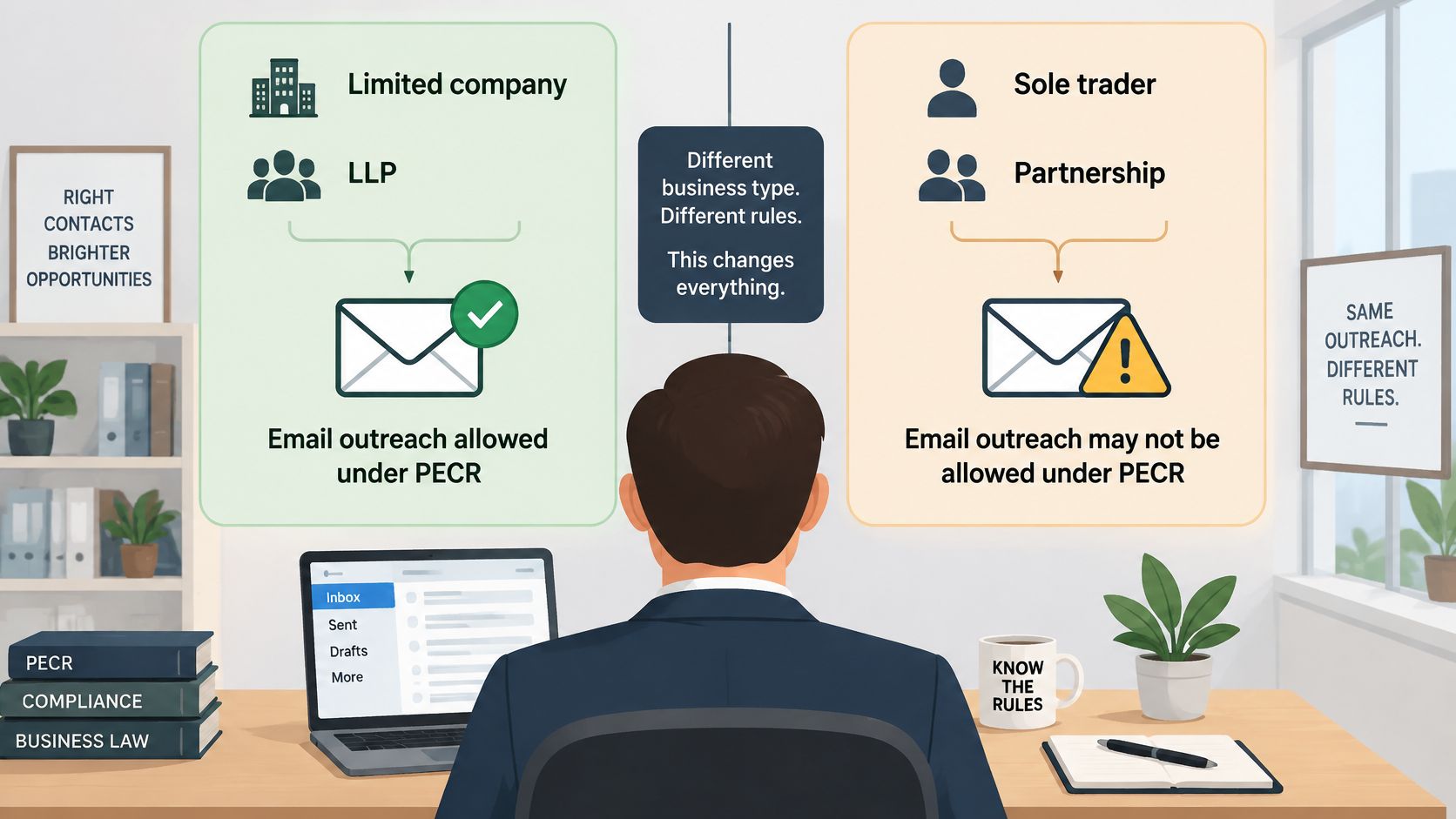
The Information Commissioner's Office guidance on marketing and data protection says Privacy and Electronic Communications Regulations don't require consent for marketing emails sent to corporate subscribers, such as limited companies and limited liability partnerships. Sole traders and some partnerships are treated as individual subscribers. For them, unsolicited marketing email generally requires specific consent or a valid soft opt-in.
The soft opt-in test
For an individual subscriber, a soft opt-in needs all of these conditions.
- Obtained during a sale or negotiation. The details came from that earlier contact, not from a scraped list.
- Similar products or services. The new message relates to what was discussed before.
- Opt-out offered at collection. The person could refuse marketing when they shared their details.
- Opt-out in every message. Each later email gives a clear way to stop further messages.
Personal data still brings data protection duties in B2B outreach, even when PECR consent is not required for a corporate subscriber. A named contact, direct dial or personal work email should be handled as data about a person. Every marketing email must identify the sender and provide a way to opt out. If a person objects to direct marketing, stop.
Deliverability limits sit alongside the law
Permission and inbox placement are separate checks. A lead can be lawful to email and still damage a domain if the targeting is lazy.
For senders delivering 5,000 or more messages per day to Gmail accounts, Google's email sender guidelines require authenticated outgoing email and easy unsubscribing, and Google recommends keeping the spam rate below 0.1% and preventing it from reaching 0.3% or higher. Tight relevance, suppression of objections and clean verification help you stay inside those limits.
A verified email confirms deliverability. It does not establish permission. Keep those checks in different columns so a valid address cannot masquerade as consent.
SignalVan keeps sending inside your own Smartlead account and holds it for two approvals: approve the campaign, then approve sending. Use that second approval to check subscriber category, opt-out wording and relevance before anything leaves the account.
Why Timing Decides Who You Reach
The most common mistake is treating a three-week-old signal like a fresh one. The evidence was real when it appeared. Its value falls as the buyer talks to other vendors, fills the role, or solves the problem another way.
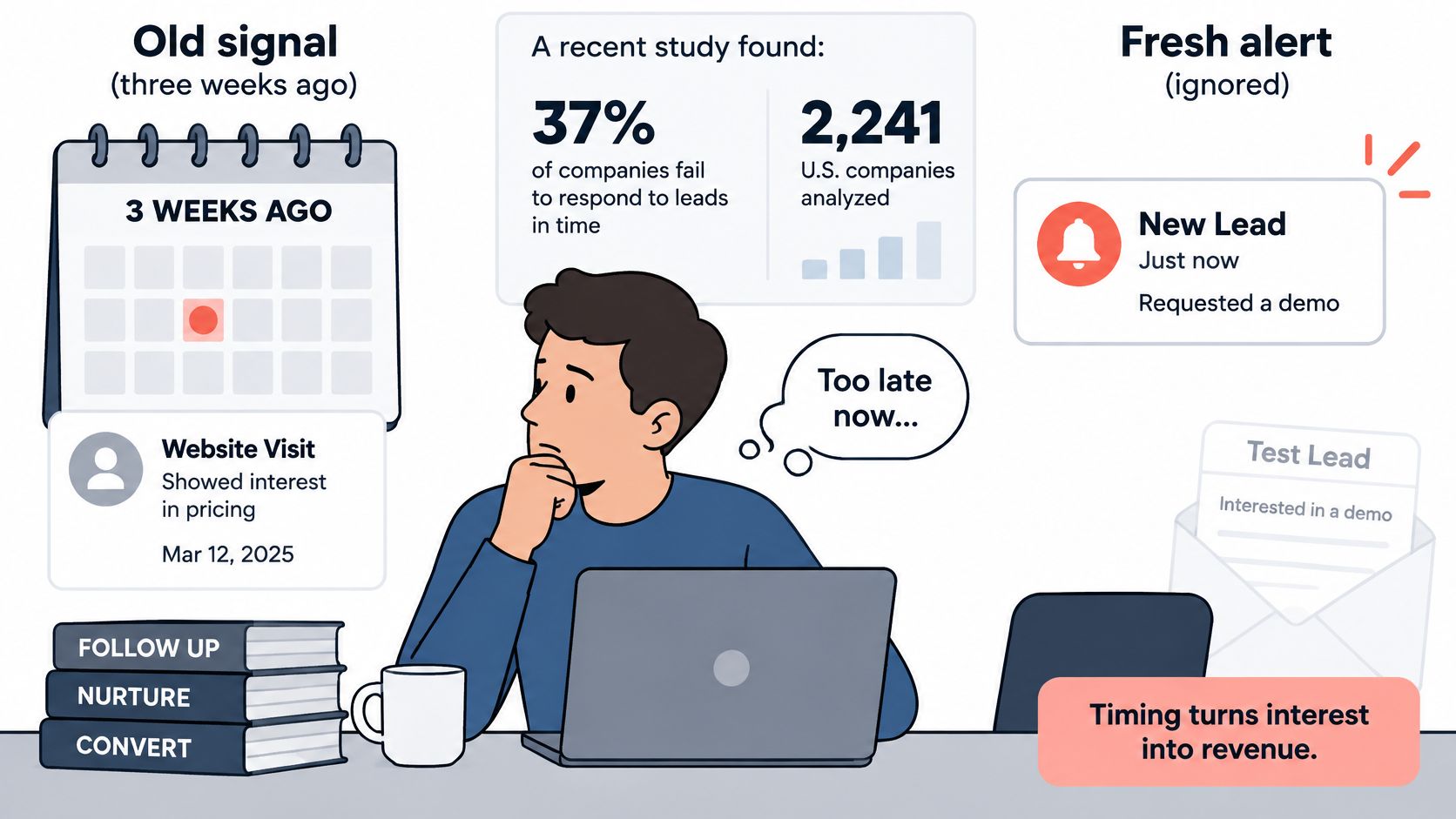
The 2011 Harvard Business Review study reported by Vida submitted test leads to 2,241 U.S. companies. Only 37% replied within one hour, 23% never responded, and the average response time among companies that replied within 30 days was 42 hours. A companion analysis of approximately 1.25 million sales leads found firms that attempted contact within one hour were nearly seven times more likely to qualify a lead than firms that waited an additional hour, and more than 60 times more likely than firms waiting at least 24 hours.
A separate 2021 analysis points the same way. InsideSales research reported by Mega Web Vision covered more than 55 million sales activities involving 5.7 million inbound leads across more than 400 companies. It found 57.1% of first call attempts occurred more than one week after the lead arrived, only 0.1% of leads received engagement within five minutes, and conversion rates were more than eight times higher when the first attempt occurred within five minutes than between five minutes and 24 hours.
How to use the numbers without over trusting them
Both sets of findings are observational. Fast teams may also be better organised, better staffed, or selling something clearer. Speed alone doesn't prove every gain. The size of the gap still makes response time worth testing in your own funnel.
Treat the signal date as a service-level trigger. Route new evidence into a short review queue. Draft from the specific signal. Keep human approval, but remove idle waiting between steps. That's the core of signal-first prospecting, and it works best on high-intent leads where the reason to act is visible and dated.
Sort results by signal type. Help requests and tenders age at different rates. Hiring signals and new appointments may stay useful longer. Record signal-to-approved-send time for each type, then compare replies and meetings across a five-minute, one-hour, and 24-hour threshold.
Fast doesn't mean uncontrolled. It means the review happens while the evidence is still fresh.
Where Your Funnel Leaks and What to Measure
Start with a simple worked example. It shows why small leaks matter more than big traffic claims.
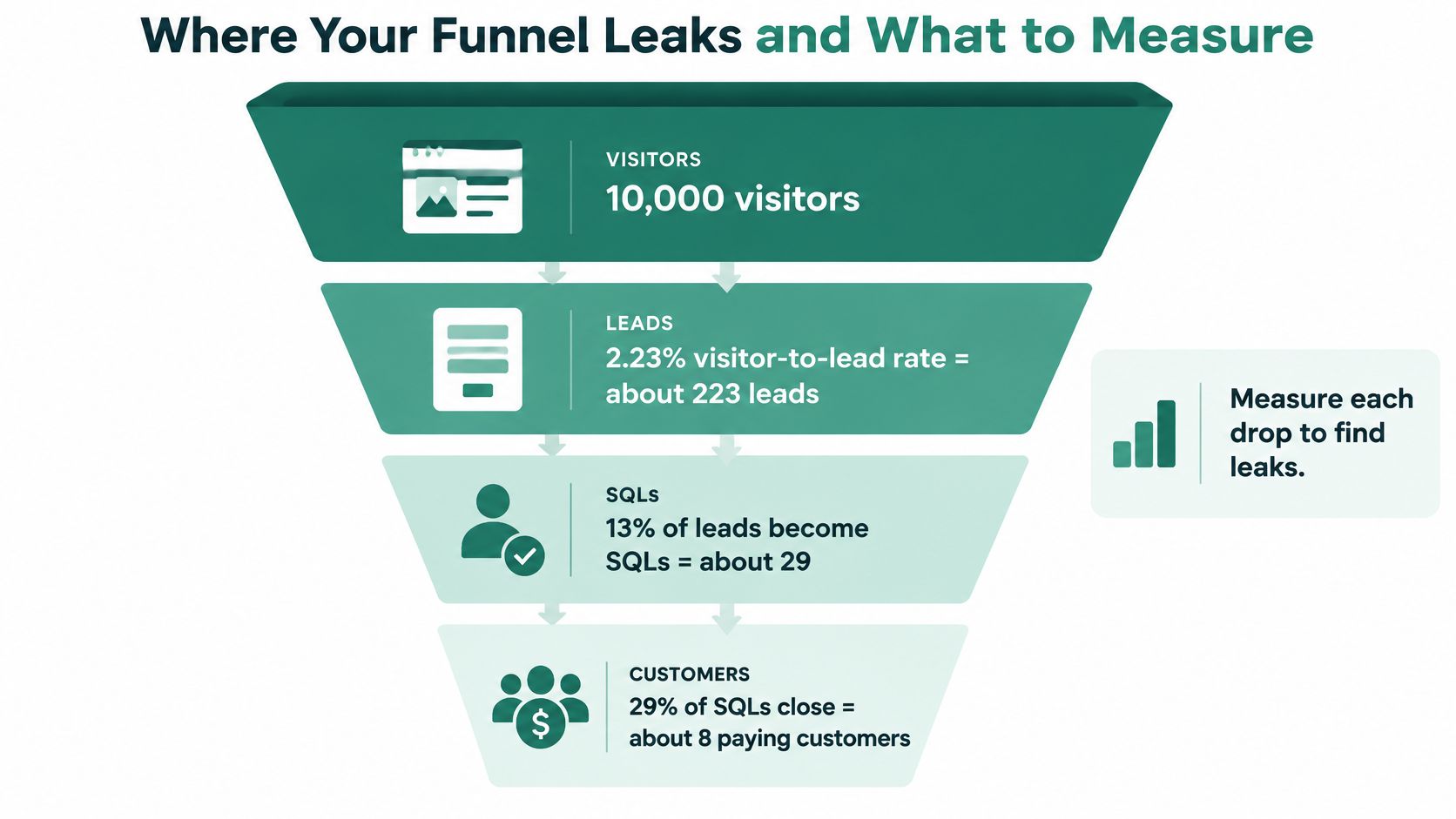
| Funnel stage | Benchmark rate | Expected count from 10,000 visitors |
|---|---|---|
| Visitor to lead | 2.23% | about 223 leads |
| Lead to SQL, treating leads as MQLs | 13% MQL-to-SQL | about 29 SQLs |
| SQL to customer | 29% SQL-to-close | about 8 paying customers |
These rates come from reported B2B reference ranges in Statistics Fundamentals' lead generation statistics, which place visitor-to-lead conversion near 2.23%, MQL-to-SQL conversion near 13%, and SQL-to-close conversion near 29%. Applied to 10,000 visitors, that yields about 223 leads, roughly 29 SQLs, and approximately 8 customers. The example treats every lead as an MQL, so the 13% step is applied to the full lead count.
Benchmarks are a starting point
Aggregated ranges aren't targets for your market, price, or sales cycle. Use them to sanity check your own cohort baseline. Then judge changes against your baseline, not against a pooled average from different companies.
A cleaner test compares like with like. Put prospects with dated, source-linked buying signals in one group. Put broader account matches in another. Hold geography, segment, offer, and outreach sequence constant. If you change the offer and the source at the same time, you won't know which one moved the result.
Measure the denominator, not just the wins
Stage conversion only tells part of the story. Track the quality of what enters each stage.
- Verified mailbox rate. Share of contacts confirmed as deliverable before sending.
- Uncertain-contact rate. Share labelled catch-all, unknown, or doubtful.
- Positive-reply rate. Replies showing genuine interest, not automated responses.
- Qualified-meeting rate. Meetings with the right person about a real need.
- Opportunity creation. Leads that become tracked deals in your pipeline.
- Revenue per approved send. Revenue divided by messages you approved, not records found.
These measures stop enrichment or automation looking successful just because it adds records. A tool can double your lead count and still make acquisition worse. You'll see that quickly if verified mailbox rate falls or uncertain contacts rise.
Use cohort comparisons by acquisition source and evidence strength. A tender notice with a date and contracting organisation isn't the same as a broad industry match. A help request posted yesterday isn't the same as company news from last quarter. Group them separately or your averages will hide the signal that converts.
If a change raises lead count but lowers verified mailbox rate or positive-reply rate, it hasn't improved acquisition. It has widened the top of a leaking funnel.
Fix one leak at a time. If leads are plentiful but SQLs are scarce, tighten qualification. If SQLs are healthy but closes are weak, the problem sits later and more top-of-funnel volume won't repair it.
Run a Signal-Led Lead Process and Test It First
Keep the first test small enough to read clearly. One segment, one signal type, and a capped budget will teach you more than a broad launch across every market you serve.
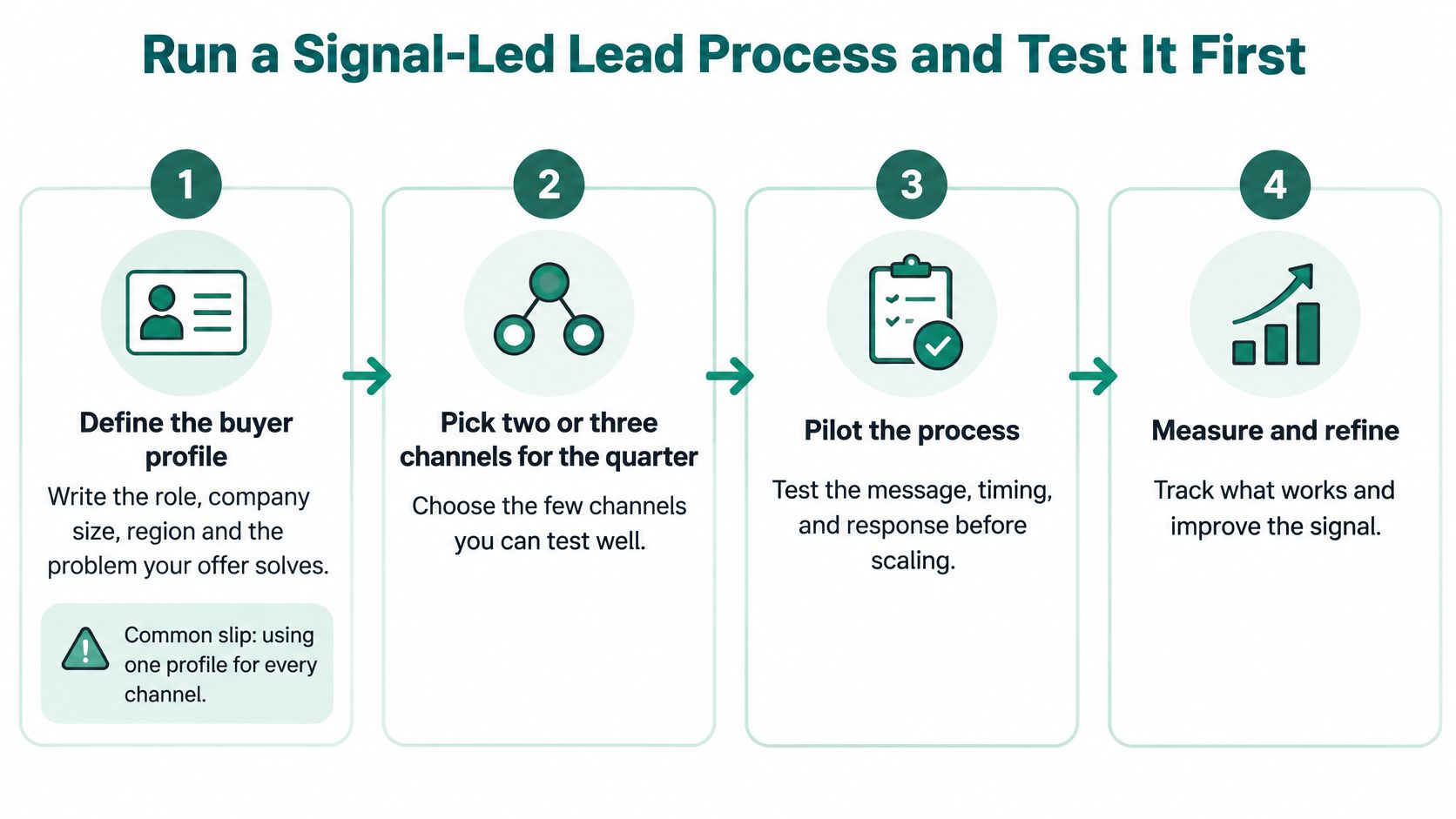
Define the buyer profile. Write the role, company size, region, and the problem your offer solves. Common slip: using one profile for every channel. A founder-led LinkedIn approach and a cold email campaign rarely need identical targeting.
Pick two or three channels for the quarter. Choose channels you can staff properly and measure weekly. Spreading across six hides what works because no single channel gets enough volume or attention.
Choose the buying signals. Options include a job post for the role you sell to, a funding round, a new decision-maker, a public tender, or someone asking for recommendations. Start with one signal type and one segment, such as UK companies hiring for the role you sell to. Common slip: treating an industry label as proof of need.
Build a shortlist with source and date. Every lead should show its buying signal with the source and the date it happened. Dated evidence decides priority. Undated evidence invites delay.
Set a credit limit before the search starts. Check estimated credit use first, so the test cost is capped. Credits pay for lead searches, contact details, mobile numbers, and related work. A ceiling keeps the pilot honest.
Verify contacts before writing. Reveal verified contact details only for leads you'll use, so you never pay for a name you won't use. Common slip: treating a valid-looking address as a confirmed person. Check the verification status and keep uncertain results labelled.
Draft from the specific evidence. The first line should come from what the person said or did. Then read, edit, and approve the campaign. Common slip: generic openers that could be sent to anyone.
Approve sending separately. Campaign approval and sending approval are different decisions. Messages go out only through your own Smartlead account after both approvals. You stay in control of the final send.
Review after two weeks. Compare positive-reply rate and qualified-meeting rate with your baseline. Keep the test running if the numbers hold. Change one variable at a time if they don't.
The four step version
The process has four steps: paste your website, see ranked leads with proof, get the decision-maker's verified contact details for the leads you pick, and approve a message that goes out through your own Smartlead. Setup starts with your website. The summary of what you sell and who buys it waits for your approval before prospecting begins.
Run one check this week. Pick any ten leads at random. Can every lead show its signal, its date, and its verification status? If not, fix the record before you scale the outreach.
When several discovery methods run at once, merge duplicates so each person appears once with every signal that found them. That gives you the full picture and stops the same person entering two sequences. Export the list to Excel if your team reviews leads outside the platform.
Don't judge the pilot on replies alone. A polite reply from the wrong person isn't progress. Look for replies from decision-makers, meetings that match your qualification checks, and opportunities your team would happily work.
Paste your website at signalvan.com to see who's ready to buy this week.
SignalVan helps small B2B teams find companies showing dated buying signals, verify the decision-maker's email and mobile, and draft a first message you approve and send through your own Smartlead. If timing is where your lead acquisition marketing is leaking, visit SignalVan and start with a small, signal-led test you can measure.
Keep reading

Excel Export Data: How to Keep Your Formatting Intact
Excel Export Data: How to Keep Your Formatting Intact

Marketing Software for Agencies: Top Picks for 2026
Marketing Software for Agencies: Top Picks for 2026
Lead Generation Software: 10 Tools That Find Real Buyers
Lead Generation Software: 10 Tools That Find Real Buyers
Start with your website.
See your first leads, with the reason each one is there.