

Lead Generation vs Demand Generation: Which to Use and When
Lead Generation vs Demand Generation: Which to Use and When
More leads aren't automatically a better outcome. In Endeavor Business Media's 2024 B2B marketing benchmark, 69% of surveyed B2B marketers expected to fund lead generation more, but spending on names doesn't establish buying intent. Demand generation builds awareness and preference; lead generation turns relevant interest into identifiable contacts or accounts sales can pursue. The right choice is a sequence, with the handoff governed by evidence rather than a lead-volume target.
Table of Contents
- Lead Generation and Demand Generation at a Glance
- Where Each Approach Sits in the Buying Journey
- Build Separate Scorecards for Each Approach
- Measure Demand When Buyers Stay Anonymous
- When a Buying Signal Justifies Naming a Prospect
- Compliance Checks Before Any First Message
- Which Mix Fits Founders, Agencies and Sales Teams
- Choose the Mix That Fits Your Team Today
Lead Generation and Demand Generation at a Glance
Demand generation creates reasons to care. Lead generation identifies who merits a sales conversation. Neither is better in general, and neither fixes a weak offer.
The useful distinction isn't content versus outbound. Educational content can support either approach. An ungated buying guide can build understanding across a market. A consultation form attached to that guide can capture an identifiable prospect. The purpose and expected output determine the classification.
Lead generation and demand generation compared
| Criterion | Demand generation | Lead generation |
|---|---|---|
| Primary goal | Create awareness and preference in a target market | Capture identifiable contacts that sales can pursue |
| Audience | Broad market, including people who never identify themselves | People or accounts that have shown interest and can be contacted |
| Typical output | Reach, engagement, branded search, pipeline influence | Qualified contacts ready for outreach or a sales call |
| Typical activities | Educational content, research, events, consistent presence in the category | Forms, gated downloads, outbound lists, signal-based prospecting |
| Time horizon | Longer, harder to attribute to one campaign | Shorter, easier to count week to week |
| Common failure | Spending on reach with no path to a sales conversation | Chasing volume without relevance or timing |
Where teams confuse the two
The time-horizon row deserves attention. A contact record appears immediately, making lead generation easy to count. Preference doesn't appear as a neat CRM event. That doesn't make preference worthless or a contact valuable.
Attribution creates another trap. A buyer might encounter educational posts, discuss suppliers privately and then submit a demo request. Crediting only the form hides the earlier demand work. Crediting every content impression with the eventual opportunity exaggerates its contribution.
Budget rule: Fund an activity for the outcome it is meant to produce, not the metric that's easiest to report.
Calling every form fill demand obscures whether anyone wants the product. Calling every mailing demand generation obscures whether the campaign was trying to obtain replies. Teams should label each campaign before launch, including its intended audience, next action and success criteria.
Most B2B teams need both approaches in a defined order at the account level. Build understanding where interest is weak. Capture and qualify interest when a credible reason to engage appears. Both programmes can operate concurrently across different accounts, but the handoff shouldn't be arbitrary.
Where Each Approach Sits in the Buying Journey
A buyer's journey starts before a sales team has a name to work. The buyer notices a problem, investigates possible solutions and compares suppliers before deciding whether a conversation is worthwhile.
The stages provide a useful operating map, not a claim that every purchase follows a tidy line:
- First recognition of a problem: The buyer notices a need or an expensive workaround.
- Category research: The buyer explores possible ways to solve it.
- Comparison of suppliers: The buyer evaluates providers and approaches.
- First contact: The buyer makes an enquiry or responds to outreach.
- Qualified opportunity: Sales establishes a credible problem, fit and purchase process.
- Paying customers: The buyer completes a purchase.
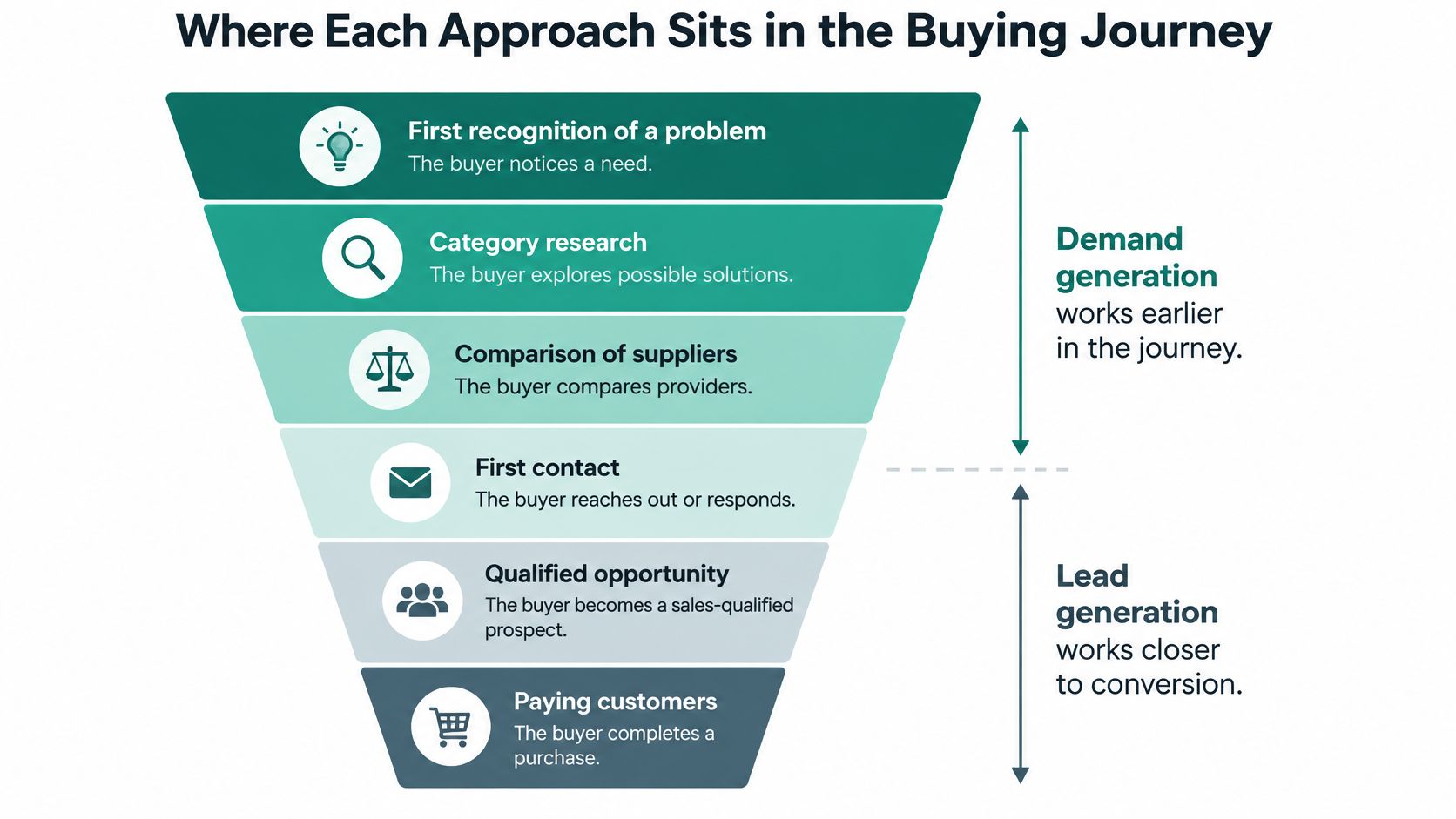
Demand generation primarily supports the earlier stages. Lead generation becomes useful when an identifiable person or account has a reason to talk. A contact record alone doesn't establish that reason.
In Content Marketing Institute's 2025 B2B benchmark, 87% of surveyed B2B marketers said content marketing created brand awareness during the previous 12 months, 74% said it generated demand or leads, 62% said it nurtured subscribers, audiences or leads, and 49% said it generated sales or revenue. These are different reported outcomes, not conversion rates between stages.
Why a list can't replace recognition
According to Gartner-related reporting summarised by Madison Logic, B2B buyers spend about 83% of their purchase journey independently, with 17% interacting directly with potential suppliers. Sales contact therefore captures only part of the decision process.
Say a software company sells a specialist procurement tool but has little brand recognition. A list of procurement directors identifies possible buyers, not people who understand why the tool matters. Practical content explaining approval bottlenecks, supplier comparisons and implementation trade-offs gives those directors a reason to consider a different approach.
Account-focused education can support that work. An account-based marketing approach helps coordinate relevant content across the people involved in a purchase rather than treating one download as an account-wide decision.
Public engagement can also inform discovery. SignalVan finds leads among people who react to or comment on LinkedIn posts by creators in a business's space and by its competitors. That activity provides context, not proof of purchase intent.
A quick funnel check should ask:
- Problem recognition: Has the account expressed a problem, or merely engaged with a topic?
- Supplier consideration: Is there evidence of comparison, evaluation or a request for help?
- Sales readiness: Is there enough context to justify a useful conversation rather than a generic pitch?
Build Separate Scorecards for Each Approach
Lead generation needs its own scorecard for identifiable, sales-actionable records. Combining contact totals with brand engagement makes weak performance harder to diagnose.
Demand generation needs a distinct view of account readiness and pipeline contribution. A shared dashboard is useful, but the measures shouldn't become one undifferentiated marketing score.
Which measure belongs to which approach
| Measure | Belongs to | What it tells you |
|---|---|---|
| Valid-contact rate | Lead generation | Share of contacts that pass mailbox checks |
| Reply quality | Lead generation | Whether replies name a real need, not only out-of-office messages |
| Meetings held | Lead generation | Conversations that actually took place |
| MQL-to-SQL conversion | Lead generation | Whether qualified leads are accepted by sales; compare within one segment only |
| Engaged target accounts | Demand generation | Named accounts interacting with content or the brand |
| Relevant roles reached per account | Demand generation | How many buying-committee roles are engaged, not just one contact |
| Sourced pipeline | Demand generation | Pipeline where a demand channel created the first touch |
| Influenced pipeline | Demand generation | Pipeline where demand touches appeared before the deal opened |
A valid-contact rate measures mailbox-check results, not willingness to buy. Reply quality requires reading responses: an out-of-office message isn't commercial progress, while a reply describing a relevant constraint can be useful even without an immediate meeting.
The Grou Global benchmark comparison reports an MQL-to-SQL median of approximately 9.8% in a cross-industry dataset, while a SaaS-oriented benchmark describes 20–30% as a solid target. That spread is a reason to segment results by market, offer, source and qualification policy, not select the more flattering number.
Track the full operating sequence
Use this sequence: signal-to-qualified-account rate, verified-email and verified-mobile rates, reply rate, meeting-held rate, SQL-to-opportunity rate, then sourced pipeline per credit or hour. Define marketing-qualified lead and sales-qualified lead acceptance criteria before comparing campaigns.
Keep pipeline attribution explicit. The table's sourced and influenced definitions should be documented in the CRM. Sourced pipeline can also help evaluate prospecting efficiency, but the same opportunity shouldn't be counted repeatedly as separate pipeline.
When several discovery methods find the same person, merge the records. The platform consolidates duplicates so each person appears once with every signal that found them. This preserves evidence without inflating contact totals.
Review reply quality and meetings held weekly. Review MQL-to-SQL conversion and sourced pipeline monthly, always within the same segment.
Measure Demand When Buyers Stay Anonymous
A form-based report misses buyers who research without identifying themselves. A company can increase recognition, branded search and repeat visits without recording a new lead.
The 6sense guide to changing B2B buyer research reports that only 3% of website visitors self-identify through form fills, leaving 97% anonymous, and cites a June 2025 analysis in which 58.5% of Google searches ended without a click. Neither a missing form fill nor a missing website visit proves that a buyer hasn't encountered the brand.
Separate observable demand from captured leads
Track demand through a small set of complementary indicators:
- Branded search: Measure searches containing the company or product name, including combinations with category terms. Keep general category searches separate because they don't establish brand preference.
- Repeat target-account visits: Where lawful and technically supportable, track returning activity from companies on the target list. Account identification shouldn't be presented as identification of a particular person.
- Engaged target accounts: Count companies rather than treating every engaged employee as a separate commercial opportunity.
These measures need interpretation. A rise in branded searches after a campaign supports a demand hypothesis; it doesn't prove that every search came from that campaign. Sales-conversation notes and eventual pipeline provide useful corroboration.
Buyers don't owe a supplier a form submission before their interest counts.
Why volume is a weak verdict
The 2025 Demand Generation Benchmark Survey found that increasing lead quality was the top goal for 20% of respondents, compared with 16% for increasing lead volume, while 23% rated volume least important; the same benchmark material cites a 2025 TrustRadius study of 1,076 technology demand-generation marketers allocating 53% of discretionary budget to demand generation and 38% to brand awareness.
Those allocations aren't a recommended budget split. They reinforce the need to judge different activities against different objectives.
Before the next campaign, set one demand measure and one lead measure, each with a recorded baseline. For example, pair engaged target accounts with meetings held, rather than expecting a contact count to explain both.
When a Buying Signal Justifies Naming a Prospect
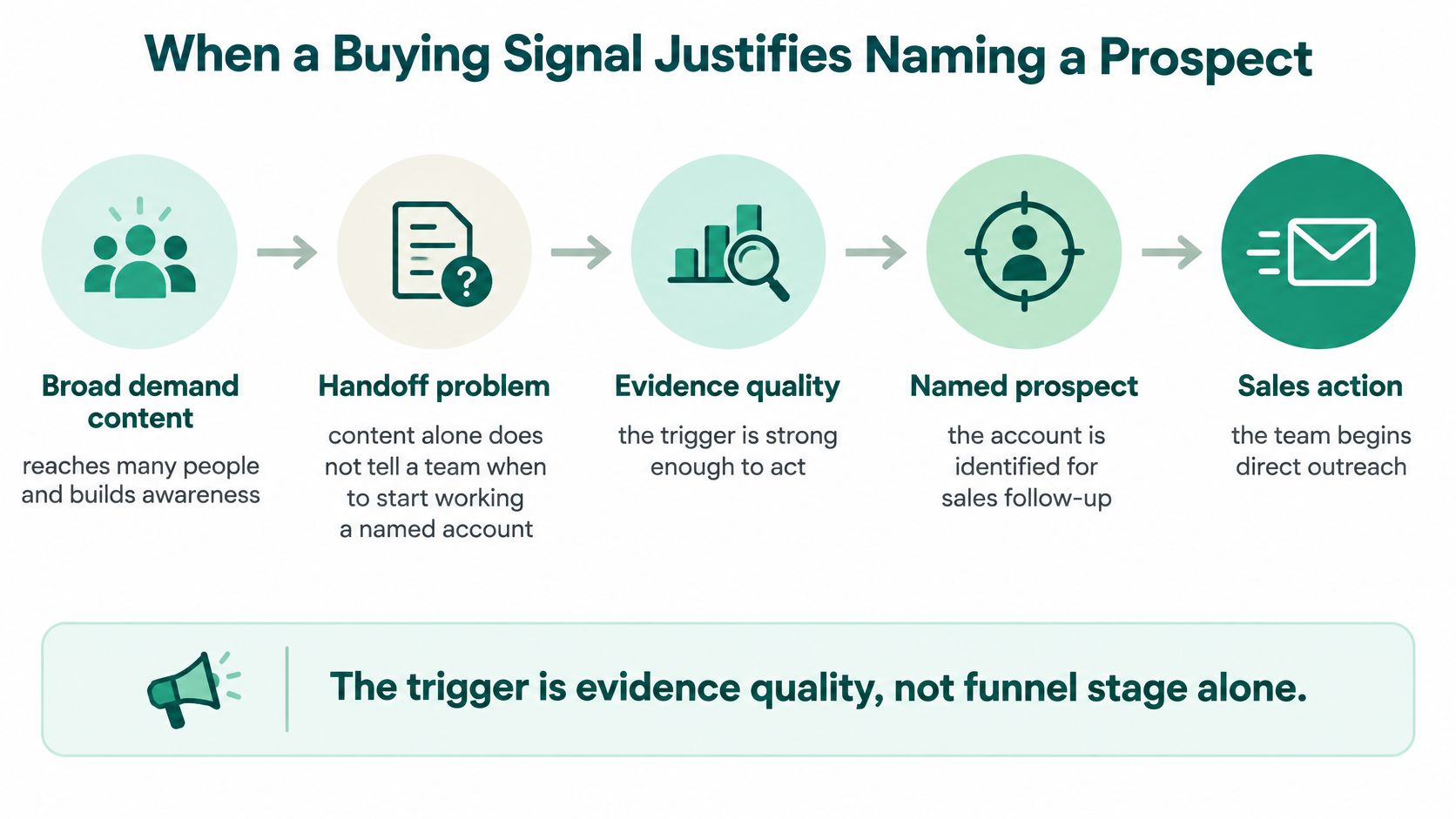
Broad educational content doesn't tell a sales team when to begin working a named account. The trigger is evidence quality, not funnel stage alone.
A useful handoff rule distinguishes curiosity from a current, relevant need. Stronger evidence justifies more specific action, but it still requires a fit check.
Evidence strength and the action it justifies
| Evidence level | Example | Action |
|---|---|---|
| One weak signal | A single post on a broad topic | Keep the account in awareness content; do not reveal contacts |
| Repeated, recent signals | Two different signals in a short window, such as a hiring post and a new decision-maker | Rank the account and check fit against the offer |
| Specific problem signal | A public request for a recommendation for the problem being solved | Reveal verified contacts for chosen leads and draft a first message for approval |
| Dated tender or funding round | An open public tender or a recent funding announcement | Raise timing priority, then confirm the signal is still current before outreach |
A broad post can indicate professional interest without an active project. Hiring plus a newly appointed decision-maker provides more context, but the role and business still need to match the offer. A direct request for recommendations gives a clearer reason to help.
Qualify before spending on contact data
The LeadSpot benchmark compilation, summarising research across more than 500 revenue leaders, reports 28% MQL-to-SQL conversion when leads were qualified before delivery, versus 9% when qualification happened after handoff. These are directional benchmarks, not promised results.
The operational lesson is straightforward: establish the reason to engage before revealing contact details. That protects enrichment credits and sales capacity.
A funding announcement doesn't establish a need for every product. An open tender may specify an unsuitable scope or an expired response window. Assessing high-intent leads means checking the actual problem and eligibility, not treating a signal label as qualification.
Each new lead in the platform arrives with the reason it matters now. Each record also shows the buying signal's source and date, making that judgement reviewable.
Conservative handoff: When evidence sits between two action levels, take the lower action until a second dated signal confirms it.
Compliance Checks Before Any First Message
A buying signal shows timing. It doesn't grant permission to contact. Recipient classification, data protection and sending requirements remain separate checks.
In the UK, the Information Commissioner's Office guidance says PECR doesn't require consent for unsolicited electronic-mail marketing to corporate subscribers, including limited companies and limited liability partnerships. Sole traders and some partnerships are individual subscribers, so specific consent or the soft opt-in conditions are generally required; using a person's name, email or phone number still brings data-protection duties, and marketing emails must identify the sender and provide an opt-out route.
In the US, the Federal Trade Commission's CAN-SPAM compliance guide states that there is no business-to-business exception: From, To, Reply-To and routing information must be accurate, and subject lines must not be deceptive. A verified email isn't permission to imply an existing relationship.
Check delivery separately from relevance
For messages sent directly to personal Gmail accounts, Google's sender guidance requires the From header's organisational domain to align with either the SPF or DKIM organisational domain; bulk senders must configure both SPF and DKIM, although only one needs to align for that requirement.
Good targeting can't compensate for poor authentication. Equally, authentication doesn't establish a lawful basis for contacting someone.
Before any first message:
- Classify the recipient as corporate or individual, and assess the applicable recipient-country rules.
- Record the signal source and date, keeping discovery evidence separate from consent status.
- Confirm sender identity and an opt-out route, including a process for honouring objections.
- Check the subject line and headers against the actual sender, offer and relationship.
- Confirm domain authentication before authorising sending.
SignalVan leaves every first outreach message available to read, change and approve. Nothing is sent until the customer approves the campaign and then approves sending, and messages only go through the customer's own Smartlead account.
For teams operating across the UK, US, Europe and India, these UK and US checks aren't a universal legal clearance. Specific legal questions should go to a qualified adviser.
Which Mix Fits Founders, Agencies and Sales Teams
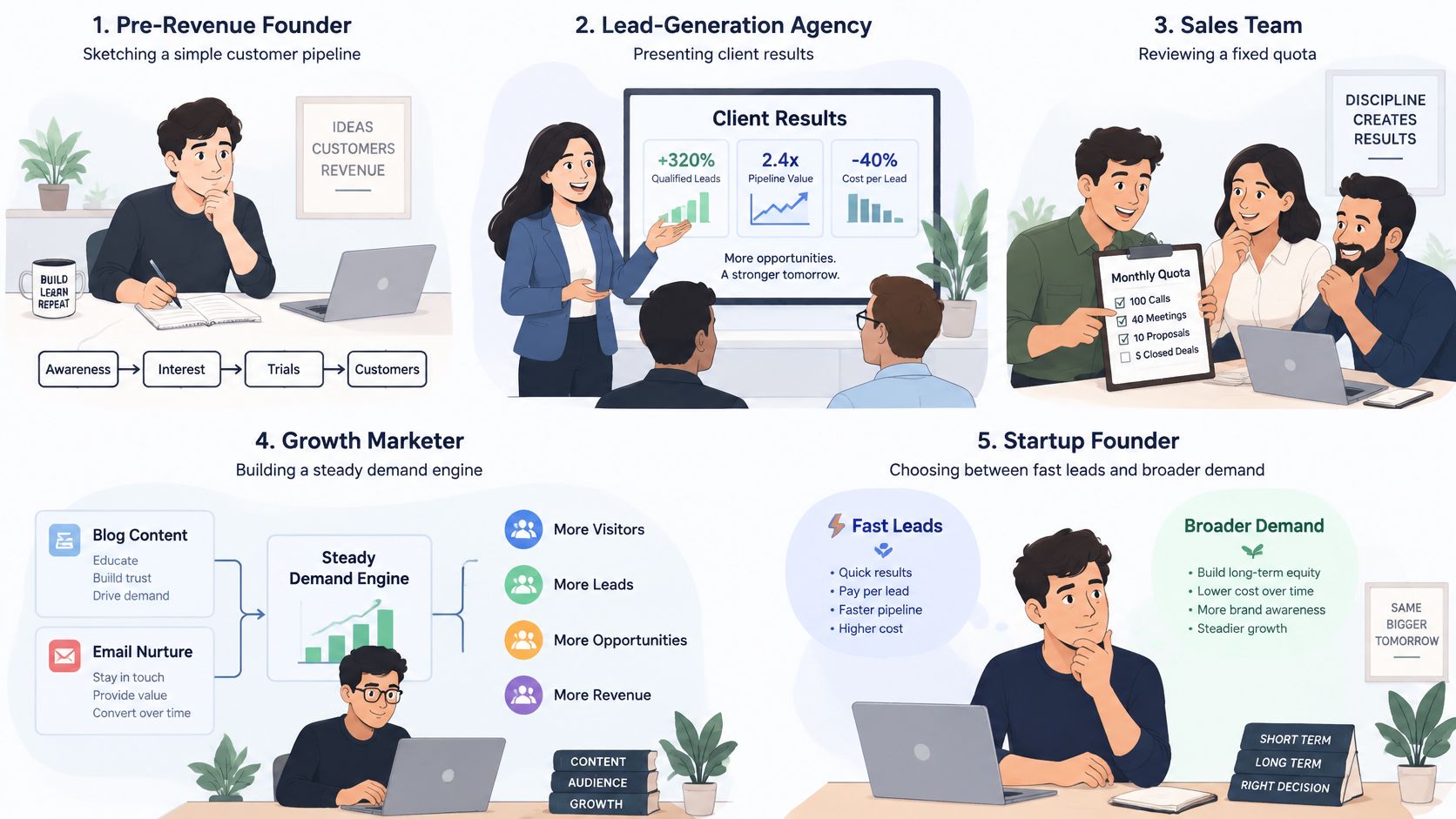
A pre-revenue founder needs a different starting point from an agency managing established client offers. The practical question in lead generation vs demand generation is which constraint needs attention first: unclear positioning, insufficient recognition or too few qualified conversations.
A team without a clear offer should begin with focused demand work and problem conversations. Buying contact data before deciding who benefits creates a larger list of unresolved assumptions.
Starting mix by team situation
| Situation | Start with | Add next | Watch for |
|---|---|---|---|
| Pre-revenue founder seeking first paying customers | Focused demand content in one niche | Named accounts from buying signals once the offer is clear | Spreading effort across too many channels |
| Lead-generation agency serving clients | Client-specific buying signals | Demand content for the client's category | Reporting contact volume instead of qualified leads |
| Small sales team with a fixed quota | Ranked prospects with verified email | Light demand content aimed at target accounts | Over-contacting the same accounts |
| Growing B2B company with revenue operations | One shared scorecard with both sets of measures | Handoff rules by evidence level | Mixing signal data with consent status |
| Independent consultant | Companies with active needs, such as hiring or open tenders | Expert content that builds recognition | Chasing every signal, not only the strongest ones |
Match the workflow to the constraint
An agency should agree qualification rules separately for each client. A hiring signal relevant to a recruitment provider may have little value for a cybersecurity consultancy. Reporting should explain that difference rather than combine every discovered contact into one delivery total.
A small sales team needs account ownership and suppression rules. Repeated approaches by different representatives waste capacity and make otherwise relevant outreach look careless. A revenue operations team should maintain one dashboard with separate demand and lead measures, not one blended score.
SignalVan's signal-first prospecting supports the lead-generation half. It ranks companies by public buying signals, reveals a decision-maker's verified email or mobile for selected leads, and drafts the first message for approval. It doesn't replace the educational work that builds recognition.
Discovery includes topic posts, requests for help, relevant hiring, company news, decision-makers new in their roles, business directories and public tenders. Leads can be grouped into All, Ready to approach, Strong match, Keen leads to explore, Partners and Also found, with ready prospects at the top.
When comparing B2B lead-generation services, the useful test is whether the workflow explains why an account belongs on the list. A contact database answers who exists. A qualified prospecting process must also explain why a conversation makes sense.
Choose the Mix That Fits Your Team Today
Run demand generation to build category recognition and preference. Run lead generation against named accounts when the evidence is strong enough to justify contact. Rank by buying signals, qualify before revealing contacts and keep the approaches on separate scorecards.
The immediate priority should follow the constraint. An unclear offer needs sharper positioning and market education. A clear offer with credible active needs needs disciplined prospect selection, not another broad awareness campaign.
Start with an approval-led workflow
- Paste the business website. The platform proposes the target customer and region for review and approval.
- Review ranked leads. Check the reason for inclusion and the source and date attached to each signal.
- Choose leads to pursue. Reveal verified email for selected prospects, review the drafted first message and approve it before sending through the business's own Smartlead account.
The goal is paying customers, not a fuller spreadsheet. Before a message goes out, check whether the account resembles the intended paying customers, whether the buying signals are relevant, whether the timing remains current and whether the verified email belongs to the right decision-maker.
Campaign approval and sending approval remain separate. That final review should catch unsupported claims, stale evidence and inappropriate recipients before outreach begins.
SignalVan finds companies showing public buying signals, provides verified decision-maker contact details for selected leads and drafts messages for customer approval, supporting lead generation without replacing demand work. Paste your website at signalvan.com to see who's ready to buy this week.
Keep reading

Excel Export Data: How to Keep Your Formatting Intact
Excel Export Data: How to Keep Your Formatting Intact

Marketing Software for Agencies: Top Picks for 2026
Marketing Software for Agencies: Top Picks for 2026
Lead Generation Software: 10 Tools That Find Real Buyers
Lead Generation Software: 10 Tools That Find Real Buyers
Start with your website.
See your first leads, with the reason each one is there.