

Who Are the Decision Makers in B2B: How to Find Them
Who Are the Decision Makers in B2B: How to Find Them
The popular advice to find the most senior person and pitch them is wrong. A decision maker is anyone who can approve, block, shape or champion a purchase, and B2B purchases usually involve several such people. The useful question isn't who are the decision makers, but which people control this purchase and what has given them a reason to act now.
Table of Contents
Who Decision Makers Are and Why a Title Misleads
A title describes someone's position. It doesn't establish their authority over a particular purchase. A managing director might approve expenditure while leaving the shortlist to an operations manager and the technical veto to an IT lead.
Gartner's B2B buying report describes the average enterprise buying group as five to eleven stakeholders across about five business functions, and reports that 99% of B2B purchases are driven by organisational change, while 66% of buyers say the amount of change confronting their organisation feels overwhelming. Those functions can include operations, finance, IT, procurement and end users. The person who starts looking for a solution therefore isn't necessarily the person who controls the budget or signs the contract.
Think of a jury. No single juror delivers the verdict, but any one of them can hang it.
Authority belongs to the purchase
A finance director can approve a budget without choosing the software. An engineer can reject an integration without signing anything. A procurement manager can stop supplier onboarding even after the department head has agreed to proceed.
That makes seniority a poor starting filter. The better starting point is the business change: a new operating model, a leadership appointment, an expansion project or a requirement that the current supplier can't meet. Each event creates responsibilities that a generic organisation chart won't reveal.
For a founder or agency building an account list, this distinction matters immediately. A senior contact with no ownership of the problem is a weak prospect. A department manager tasked with fixing it may be the strongest route into the account.
Agreement matters more than access
In Gartner's survey of 632 B2B buyers conducted in August and September 2024, 74% of buying teams demonstrated unhealthy conflict, groups reaching consensus were 2.5 times more likely to report a high-quality deal, information aligned to shared group relevance improved consensus by 20%, and content focused only on individual-level relevance had a 59% negative impact on consensus. Conflict included competing objectives, disagreement over options and decisions overridden by outside stakeholders.
The practical lesson isn't to copy every stakeholder into an introductory email. It's to understand what the group must agree on before creating a message that only appeals to one person.
An operations lead may want less manual work. Finance may need a defensible cost. IT may need compatibility with existing systems. A useful proposal connects those requirements rather than encouraging one enthusiastic contact to ignore the others.
Rank suggests who might attend the meeting. Role and timing indicate who will decide. Before a name becomes an outreach target, the account record should answer:
- Control: What can this person approve, reject or influence?
- Problem: Which business problem are they responsible for addressing?
- Urgency: What evidence explains why that problem is live now?
A contact without those answers is a research lead, not a confirmed decision maker.
Six Roles Inside a Buying Group
Buying group roles, what they control and how to confirm them
| Role | What they control | Signal to look for | How to confirm |
|---|---|---|---|
| Economic buyer | Final budget approval | Appointment to a budget-holding senior role | Leadership page, press release |
| Technical evaluator | Fit, integration and security checks | Job post for the tool or technology | Job posts, IT or engineering titles |
| End user | Daily use; can champion or block adoption | Team posts asking for help with the problem | Public posts, team pages |
| Procurement | Vendor process, terms and supplier onboarding | Published tender or supplier registration | Tender notices, procurement contacts |
| Security or legal reviewer | Data, compliance and contract risk | Regulatory change or new data project | Policy pages, job titles |
| Internal champion | Pushes the purchase inside the company | Public statement about the problem | Posts, talks, interviews |
These are responsibilities to identify, not seats that must always belong to separate people. The table provides starting evidence, but confirmation requires checking the person's involvement in the specific purchase.
The economic buyer authorises the spend. The end user works with the result and can expose practical objections that an executive misses. Procurement manages the supplier process, commercial terms and onboarding requirements, which shouldn't be confused with owning the original business need.
The people prospecting lists miss
The technical evaluator determines whether the proposed solution can work in the existing environment. Integration, migration, access permissions and ongoing maintenance belong in that conversation. A job description naming the relevant technology can identify the team, but it doesn't prove that the job holder controls vendor selection.
The security or legal reviewer examines a different question: whether the organisation can accept the risk. A tool can satisfy its users and still fail a data-processing or contract review. The account map should distinguish technical suitability from permission to use the solution.
An internal champion does the work between supplier conversations. They explain the problem to colleagues, obtain internal answers and help move the proposal forward. Friendly replies don't establish champion status; evidence of internal action does.
One person can hold several roles
Say a hypothetical 40-person firm is buying accounting software. The finance lead might control the budget, the operations manager might be the daily user, and the office manager might push the project forward. An external IT adviser could assess integration while a solicitor reviews the contract.
That example shows why employee count and leadership pages aren't enough. Some influential people may sit outside the company entirely.
Practical rule: An unnamed role is a gap to investigate, not permission to substitute the most senior contact available.
A useful map leaves uncertainty visible. It doesn't disguise missing information with an impressive title.
Smaller Buying Groups and Founder-Led Accounts
Smaller accounts often need fewer people involved. More contacts don't automatically mean better coverage, particularly when a founder combines spending authority with responsibility for the outcome.
G2's 2025 buyer behaviour findings point to software buying groups of roughly three to four members, IT involvement in nearly 50% of decisions, and growing influence for end-user champions. That's software-purchasing evidence, not a headcount rule for every B2B sale. It supports a narrower recommendation: map actual participation instead of importing an enterprise-sized contact list into a small account.
Start with the people touching the problem
For a founder-led business, the initial map should concentrate on the people who experience the problem, approve the expense and test the proposed fix. Those responsibilities might belong to different colleagues or overlap substantially.
A frontline employee asking for help with a broken reporting process can be more relevant than a director whose public profile says nothing about it. The employee provides a route to understanding the requirement. The founder may only become involved when there's a clear proposal to approve.
The first discovery conversation should resolve these questions:
- Daily use: Who will work with the solution and handle the change?
- Spending authority: Who can approve the purchase from an available budget?
- Evaluation: Who must test or review it before a commitment?
The answers should determine the next contact, rather than a rule to reach everyone in management.
Keep the list deliberately small
For an early-stage founder, lead-generation agency or small sales team, an oversized account list creates unnecessary work. It also encourages messages that mention several unrelated priorities because the seller hasn't chosen a specific entry point.
A compact map makes outreach more precise. The initial message can address the person with the clearest connection to the problem, while the account record retains unresolved approval questions.
Missing roles should remain marked as gaps. A business without a dedicated procurement department may still have a supplier approval process. Small doesn't mean informal enough to skip confirmation.
Buying Signals That Show a Decision Maker Is Active
A decision maker becomes active when a dated event gives them a reason to act. That's the basis of signal-first prospecting: start with observable activity, then identify the person responsible for responding to it.
Signals that point to an active decision maker
| Signal | What it suggests | Role to check | Where to confirm |
|---|---|---|---|
| Job post for the function being sold to | Function has need and possibly budget | Hiring manager or function head | Careers page, job boards |
| Funding round | Spending priorities may shift | Founder or finance lead | Funding announcement, news release |
| New appointment in a function | New owner for old problems | The new appointee | Press release, public profile |
| Public request for recommendations | Live need | Person who posted the request | Public post or forum thread |
| Company news about the problem | Problem is on the agenda | Named executive quoted | News article, company blog |
| Open public tender | Defined purchase is live | Buyer named in the notice | Tender notice with publication date |
Read the event without exaggerating it
A job advertisement can show that a team is investing in a capability. It doesn't prove there's budget for an outside supplier. The useful detail is the responsibility described, such as replacing manual reporting or supporting a system migration.
Funding can create spending options, but the announcement alone doesn't identify an approved project. A new appointee may review inherited processes, yet their arrival isn't evidence that every existing supplier is under review.
Public requests on LinkedIn or a forum provide more direct context. The wording can reveal the problem, requirements and alternatives already being considered. The seller should check whether the request remains unresolved before treating it as an active opportunity.
Tenders provide a defined purchasing route
The UK Cabinet Office's Procurement Policy Note 023 provides advance notification of 2026 threshold amounts under the Procurement Act 2023. A tender record can identify the contracting authority, procurement category, publication date and purchasing process.
The notice should govern the approach. Sellers need to inspect eligibility, deadlines and permitted clarification channels rather than treating the named buyer as an invitation to bypass procurement.
For every signal, the account record should retain the original source, publication date and relevant wording. A reposted announcement should not be mistaken for a new event.
A buying signal is a reason to check. It isn't proof that the company needs a particular supplier.
Lead prioritisation should reflect evidence quality, role relevance and whether the event remains actionable. A sensible prospect-ranking approach separates a direct request for help from a broad company announcement.
SignalVan gives each new lead the reason it matters now, with the signal's source and date. That allows the reason for approaching the account to be reviewed before anyone is contacted.
How to Map the Buying Group in a Target Account
A buying-group map should be an evidence record, not a collection of public profiles. Its purpose is to show who can move a particular purchase forward and what remains unknown.
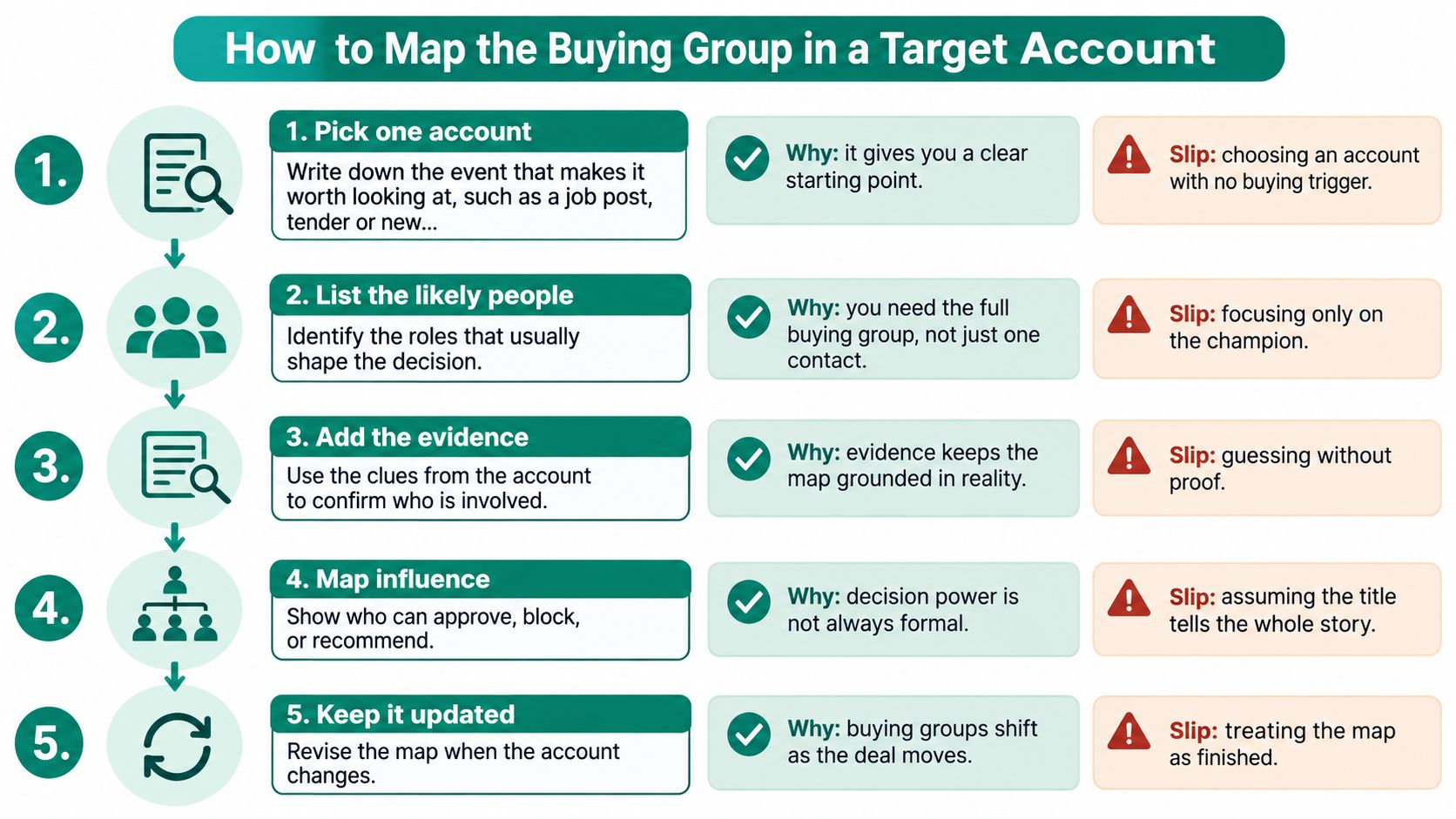
The visual workflow keeps the process focused on evidence and influence.
Build the record around the event
Pick an account with a specific trigger. Record the job post, tender, appointment or public request that makes the company worth investigating. The event limits the scope; choosing an attractive company without a buying trigger leaves the seller inventing relevance.
List the business functions affected by the problem, using the buying-group roles as a checklist. A reporting project might touch finance, operations and IT; the common mistake is mapping only the department that first mentioned it.
Find a named person for each relevant function. Use company pages, press releases, job advertisements and public profiles, retaining the supporting source beside each name. A matching title is a candidate, not confirmation of purchase involvement.
Assign a likely role and a confidence label: confirmed, likely or guessed. Confirmed requires explicit evidence of involvement, likely means the responsibilities strongly fit, and guessed means the connection remains untested. The dangerous slip is allowing an inference to become a fact when a record moves into the CRM.
Mark missing roles as gaps. A blank security-review field should become a research question, not disappear because a champion has replied. This keeps the seller aware of approvals that could still interrupt the purchase.
Check whether the event remains current before drafting outreach. Inspect the original page, any closing date and subsequent announcements; an old vacancy or completed procurement can invalidate the original reason for contact.
Make the map useful during conversations
A finished map fits on an account page. Each person has a role, source, evidence date and confidence label, followed by a short list of unanswered questions.
The record should distinguish observed facts from interpretations. A press release may confirm that someone leads finance; budget authority for the proposed project remains an inference until supported separately.
A practical signal-led account workflow also needs a clear next action. That might be checking a tender clarification, identifying the integration owner or asking the champion how approval works.
The map shouldn't become a research project with no contact decision. Once there's a supported entry point, the next message should test a relevant assumption. Replies can then improve the map instead of merely extending an email sequence.
Contacting Decision Makers Lawfully in the UK
In the UK, the organisation and subscriber type affect the legal route. Those checks belong before message drafting, not after contact details have been exported.
| Contact type | Electronic-mail marketing route | Required check |
|---|---|---|
| Limited company or LLP | PECR consent generally isn't required for unsolicited marketing email | Confirm corporate subscriber status; identify the sender and provide an opt-out |
| Sole trader or some partnerships | Consent or a valid soft opt-in is normally required | Establish the applicable permission before sending |
| Generic or role-based address | The address alone doesn't determine permission | Check subscriber type and the intended channel |
| Named work contact | Personal-data obligations may also apply | Assess the use of the person's details alongside the marketing rules |
The Information Commissioner's Office marketing guidance says unsolicited marketing emails to limited companies and LLPs don't require consent under PECR, while individual subscribers, including sole traders and some partnerships, normally require consent or a valid soft opt-in; senders must identify themselves and provide an opt-out.
Check the recipient, then the channel
The ICO's electronic-mail marketing guidance also explains that PECR isn't limited to messages containing personal information. A role-based address isn't an automatically safe default, and personal-data rules also matter when a person's name or phone number is used.
The review should follow this order:
- Organisation type: Confirm the legal entity from the company record rather than guessing from its trading name.
- Contact type: Establish whether the recipient is a corporate or individual subscriber and whether personal data is involved.
- Channel: Check the rules for the proposed method; permission for an email shouldn't be assumed to cover a call or text.
A verified email establishes a contact-quality fact, not legal permission. The same distinction applies to a verified mobile number.
The sender should retain address provenance and discovery dates, honour objections and check that the opt-out works. Before sending through their own Smartlead account, the user must review the recipient classification and drafted message.
This is general information, not legal advice, so the ICO guidance should be checked before any campaign.
Confirm the Decision Maker Before You Send
The final check should cover role, timing, contact accuracy, message relevance and approval. A well-researched account can still produce poor outreach if the selected person or opening line doesn't match the evidence.
Confirm the role fits the purchase. Compare the selected contact with the account map and check what they can influence. A relevant department is not enough if the person has no responsibility for the project.
Recheck the dated signal. A resolved request, withdrawn tender or changed appointment can make a previously sensible approach irrelevant. The message should reflect the latest observable position.
Verify the chosen contact details. Check the email and mobile number and record where each came from. This explanation of email address verification helps distinguish contact checks from assumptions about deliverability or permission.
Write the first line from what the person said or did. A request for accounting-system recommendations supports a specific opening about that request. It doesn't justify claiming that the company has approved a replacement project.
Approve the message before sending. Review the factual claim, recipient, proposed next step and opt-out. A generated draft should never be treated as approved merely because the contact details passed verification.
Keep control of the handoff
SignalVan's process has four steps: paste a website, review ranked leads with proof, obtain verified decision-maker contact details for selected leads, and approve a drafted message. Its outreach agent writes each first line from the person's activity; the user approves it and sends through their own Smartlead account, never automatically.
For founders seeking their first paying customers, disciplined selection matters more than filling a sequence with plausible names. No tool can promise results, but the seller can insist on a supported reason for every approach.
The decision to send belongs with the person responsible for the campaign. That final review should preserve the distinction between evidence, inference and a claim made to a prospective customer.
SignalVan connects public buying signals with relevant decision makers, verified contact details and a first-message draft for approval. Paste your website at signalvan.com to see who's ready to buy this week.
Keep reading

10 B2B Lead Generation Services 2026: Which Fits Your Team
10 B2B Lead Generation Services 2026: Which Fits Your Team

Prospect Rankings That Show Who to Contact
Prospect Rankings That Show Who to Contact
Approval Workflow Tools for Sales Outreach: 10 Compared
Approval Workflow Tools for Sales Outreach: 10 Compared
Start with your website.
See your first leads, with the reason each one is there.