

Outbound Lead Generation: A Practical Guide for 2026
Outbound Lead Generation: A Practical Guide for 2026
It's Monday. The spreadsheet has 800 rows, the sending domain is warmed up, and the sequence sits in drafts. The only question that matters is the one nobody answers for you. Which twenty of those companies should get a message this week, and which should get nothing at all?
Most outbound advice answers a different question. It explains how to send more, faster, to a bigger list. That's why inboxes are crowded and why buyers spot a mass send in the first line. The teams booking meetings now do something quieter. They earn the right to send, because they know which accounts show a dated, specific reason to talk, and they leave the rest alone.
Table of Contents
- What Outbound Lead Generation Means in Practice
- Outbound Channels Compared by Reach and Effort
- Compliance Rules to Check Before You Send
- Which Buying Signals Should Set Your Contact Order
- How to Run an Outbound Campaign Step by Step
- How to Measure Outbound and When to Stop
- Confirm Your First Outbound Test This Week
What Outbound Lead Generation Means in Practice
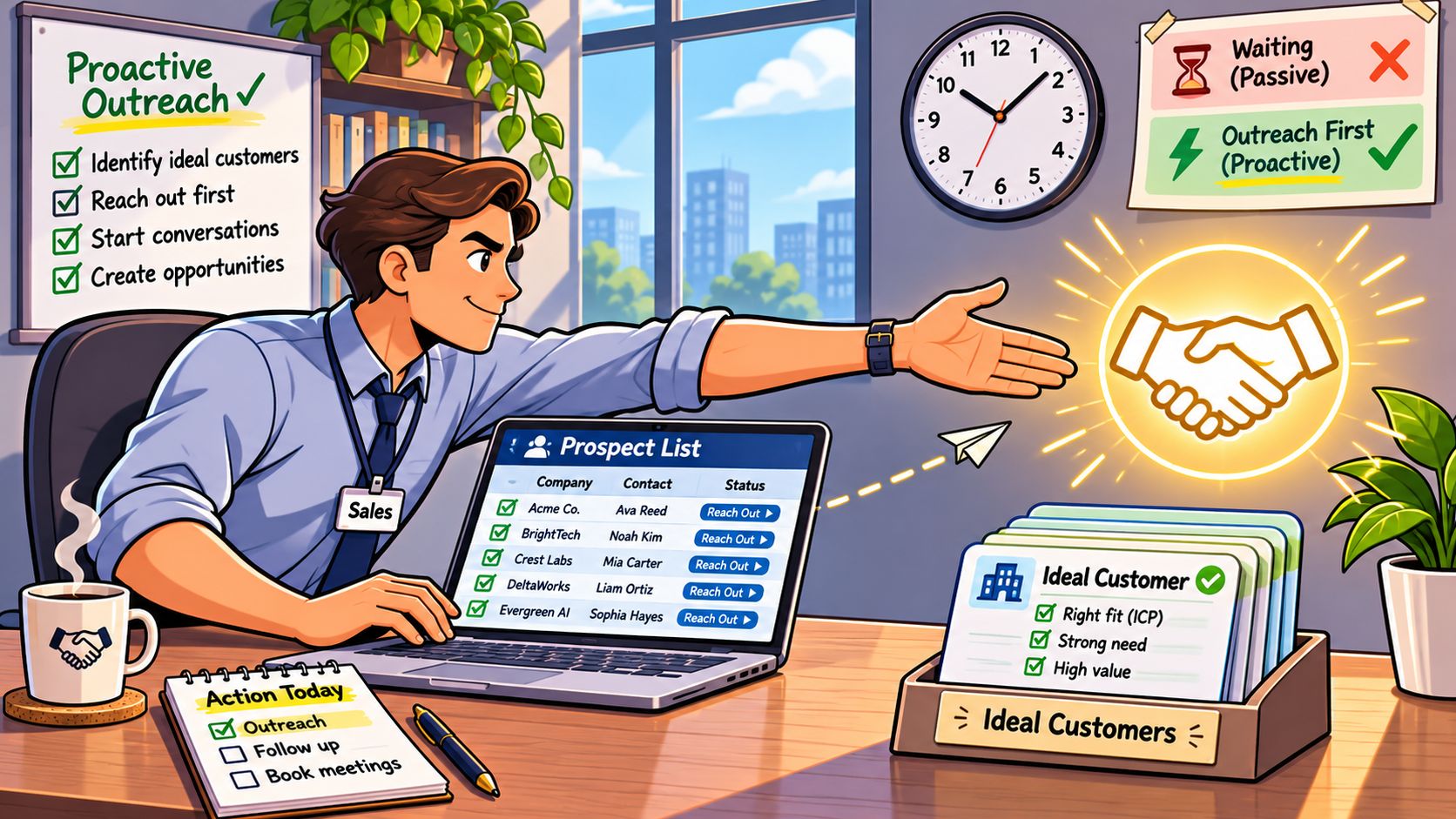
Outbound lead generation means finding the companies and people who fit your offer and starting conversations with them, instead of waiting for them to find you. You choose the market, check which accounts show a reason to talk, and make contact while that reason is still true.
Inbound is a shop window. You dress it well, it sits on a busy street, and you hope the right people walk past. Outbound is walking that street yourself with a short list of doors worth knocking on. Both build a business, but only one lets you decide who you speak to this week.
Four terms worth fixing before you start
Loose language causes most of the waste in outbound. A list of 5,000 "leads" that nobody has checked is a list of 5,000 companies. Fix these four terms and the rest of the process gets easier.
- A prospect is a company or person that fits your target profile: right sector, right size, right region, right role.
- A lead is a prospect with a reason to talk to you now, not a prospect you'd like to talk to eventually.
- Buying signals are dated public evidence of a possible need, such as a job post for the role you sell to, a funding round, a new decision-maker, a tender, or someone publicly asking for help.
- Paying customers are the people who buy and stay. That's a smaller group than the people who reply once and go quiet.
Budgets are contested, so the channel has to earn its place. In 2024, 16% of B2B marketers identified lead generation as their primary marketing goal, according to HubSpot's B2B marketing research. Plenty of teams are chasing the same attention with the same tools.
Outbound runs alongside inbound rather than replacing it. A company with a steady flow of buyers already asking for a demo should protect that engine and add outbound for the segments inbound never reaches. A founder with a handful of enquiries a quarter and no repeatable pipeline usually needs outbound first, because it's the only channel that produces first conversations on a schedule the founder controls.
If you need first conversations this quarter, outbound is the channel to start with. If you need them next year, build the content engine and come back.
Outbound Channels Compared by Reach and Effort
Channels don't compete on quality. They compete on what they can reach, what they cost per conversation, and how many attempts they take before one lands. They also compete on timing: a cheap send to a buyer whose decision already closed is still a wasted send. Pick by where your buyers already are, then give that channel enough touches to produce a real signal.
Outbound channels compared by reach, limit and compliance check
| Channel | Best for | Main limit | Compliance check |
|---|---|---|---|
| Cold email | Testing offers across many accounts at low cost | Deliverability and list quality | Sender identity and a working opt-out on every message |
| Cold calling | Qualifying decision-makers quickly | Many attempts per booked meeting | Call rules that apply in the market you call |
| LinkedIn direct messages | Reaching named people with context | Volume limits and account restrictions | Platform terms and the recipient's stated preferences |
| Direct mail | High-value accounts that justify a physical follow-up | Cost per contact and print lead time | Postal and data-use rules for the named recipient |
| Events and trade shows | Meeting several buyers in one place | Limited to event dates | Consent rules for any badge or attendee data you reuse |
| Public tenders and registers | Companies with a stated, funded need and a deadline | Narrow pool and competitive bids | Use the data only for the purpose it was published for |
| Local business directories | Local service businesses with clear categories | Thin contact detail and mixed accuracy | Verify the recipient type before sending |
Cold email is the cheapest way to test whether an offer lands across a few hundred accounts at once. Its ceiling isn't your copy, it's deliverability and list quality. A bounce rate you ignore becomes a domain that can't reach anyone, which makes the list the channel's real cost.
Cold calling qualifies a decision-maker faster than any written channel, and the arithmetic is unforgiving. Gong's 2024 analysis of more than 300 million calls put an average booked meeting at about 402 dials, with a connection rate near 5.4% of dials. Outreach usually takes several touches before a first meeting on any channel, so treat published figures as indicative rather than a budget line. Market, offer, list quality and seniority move results more than dial technique does.
LinkedIn direct messages reach a named person with visible context, such as a post they wrote or a role they started last month. The limit is platform volume and account restrictions, so treat it as a high-context channel for a short list and skip it when you have nothing specific to say.
Direct mail earns attention for a small number of high-value accounts and rarely justifies print cost and lead time below that. Events and trade shows put several buyers in one room on fixed dates, and any badge data you reuse carries its own consent terms. Public tenders and registers show a funded need with a deadline inside a narrow, competitive pool, so search before the deadline or not at all. Local business directories work for categorised local services, though the contact detail is thin and verification is the main effort.
Plenty of sales teams don't choose one. A 2025 survey of 500 sales professionals found that 43% of sales teams used a hybrid model combining inbound and outbound within the same function, according to Outreach's prospecting report.
Pick one channel your buyers already use and give it enough touches to judge. A channel earns its place by reaching accounts with a reason to talk now, so if you're choosing where to hold the work, compare how each lead generation software option records why an account was picked and whether the signal that found it is still fresh enough to matter.
Compliance Rules to Check Before You Send
Compliance turns on who you're emailing, not just where your company sits. A named sole trader and a limited company can share a postcode and fall under different rules. Get the recipient type wrong and the rest of your process doesn't matter.
Contact rules by market and recipient type
| Market or recipient | Rule in brief | What you must do | What to record |
|---|---|---|---|
| United States | CAN-SPAM: accurate headers, no deceptive subject lines, valid postal address | Honour opt-outs within 10 business days | Suppression list and opt-out date |
| UK corporate subscribers (limited companies, LLPs, government bodies) | PECR: consent not required for marketing email | Identify yourself and give a valid opt-out | Recipient type and opt-out log |
| UK sole traders and some partnerships | Treated as individual subscribers, so the exemption generally does not apply | Check the consent position before you send | Recipient type and lawful basis |
| European Union | Legitimate interest can be a basis, but ePrivacy rules still apply | Tell the person no later than the first message and offer an objection route | Source, reason for relevance and data used |
The ICO's guidance on business to business marketing sets out the UK position. Under PECR, marketing email to corporate subscribers, meaning limited companies, limited liability partnerships and government bodies, doesn't require consent. The exemption generally doesn't cover sole traders or some partnerships, which are treated as individual subscribers. Even where consent isn't needed, you must identify yourself and give a valid way to opt out. Checking the recipient's company type in a public register takes a minute and decides which column of the table applies.
In the United States, the FTC's CAN-SPAM compliance guide covers the federal rules in force since 2003: accurate header information, no deceptive subject lines, identification as an advertisement where required, a valid physical postal address, a clear opt-out, and opt-out requests honoured within 10 business days.
In the EU, the European Commission's guidance on legal grounds for processing data recognises legitimate interest as a possible basis for direct marketing. It isn't blanket permission. You must tell the person no later than the first message that their data is used for advertising and that they can object at any time. A buying signal explains why you're writing. It doesn't replace that notice.
Keep one record per contact: recipient type, source, reason for relevance, personal data used, and the objection route. An opt-out outlives the signal that found the person, so check your suppression list before every send, not only the first one. A fresh buying reason never overrides a recorded objection. Lead data stays private to your SignalVan account and is never pooled, resold or searchable by other customers, so the record you build is yours alone if anyone asks how you got a contact.
Not legal advice: this is general operating guidance. Sector rules, such as financial services or healthcare, can be stricter than the national baseline, so check before you scale.
Which Buying Signals Should Set Your Contact Order
Contact accounts that show a current, dated reason and hold everything else. That one rule does more for reply quality than any subject line test you'll run.
Signal-first prospecting means ordering accounts by evidence rather than by list size. The account with a tender closing in nine days or a role advertised last week outranks fifty companies that merely match your firmographics.
Buying signals, what they tell you and when to act
| Signal | What it suggests | Example to check | Act when |
|---|---|---|---|
| Job post for the role you sell to | The team is building capacity in that area | A hire for a role your offer supports | While the role is still open |
| Funding round | Budget may be available for new spend | A seed or growth round in company news | Soon after the announcement |
| Someone asking for recommendations | An active, stated need | A public post asking for a tool, supplier or agency | While the question is still open |
| New decision-maker | Priorities often reset in the first months of a role | An appointment announced on LinkedIn or in company news | Early in the role |
| Public tender | A funded, scheduled purchase | A notice in a public tender register | Before the bid deadline |
| Generic industry news | Context only, no stated need | A market report or trend piece | Do not act on it alone |
Read the middle column carefully. A job post tells you the team is building capacity, not that it has budget for your product. A funding round means money exists, not that any of it is earmarked for you. The signal sets the order of contact. The conversation establishes whether there's a need.
The cost of ignoring that distinction is measurable. Gartner's 2025 sales survey found 73% of B2B buyers actively avoid suppliers that send irrelevant outreach, and 61% prefer a rep-free buying experience, as reported in Gartner's announcement on buyer preferences. Buyers will self-serve the general information. They want a seller when judgment is required.
What to do when the signal is ambiguous
Most signals are ambiguous. A hire two levels below your buyer is a hint, not a mandate. A funding announcement says nothing about timelines.
- Ask one low-friction question. Something like "are you handling this in-house or bringing in help?" costs the reader four seconds.
- Offer one useful observation. A benchmark from a similar company, no pitch attached.
- Wait for a second source. A role posted and a new starter in the same team is much stronger evidence than either alone.
For each lead, write down what happened, where you saw it, the date, and why it matters now. Each SignalVan lead arrives with exactly that, the reason it matters now alongside the source and the date it happened. Then write what would invalidate it: the role being filled, a tender deadline passing, a clear no. When that happens, drop the lead rather than reworking it.
Do-not-contact rule: if the only evidence is generic industry news, a hire unrelated to your offer, or a company outside your sector, the account stays on the hold list.
Good contact order also protects the reader. If you're choosing where weaker signals sit in your queue, this guide to identifying high-intent leads sets out how to rank evidence you can defend.
How to Run an Outbound Campaign Step by Step
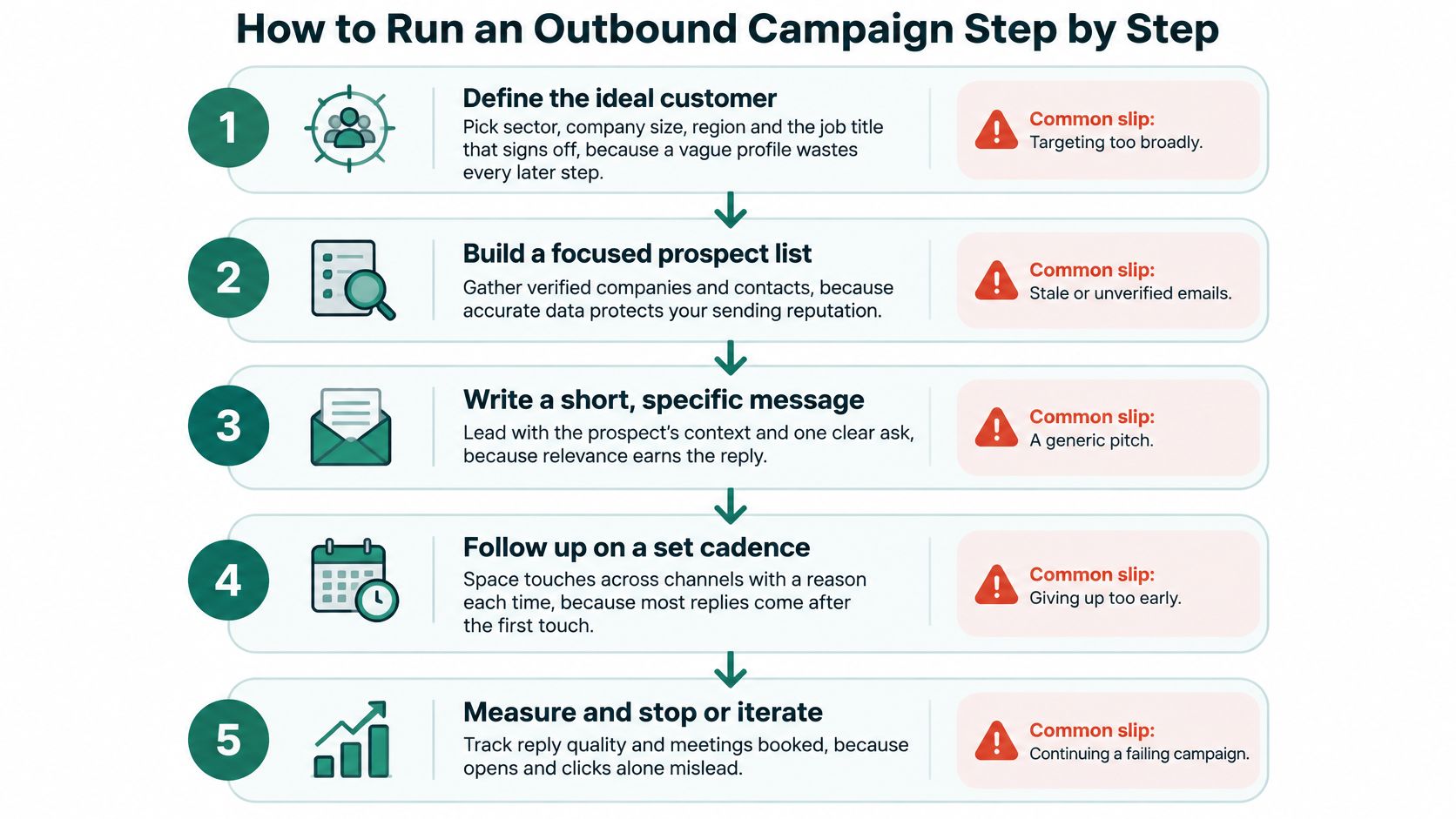
The whole campaign fits in one line: define who you serve, find accounts with a dated reason, verify the person, write one specific message, approve it, send a short sequence, log everything, and review weekly. Each step below carries its own reason and the slip to avoid.
Define the ideal customer. Sector, company size, region, and the job title that signs off the purchase. The slip is targeting by industry alone, which leaves the list builder unable to tell a fit from a near miss.
Build the account list from sources that carry a date. Job posts, funding announcements, public tenders, company registers, and posts where someone asks for help. The slip is buying a static list where every row looks the same and none of them tell you what changed last week.
Verify each contact before you write a word. Confirm the named decision-maker and a verified email, and record where the contact came from. The ICO's guidance on marketing and data protection is useful here: verification is a risk control, not proof that anyone wants to buy, and data protection still applies when you use a named person's details. The slip is sending to addresses you can't trace back to a source.
Rank by timing. The account with a role advertised last week goes first. The strong fit with nothing happening goes on a hold list you revisit monthly.
Write one observation and one ask. Reference something specific and true, then request a single clear next step. The slip is three paragraphs about your company before the reader's name appears in a sentence.
Approve the campaign, then send a short sequence over several weeks. Four to six touches is enough to learn whether the signal was real. The slip is one email and silence.
Log every reply, meeting and opt-out in the same record. Remove opt-outs the same day, not at the end of the week.
Review weekly on quality, not volume. Change one variable at a time, whether that's the signal, the opening line, or the ask. Change all three and you learn nothing.
SignalVan follows the same sequence in four moves: paste your website, see ranked leads with proof, get the decision-maker's verified contact details for the leads you pick, and approve a message that goes out through your own Smartlead. Two approvals sit between a draft and an inbox, one to build the campaign and one to start sending, and the sending account is yours.
For the follow-ups, these cold email follow-up templates give you a shape to work from. Add something new on each touch, because a reminder that says the same thing twice reads like a reminder.
How to Measure Outbound and When to Stop
Opens, clicks and reply counts don't tell you whether outbound is working. They tell you whether a message arrived. A buyer can read your email, look you up through an AI assistant, shortlist you, and never click anything you can see.
Gartner's buyer research reports that 45% of B2B buyers used generative AI during a purchase, 69% prefer to validate AI-generated insights with sales representatives, and buyers work from an average of seven information sources, according to Gartner's survey on validating AI-generated insights. That's why claiming one message caused one deal is usually wrong, and why assisted influence needs its own measures.
- Qualified-account progression. How many accounts you contacted on a dated signal reached a real conversation, not how many opened.
- Positive-reply quality. Count replies that name a problem, a timeline or a colleague. A "not now" is a no with a date attached, and it belongs in the record.
- Time from signal to response. A reply four weeks after a tender closed is worthless, however enthusiastic it sounds.
- Meeting-to-opportunity conversion. A meeting that never becomes a qualified opportunity is a calendar entry.
- Share of opportunities where outreach supplied context. Ask the person who took the meeting what they already knew when they replied.
Tie each signal to the buyer stage you can observe, then stop on campaign outcomes rather than on a score. Stop after an opt-out, immediately. Stop when the planned sequence ends with no reply. Stop when the account turns out to be a poor fit.
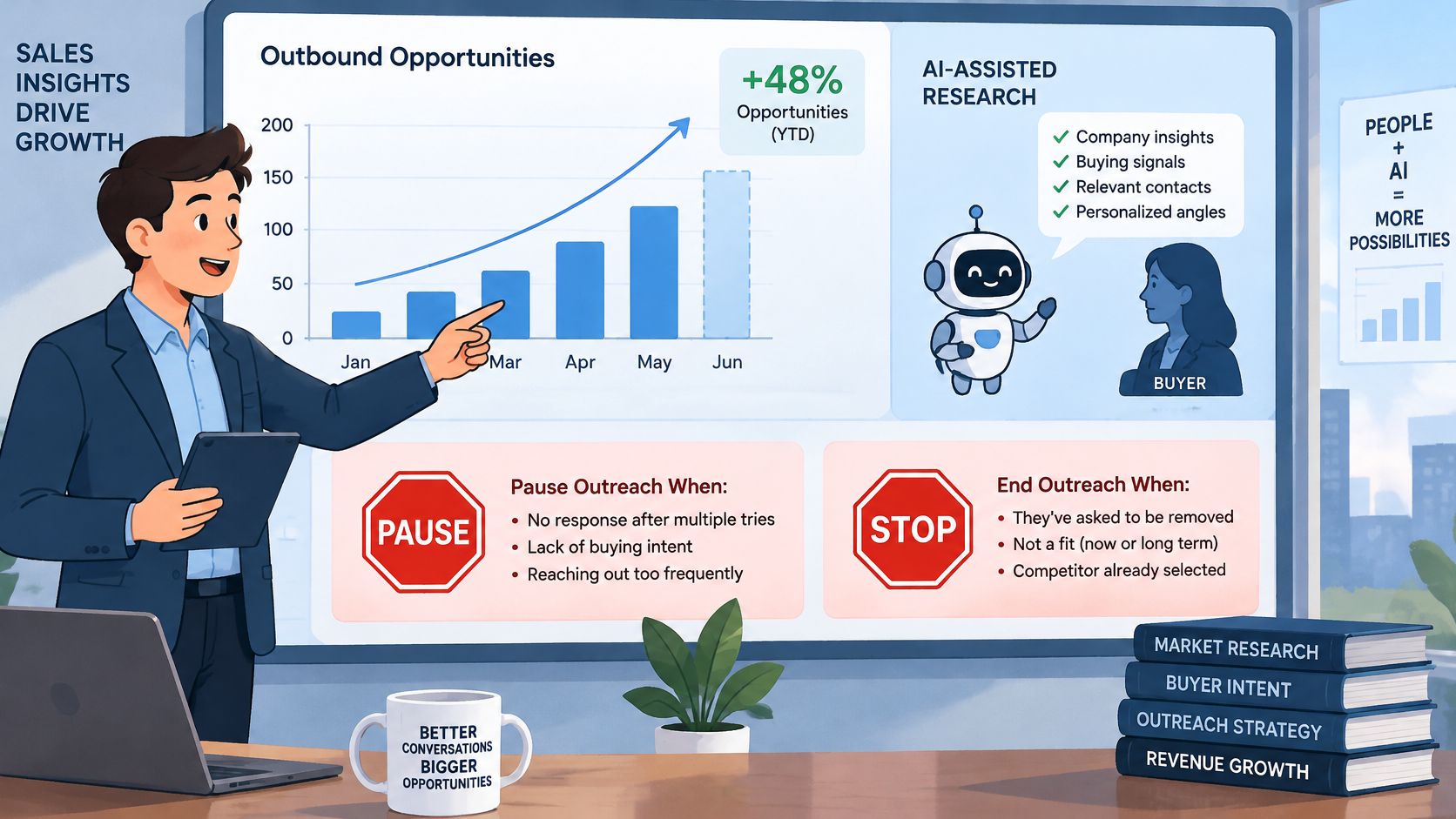
A filled role, a passed tender deadline or a stated lack of need is the invalidation rule you already set when you ordered the contact list. It doesn't need a second scoring system on top.
Monthly review: compare which signal types produced real conversations and which produced nothing. Then narrow next month's list to the signals that earned meetings.
Stopping is the result of tighter targeting, not a sign the channel failed. Fewer accounts, better timing, and a clear exit rule is what a working programme looks like from the inside.
Confirm Your First Outbound Test This Week
The decision for this week is small and specific. One channel from the comparison table, and one buying signal that fits your offer. Everything else follows from those two choices.
Here's the checklist to run before Friday.
- Choose that single channel and write it down, so nobody reopens the debate next week.
- Pick one dated signal type and note exactly where you'll find it, whether that's a job board, a tender register or a named LinkedIn group.
- Set the stop rule before you write anything, including what counts as a clear no.
- Draft one first message around a single observation and one clear next step.
- Put the review date in the calendar now, four to six weeks out.
A campaign with no stop rule and no review date isn't a test. It's a habit with a spreadsheet attached.
The setup step is your website. SignalVan's agents read it, work out what you sell and who buys it, and you approve that summary before any search runs. You then see ranked leads with the signal, its source and its date. Verified contact details are revealed only for the leads you pick, so you never pay for a name you won't use, and the free start includes every signal, the full approval workflow and Smartlead sync. Nothing goes out until you approve the campaign and then approve sending, and it leaves only through your own Smartlead account.
Paste your website at signalvan.com to see who's ready to buy this week.
SignalVan handles the part that eats a founder's week: working out which companies show a real, dated reason to talk before a single word is written. Each lead arrives with its buying signal, the source, the date, a verified email and a carrier-checked mobile for the decision-maker, plus a drafted first message you can edit or reject. Start free at SignalVan and see which accounts in your market deserve a message this week.
Keep reading
B2B Sales Email Templates: 7 Signal-Based Examples
B2B Sales Email Templates: 7 Signal-Based Examples

Sales Operations Management: What It Does for Revenue
Sales Operations Management: What It Does for Revenue
Ideal Customer Profile: What to Write First
Ideal Customer Profile: What to Write First
Start with your website.
See your first leads, with the reason each one is there.