

AI Sales Assistant: What It Does and What You Control
AI Sales Assistant: What It Does and What You Control
83% of sales teams using AI reported revenue growth, compared with 66% of teams without AI, according to Salesforce's 2024 State of Sales findings. That's an association, not proof that software caused the growth. An AI sales assistant should handle prospect research, organise evidence and draft relevant messages, while a person decides which accounts deserve attention and what gets sent. Faster preparation is useful. Faster unchecked outreach isn't.
Table of Contents
- What an AI Sales Assistant Does for Your Pipeline
- How Buying Signals Turn Into Prospects
- Sales Tasks an AI Sales Assistant Handles and Where You Decide
- How to Run a Prospecting Workflow With an AI Sales Assistant
- Compliance Checks for the UK, US and Europe
- Run a 30-Day Pilot Before You Scale
What an AI Sales Assistant Does for Your Pipeline
An AI sales assistant reads public evidence of buying signals, ranks accounts, finds a verified email for a relevant decision-maker and drafts a first message. A person decides what happens next. For prospecting, it's a research and drafting assistant, not a replacement for the seller.
AI is no longer confined to isolated experiments. In 2024, 81% of sales organisations were experimenting with AI or had fully implemented it, with 40% experimenting and 41% having completed implementation, according to Salesforce's State of Sales reporting. Adoption alone doesn't establish value, but it does make a practical evaluation more useful than another debate about whether AI belongs in sales.
Remove preparation work, not sales judgement
Small teams feel the preparation burden sharply. A founder researching prospects is also responsible for product decisions, customer calls and delivery. An agency owner can't spend the same hour checking contact records and speaking with a potential client.
Salesforce's 2024 sales-trends statistics report that representatives spend 28% of their working week selling, leaving 72% for administrative and other activities. Applied to a hypothetical 40-hour week, that's 11.2 hours selling and 28.8 hours on non-selling work.
The useful division of labour is straightforward:
- Delegate collection. Let the assistant gather company activity, retrieve source material and prepare account summaries.
- Delegate preparation. Let it organise contact results and produce an evidence-based opening line.
- Keep interpretation. A seller still decides whether the evidence indicates a relevant opportunity.
- Keep commitments. Pricing promises, sensitive claims and customer-facing messages need an accountable person.
Treat contact lists as unfinished work
A contact list answers who might fit. It rarely answers why the company should be approached now. Roles change, people leave and an apparently suitable account may have no current reason to consider another supplier.
The assistant should connect account fit with recent evidence, then make that connection inspectable. A polished paragraph without a source is not customer intelligence.
Practical rule: Delegate the work needed to prepare a decision. Keep the decision with the person responsible for the relationship.
The operating objective is clear: choose the tasks worth handing over, preserve the checks that prevent mistakes and run a bounded test before expanding usage.
How Buying Signals Turn Into Prospects
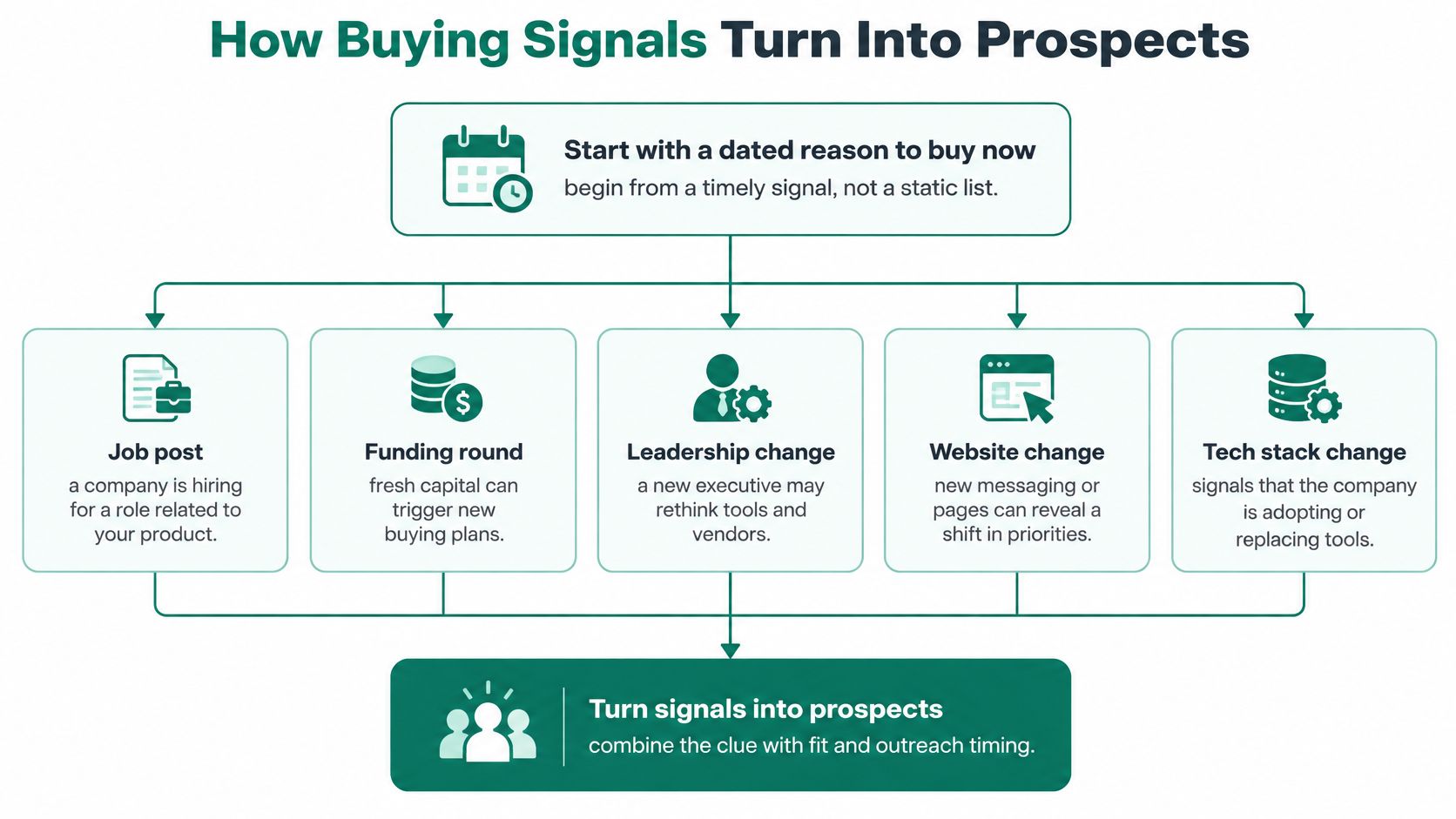
Signal-first prospecting starts from a dated reason a company may need a product now, rather than from a static list. The account must still fit the offer. A timely event at the wrong company isn't a qualified opportunity.
Relevance matters more than apparent personalisation. In a Gartner survey of 632 B2B buyers, 73% actively avoided suppliers that sent irrelevant outreach. Mentioning a company's latest announcement won't help if the offer has nothing to do with it.
Buying signals, examples and timing
| Signal | Worked example | Why timing matters |
|---|---|---|
| Job post for the role being sold to | Hiring a finance controller may mean the company is reviewing its reporting tools | Open roles fill and close, so a dated post helps establish whether the need remains live |
| Funding round | New capital may fund new sales or operations hires | Spending plans can take shape in the months after a round |
| Question asked on LinkedIn or in a forum | A request for recommendations shows a need being worked on now | Requests get answered and drop out of view quickly |
| New decision-maker in post | A new head of sales may review suppliers in their first months | New owners often set priorities early |
| Company news | An expansion into a new region may require local sales cover | Announcement dates help distinguish current projects from old developments |
| Open public tender | A new notice on Find a Tender may match the service being offered | Notice and closing dates set a clear window to act |
These are reasons to investigate, not proof of buying intent. Funding doesn't establish a budget for a particular tool. A leadership appointment doesn't mean the incumbent supplier is being replaced.
Require evidence before assigning priority
SignalVan's discovery process uses public sources including LinkedIn, job boards, company news, registers and tenders, with the source shown on every row. That lets a reviewer separate an observed event from an inference about its commercial meaning.
Public tenders are particularly concrete. The UK's Find a Tender service says procurements started before the relevant transition are published there above the applicable threshold, usually over £139,688 including VAT. That isn't a universal current threshold, so the relevant procurement regime and notice must be checked.
A tender also needs a different response from an ordinary sales lead. The reviewer should inspect eligibility, submission requirements and closing dates before deciding whether direct outreach is appropriate.
For other accounts, use a simple ranking rule: recent, specific and relevant goes first. A broad industry match belongs in a later batch, not beside an explicit request for help. The distinction between an interesting company and high-intent leads is the strength of the evidence connecting the event to the offer.
Sales Tasks an AI Sales Assistant Handles and Where You Decide
| Task | What the assistant does | What you decide |
|---|---|---|
| Finding accounts with signals | Scans public sources such as job posts, funding news and tenders | Which target markets and profiles to approve |
| Ranking prospects | Orders accounts by signal strength and date | Which accounts to approach now |
| Finding contacts | Looks up work emails and mobile numbers and marks verification status | Whether to use uncertain results |
| Drafting first messages | Writes an opening line from the evidence behind the lead | Whether to edit, approve or reject each line |
| Handling replies | Drafts a response for review | What to say and whether to reply at all |
| Sending | Does not send on its own | Starting the send from your own Smartlead account after approval |
The assistant should take the gathering and organising work. Fit, tone and timing stay with a person. That boundary matters most when a plausible recommendation could become an inaccurate customer-facing claim.
A useful assistant makes review easier. It doesn't hide uncertainty behind fluent writing or treat every populated contact field as permission to act.
Check the evidence behind the account
A job advertisement may describe a replacement hire, not an expanding department. A funding announcement may concern an investment completed long before the announcement appeared. An executive may have changed roles without gaining responsibility for the problem being sold.
The reviewer should open the source and check what it establishes. The question isn't whether the assistant found something interesting. It's whether that evidence supports this approach to this account.
Useful review gates include:
- Account identity. Confirm that the source refers to the correct company, subsidiary and geography.
- Commercial fit. Check whether the company could reasonably use the offer, not merely whether it matches an industry label.
- Signal interpretation. Separate the event itself from the inferred need.
- Exclusions. Remove existing customers, active opportunities, competitors and other sensitive accounts before campaign preparation.
For agencies, exclusions should also respect client boundaries. A lead suitable for one client may be off-limits for another. Keeping those decisions explicit is safer than expecting a model to infer commercial relationships from scattered notes.
Check contact status without inventing certainty
A verified email means a mailbox check has run and returned a usable result. It doesn't prove that the recipient wants the message, owns the budget or has consented to every form of contact.
Catch-all, unknown and doubtful results should remain labelled as uncertain. A catch-all domain may accept messages without confirming that the individual mailbox exists. An unknown result is an unresolved check, not a quieter way of saying verified.
Mobile numbers need the same discipline. A carrier-verified number still needs to belong to the intended contact, and its availability doesn't settle whether calling or messaging is appropriate.
The right action may be to find another contact, investigate further or leave the account untouched. Filling every row is not the objective.
Approve claims, not just writing style
SignalVan's outreach process writes each first line from what the person said or did, then requires approval before it goes out. The reviewer should inspect the factual assertion before polishing the wording.
Consider a company hiring a finance controller. A defensible opener can refer to the advertised role and ask whether reporting processes are under review. It shouldn't announce that the company is struggling with inaccurate reports unless the source says so.
Reply drafts deserve equal scrutiny. An assistant can suggest a useful response, but it shouldn't invent product capabilities, offer an unapproved discount or interpret a polite refusal as an invitation to keep pushing.
Approval is valuable when the reviewer can see the evidence, the uncertainty and the proposed action together.
Good approval workflow tools should make those checks visible rather than reducing review to a button beside a finished message. For any workflow, retain the approved text, reviewer and approval time so a disputed claim can be reconstructed.
Keep campaign approval separate from sending
SignalVan requires two approvals: one to build the campaign and another to start sending. Both actions take place through the customer's own Smartlead account. Approving a campaign's preparation is not permission to launch it.
This separation catches mistakes that individual message review may miss. The audience might be correct but the sending schedule wrong. The first lines might be accurate while the campaign includes a suppressed account or an unsuitable follow-up.
The sender also remains responsible for commercial-email compliance when software prepares the message. Accurate sender information, an appropriate opt-out and suppression handling aren't tasks that disappear because an assistant drafted the copy.
The test for any AI sales assistant is demanding but fair: it must show what it did, where each piece of information came from and when it was obtained. If those answers aren't available, the tool isn't ready to operate inside a live pipeline.
How to Run a Prospecting Workflow With an AI Sales Assistant
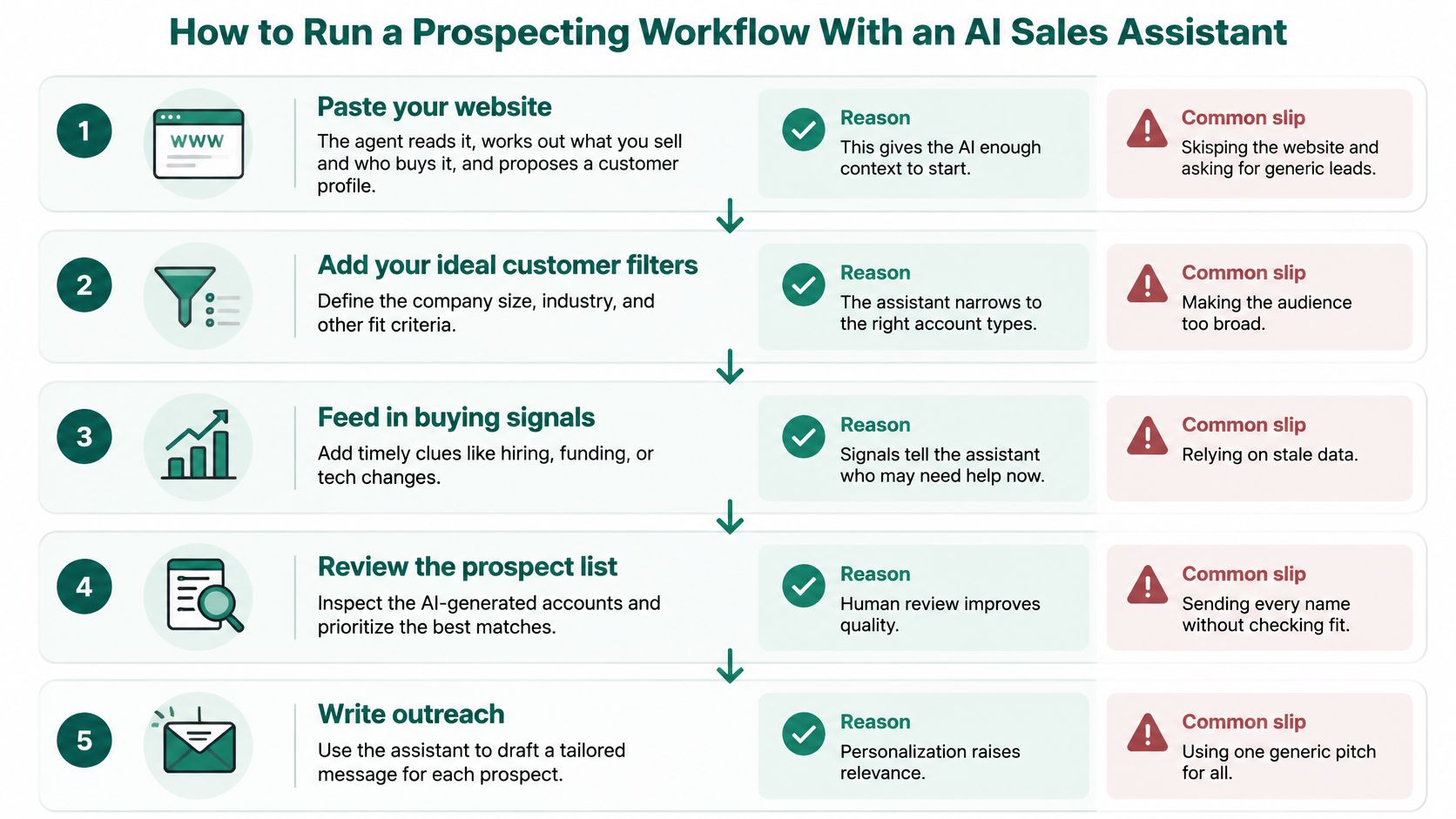
SignalVan's process has four stages: paste a website, inspect ranked leads with proof, obtain verified decision-maker contact details for selected leads, and approve a message for delivery through the customer's own Smartlead. In practice, the review work is best separated into the following steps.
Paste the website and approve the proposed profile. The agents read the site, work out what the business sells and who buys it, then propose a summary for approval, with no forms, ICP worksheets or onboarding call. This supplies the commercial context; the common slip is accepting a profile that describes every possible customer rather than the segment worth approaching first.
Review the ranked leads. Each row should show the signal, source and date, with prospects separated into ready to approach, broader matches and potential partners. The purpose is prioritisation; the common slip is treating a broad match as evidence of an active buying need.
Choose the leads that merit contact details. Contact enrichment is requested only for selected leads, so account review comes before further investigation. The common slip is enriching an entire list before checking whether the companies belong in the campaign.
Inspect the contact status. A mailbox-checked work email with a usable result is labelled verified, while catch-all or unknown results remain uncertain. This is the point to decide whether more checking is needed, rather than allowing an uncertain address to enter the sending list unnoticed.
Approve the opening line. The agent drafts from the person's observed statements or actions, and the reviewer edits, approves or rejects it. The common slip is checking grammar while overlooking an unsupported claim about the prospect's needs.
Approve campaign preparation, then authorise sending. The campaign is built in the customer's own Smartlead account after approval, with separate permission required to start sending. The common slip is assuming that approval of the audience or copy also authorises launch.
Judge the batch before judging the speed
The evidence-led prospecting workflow should produce a short, inspectable batch rather than a large queue demanding rushed approval. A healthy batch contains clear reasons for approaching each company, visible contact-status labels and first lines that a seller could defend in conversation.
A mix of verified and uncertain contacts isn't automatically a poor result. Hiding that distinction would be. The reviewer should be able to remove an uncertain contact without losing the account's evidence or the reason it was selected.
Batch acceptance test: Every selected account needs a credible reason for contact, an acceptable contact route and a message that stays within the evidence.
An early rejection is useful if it exposes a bad targeting assumption. Correcting the profile before launch is better than discovering the mismatch through complaints or irrelevant replies.
Compliance Checks for the UK, US and Europe
| Region | Rule to check | What it means for your outreach |
|---|---|---|
| UK | The PECR direct-marketing email rule does not generally apply to corporate subscribers | Data-protection law still applies when a named person's details are used |
| US | CAN-SPAM requires accurate sender details, a valid postal address and a working opt-out | Suppression handling must be ready before sending starts |
| Europe | GDPR governs personal data, alongside applicable national marketing rules | Confirm the lawful basis and local requirements before messaging a named contact |
| India | Obtain jurisdiction-specific advice before launch | Don't assume that a UK, US or European campaign setup is sufficient |
The key distinction is between a company record and a named decision-maker. The Information Commissioner's Office's B2B marketing guidance explains that PECR's email-marketing rule doesn't apply to corporate subscribers such as limited companies and limited liability partnerships. Consent is generally not required under that rule, but data-protection law still applies when personal data is used.
A generic corporate inbox and an individual employee's name, email or phone number therefore need different consideration. Nor should a campaign assume that every business recipient is a corporate subscriber. Recipient type must be checked.
Make compliance part of campaign approval
Under the FTC's CAN-SPAM compliance guide, commercial email must use accurate From, To, Reply-To and routing information, identify the sender, include a valid physical postal address, provide a clear opt-out, honour opt-outs within 10 business days, and keep the opt-out mechanism working for at least 30 days after sending.
Before launch, the campaign owner should check:
- Recipient classification. Establish whether the record concerns a corporate entity or identifiable person.
- Permitted use. Record the applicable lawful basis and regional marketing requirements.
- Suppression handling. Ensure objections and opt-outs prevent further contact.
- Data controls. Define who can access contact records and how correction, retention and deletion requests are handled.
A public source isn't blanket permission to reuse personal information. Neither a verified address nor a human approval button settles the legal question.
The sender carries responsibility even when software prepares the message. This is general information, not legal advice; campaigns across Europe and India need local review rather than assumptions copied from another market.
Run a 30-Day Pilot Before You Scale
Run a 30-day pilot on one segment before increasing volume. Establish a baseline for time per qualified prospect, reply rate and contact accuracy, then compare AI-assisted work with a comparable group prospected manually or from a conventional list.
Keep the offer, audience and sending conditions as similar as practical. Field evidence indicates that AI's effect varies by workflow, so a focused comparison is more useful than a broad productivity average, as discussed in this study of generative AI in sales workflows.
Set the decision rules before launch
- Measure useful outcomes. Track positive replies, qualified conversations and opportunities, not just messages prepared.
- Track the costs. Record review time, rejected drafts, negative replies, unsubscribes and invalid contacts.
- Preserve attribution. Tag leads with their signal source and campaign so meetings and later revenue can be traced to the originating approach.
- Watch deliverability. Review bounce rate alongside reply quality. Poor delivery can obscure whether the message was relevant.
- Choose a stopping rule. Define what warrants expansion, narrower targeting or a pause before results arrive.
Public buying signals such as hiring, funding, recommendation requests, new appointments and tenders give the pilot concrete evidence to evaluate. Clear dates make timing easier to judge.
Paying customers require more than outreach volume. The pilot should test whether better evidence and relevant approaches create worthwhile conversations, then follow those conversations through to commercial outcomes. Scale only when the gains survive contact-quality, review-effort and deliverability checks.
SignalVan finds companies showing buying signals, verifies decision-maker emails and mobiles, and drafts first messages for approval before sending through the customer's own Smartlead account. Paste your website at signalvan.com to see who's ready to buy this week.
Keep reading
B2B Sales Email Templates: 7 Signal-Based Examples
B2B Sales Email Templates: 7 Signal-Based Examples
Sales Operations Management: What It Does for Revenue
Sales Operations Management: What It Does for Revenue

Ideal Customer Profile: What to Write First
Ideal Customer Profile: What to Write First
Start with your website.
See your first leads, with the reason each one is there.