

Qualified Leads Marketing: Finding Sales-Ready Buyers
Qualified Leads Marketing: Finding Sales-Ready Buyers
The pressure to hand over more leads is the surest route to ending up with fewer customers. In 2025, 37.7% of 450 B2B brand marketers said their department was pressured to deliver marketing-qualified leads regardless of quality, according to Marketing Week's State of B2B Marketing survey. Pressure like that produces lists that look strong on Monday morning and collapse by Thursday, because volume measures how busy you are, not how ready the buyer is.
Qualified leads marketing runs in the opposite direction. You start with evidence that a company has a reason to buy, confirm you can reach the person who owns the problem, then decide whether contact this week is justified. Fit, intent, contactability and timing. Miss any one of them and the record stays a contact.
That's the argument this piece defends. A lead is qualified when there's a dated reason to call now and a lawful route to reach the right person. Everything else is a name in a spreadsheet.
Table of Contents
- What a Qualified Lead Is in Plain Terms
- Lead Stages From Raw Contact to Sales-Ready
- Four Criteria That Separate Sales-Ready Prospects
- Buying Signals That Show Timing
- UK Rules to Check Before You Send
- How to Qualify a Lead in Six Steps
- Mistakes That Make Lead Lists Look Bigger
- Set Your Qualification Rules Before the Next Search
What a Qualified Lead Is in Plain Terms
A qualified lead is a prospect who fits your customer profile, shows a real reason to buy now, and can be reached through a verified contact route. That's the whole definition. Nothing about form fills, content downloads or how many thousand rows your database holds.
Think about a restaurant with a guest list. Three hundred names on the list is not three hundred covers. The names that matter are the ones with a booking, a date and a phone number. Lead lists behave the same way: the count tells you how much admin you've done, not how much dinner you'll serve.
Four tests separate a name from a lead.
- Fit: is this the kind of company, in the kind of market, with the kind of contact you serve?
- Intent: is there evidence, dated and sourced, that the company may need what you sell?
- Contactability: can you reach the person who owns the problem on a verified work email or mobile?
- Timing: is the signal recent enough to justify contact this week rather than next year?
Volume misleads because it hides all four. A thousand-row CSV lets you report activity without ever answering whether anyone in it has a reason to talk to you. Signal-first prospecting flips the order: instead of buying a list and hunting for a reason to call, you start from something observed in public and work back to the person.
The test to apply today: would a salesperson know exactly why to call this company today, and could they say it in one sentence with a date attached? If not, it's a contact, not a lead.
Run that test on one prospect before you open your CRM tomorrow. You'll learn more from that single record than from another month of list building.
Lead Stages From Raw Contact to Sales-Ready
Four stages sit between a raw contact and a deal, and each should demand different evidence before a record moves forward. Blur them and the numbers stop meaning anything.
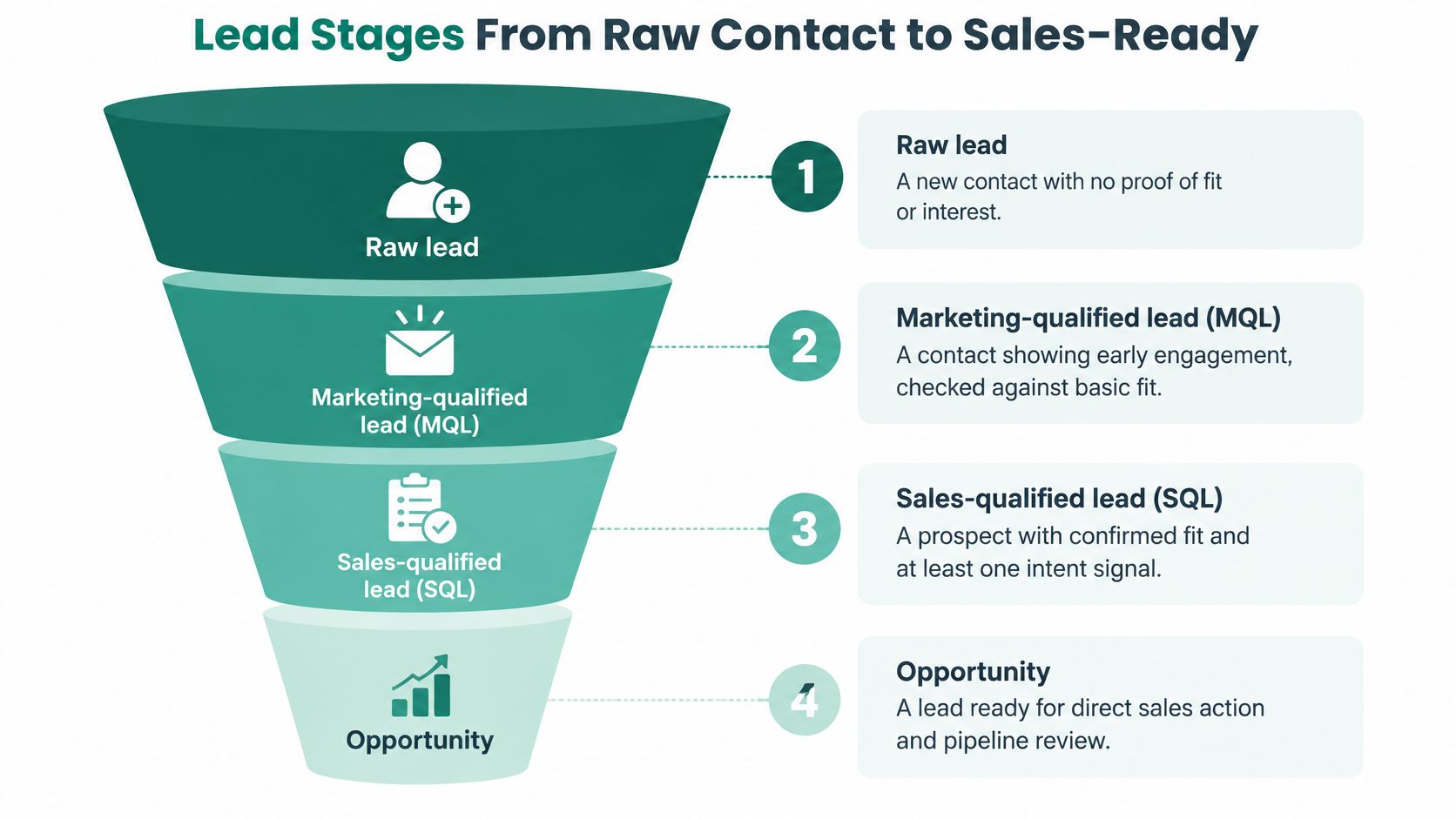
The benchmark data compiled from multiple industry sources puts the average lead-to-MQL conversion rate at 31%, followed by an average MQL-to-SQL rate of 13%. Read that as a funnel rather than a headline: 1,000 raw leads typically yield about 310 MQLs and only around 40 SQLs. Roughly 96% of the original list never reaches a sales conversation.
Those figures are benchmarks, not laws. Conversion shifts with industry, market, deal size and, most of all, how tightly each team defines its own stages. A team that calls every webinar registrant an MQL will beat 31% and learn nothing useful from it.
| Stage | What it means | Evidence to check | Average conversion from previous stage |
|---|---|---|---|
| Raw lead | Any company or person captured from a list, form or search | Source and date recorded | No rate applies, every record enters here |
| Marketing-qualified lead (MQL) | Shows intent and apparent ability to buy | Fit plus at least one intent signal | About 31% (lead to MQL) |
| Sales-qualified lead (SQL) | Passes a sales fit check and reaches a real conversation or meeting | Sales validation and meeting notes | About 13% (MQL to SQL) |
| Opportunity | A live deal with a named buyer and a timing window | Budget, timing and decision process | Measure your own SQL-to-opportunity rate |
The practical trap is the record with forty fields filled in and no dated source. That's a raw lead. It has been enriched, which isn't the same as qualified. A record only climbs a stage when someone can point at the evidence that moved it.
If the distinction between a discovered company and a working lead still feels fuzzy, the explanation of prospects versus leads is worth ten minutes before you rewrite your stages.
Write one sentence of evidence for each stage you currently use. Any stage you can't write a sentence for is decoration, and it's inflating your reporting.
Four Criteria That Separate Sales-Ready Prospects
Most leads that fail a qualification review fail on timing, not fit. That's worth sitting with, because fit is the only test many groups run.
An MQL shows buying intent and an apparent ability to purchase. An SQL passes sales fit validation and reaches a meaningful conversation or meeting. That difference is operational, not philosophical, and the conversion benchmarks behind it show how few apparent signals survive contact with a real sales conversation.

A working scoring design needs three dimensions: fit (industry, geography, company size, role), intent (a dated request, relevant post, hiring event, tender or company change) and contactability (a verified work email or mobile). Add timing as the fourth and the set is complete. Every record should preserve the source and the observation date, so the score reflects current buying context instead of demographic similarity.
What strong and weak records look like
A strong record reads like this. A mid-sized logistics firm matches your profile, has a job post live for the exact role you support dated six days ago, and carries a verified email for the operations director. Four tests, four passes. A salesperson could call today and sound informed.
The weak record is the same company with no dated evidence and only a generic inbox. It looks identical in a filtered list and it's worth nothing this quarter. Now extend that example across your whole database and the trade-off becomes obvious.
| Test | Question to ask | Evidence to record | Pass example | Fail example |
|---|---|---|---|---|
| Fit | Is this the kind of company and contact you serve? | Industry, location, company size, contact role | Mid-sized UK logistics firm, operations director | Matching company with no role or location data |
| Intent | Is there a dated reason the company may need help now? | Source, observation date, signal type | Job post for the role you support, dated six days ago | Good fit with no dated activity |
| Contactability | Can you reach the right person through a verified route? | Verified work email or mobile, status label | Verified email for the operations director | Generic inbox, or unknown, catch-all or doubtful result |
| Timing | Is the signal recent enough to matter this week? | Signal age in days, review date | Signal observed within the window you set for the market | Signal older than that window |
Measure precision by source and signal type, using MQL-to-SQL rate, meeting rate and opportunity rate, not lead volume. A rising lead count with falling SQL conversion means your threshold or your signal interpretation is too permissive. Both are fixable, but only if you're watching the right number. Ranking discipline matters here, and how to build prospect rankings that survive a sales review is the next thing to get right.
Score your last twenty leads on these four tests and count how many you'd call today. That number is your real pipeline.
Buying Signals That Show Timing
A public signal is a start date for the clock. It gives you a defensible reason to call now, while the evidence for budget, authority and an active decision still has to be checked. Treat a lead as qualified only when the dated reason and a lawful route to the right person are both present.
- A job post for the role you support. It suggests a budget line is opening and someone has admitted the problem exists internally. It does not mean they have started looking for a supplier. Window: useful for four to six weeks from posting.
- A funding round. Fresh capital often triggers hiring and tooling decisions. It does not say which department will spend. Best used when the round is paired with a hire or a product announcement.
- A new decision-maker in post. New leaders review inherited arrangements, usually in their first ninety days. Only counts if the role owns the problem you solve.
- A request for recommendations in a public forum. The strongest of the set, because the need is stated out loud. It rarely tells you the company size or budget, so verify before you draft.
- A company news item. A new site, a contract win, a market entry. Good context for a first line, weak on its own as a reason to call.
Working rule: a signal with no date is a rumour. If the row does not say when it happened, it does not belong in your queue.
Public procurement gives you the cleanest dated evidence in the UK: public tenders and procurement notices are published on Find a Tender. Read the notice type before you act. A pipeline notice is early research, a live tender is a response deadline, and an award notice names who signed and when renewal pressure may return.
Record three fields on every row: signal type, source and observation date. Then set a review date inside the useful window and route anything stale to nurture. SignalVan follows the same discipline by showing the buying signal with its source and date on each lead, and by keeping outreach under your approval before anything sends through your own Smartlead account. For the next filter, compare your queue against how high-intent leads differ from background noise.
UK Rules to Check Before You Send
A verified email is not proof that every legal condition for contact has been met. It proves the mailbox exists. That's all it proves.
The rules depend on who you're emailing. The Information Commissioner's Office confirms that PECR does not require consent or a soft opt-in for unsolicited electronic-mail marketing to corporate subscribers such as limited companies and limited liability partnerships, but data-protection law still applies when you use personal data like an individual's name or phone number, as set out in the ICO's direct marketing planning guidance. Sole traders and some partnerships are treated as individual subscribers, so email marketing to them generally needs specific consent or a valid soft opt-in. Every message must identify the sender and offer a valid way to opt out.
| Recipient type | PECR email rule | Likely data-protection basis | Check before sending |
|---|---|---|---|
| Limited company or LLP (corporate subscriber) | No PECR consent needed for marketing email | Legitimate interests or consent when using a named person's address | Identify the sender and include an opt-out route |
| Sole trader (individual subscriber) | Specific consent or a valid soft opt-in needed | Consent or legitimate interests | Confirm the recipient type before drafting |
| Some partnerships (individual subscribers) | Treated like individual subscribers | Consent or legitimate interests | Confirm the legal form from the register |
| Legal form unknown | Assume individual-subscriber rules until checked | Consent recorded before any send | Check the company register before sending |
Two questions before any first draft
Who is the recipient, in law, and what's the documented basis for contacting them? A named operations director at a limited company is a different proposition from a sole trader running the same business. Classification isn't paperwork. It decides whether the message can be sent at all.
Sending stays a human decision. Nothing goes out until the customer approves the campaign and then approves sending, and it only travels through their own Smartlead account. Add a recipient-type field to every record before anyone writes the first line.
How to Qualify a Lead in Six Steps
A lead is qualified when fit, timing and a lawful route to reach the person are all present at the same time. Miss one and the record is research, not a sales target.
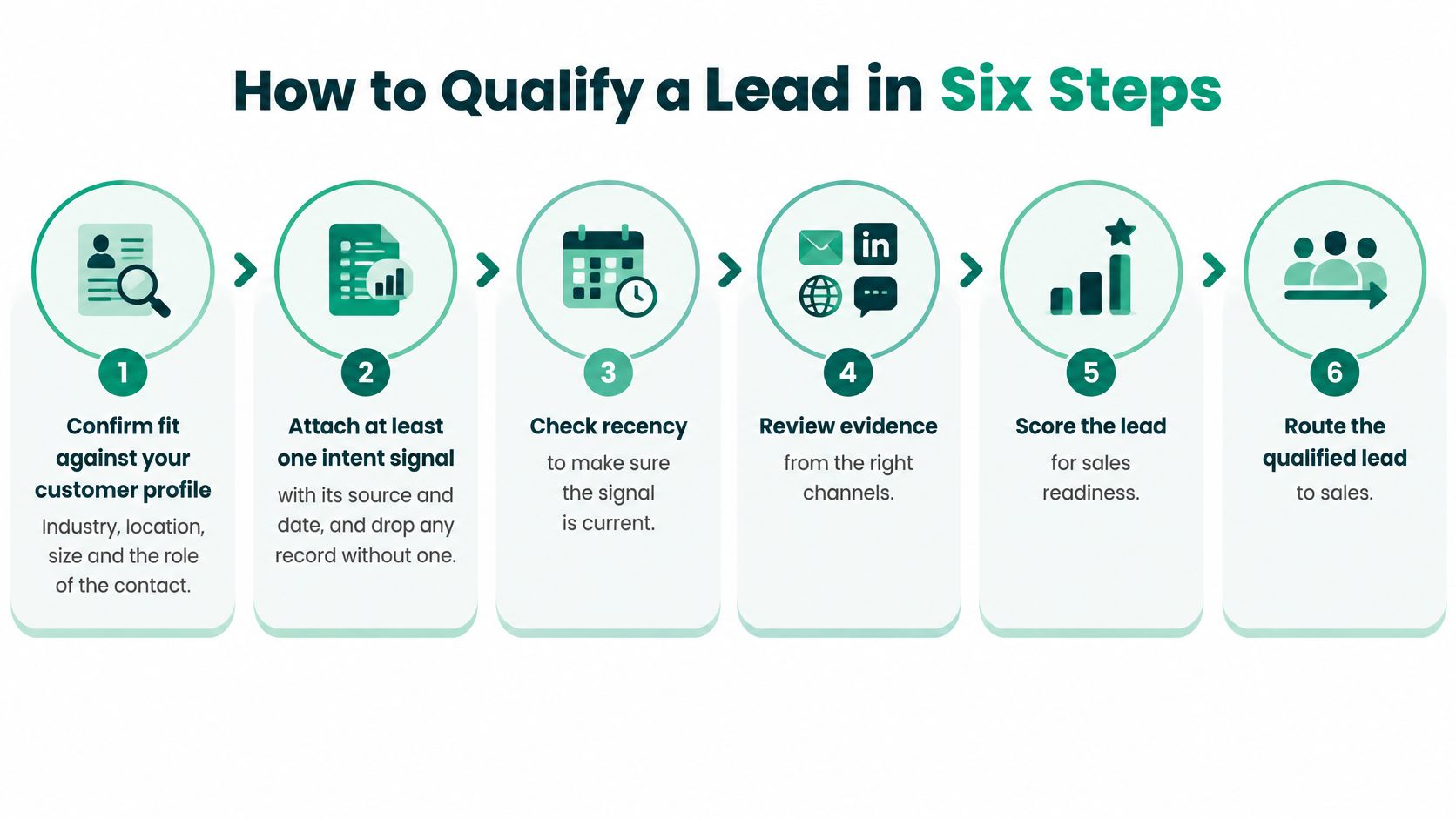
- Confirm fit against your customer profile. Industry, location, size and the role of the contact. The usual slip is scoring a lead on fit alone and calling it qualified.
- Attach one intent signal with source and date. Drop any record that cannot produce both. The slip is keeping a good-fit record "for later" with no dated evidence, which turns the list back into a database.
- Check contactability before anyone writes. Require a verified work email or mobile for the right person, and label unknown, catch-all or doubtful results instead of treating them as confirmed. The slip is assuming a catch-all address reaches a human.
- Confirm the lawful route before drafting. Recipient type decides the rule that applies, so record it while the lead is still being worked. The slip is discovering the legal form after the sequence has already gone out.
- Route while the signal is fresh. Speed belongs inside qualification because intent decays while the prospect compares alternatives and the triggering event gets old. The slip is waiting a day to follow up on a signal that was live on Tuesday.
- Draft from the signal, review, then approve. The first line should name the reason for writing and the date it happened. The slip is a template that could have been sent to anyone.
Measure the execution, not just the outcome
Track signal-to-draft time, approval latency, first-send latency, contact rate, positive-reply rate and qualified-meeting rate by signal age. That last cut separates genuine intent from slow execution and gives you a defensible service-level target instead of a vague promise to be quick.
Keep the bar uncomfortable. A qualified batch is short: fifteen leads where every row carries a reason to contact this week beats four hundred where none does.
Mistakes That Make Lead Lists Look Bigger
The volume trap works because it's flattering. Bigger numbers feel like progress, and nobody gets challenged for adding rows.
Mistake one is counting form fills and content downloads as qualified leads. A download shows curiosity, not need. It inflates the top of the funnel and pushes the work downstream, where the cost lands on sales. Fix: a mandatory dated evidence field. No date, no stage.
Mistake two is measuring list size instead of conversion by source. A source that produces 400 raw leads and two opportunities is a cost centre wearing a success story. Fix: report MQL-to-SQL rate and meeting rate per source, then cut the worst performers without sentiment.
Mistake three is skipping nurture for the nearly-right prospects. A Forrester-cited benchmark reports that companies using lead-nurturing programs generate 50% more sales-qualified leads at 33% lower cost than companies without comparable nurturing, per these lead generation statistics. That's a strong argument for keeping the fit-but-no-timing records and rechecking them when a new dated signal appears. Fix: a nurture sequence with a clear exit condition, which is a new signal, not a fixed number of touches.
Marketing and sales rarely agree on quality. In 2024, 59% of salespeople said the leads they received from marketing teams were high quality, according to HubSpot's 2024 Sales Trends Report. Ask your own sales team the same question and compare their answer with your reporting.
Find the single source producing the most raw leads and check its SQL rate before you add anything new.
Set Your Qualification Rules Before the Next Search
Decide the rules first, then run the search. Fit, intent, contactability and timing define what counts, and a list built before those rules exist will always be a list you have to apologise for.
Three decisions belong to you, not to a tool. Which signals count as intent in your market. How long each signal stays useful, expressed as a real number of days before the reason to call goes stale. Who may be contacted under your recipient-type rules, sorted by company form and role, so every lead that passes has a lawful route to the right person.
The workflow is short. Paste your website, and the agents read it to work out what you sell and who buys it, which you approve. Review ranked leads with the source and date of each signal, then reveal verified contact details only for the leads you pick, so you never pay for a name you won't use. Approve the campaign, then approve sending as a separate step, and the message goes out only through your own Smartlead account. Your leads stay private to your account.
The one-line version: a lead is qualified when it passes the four tests in the criteria table and carries a date you'd defend in a pipeline review.
Paste your website at signalvan.com to see who's ready to buy this week.
SignalVan works from public buying signals instead of a static contact database. You paste your website, review ranked companies with the source and date behind each signal, reveal verified contact details only for the leads you choose, and approve the campaign and the sending as two separate steps before anything goes out through your own Smartlead account. Visit SignalVan to start with the companies that have a documented reason to buy this week.
Keep reading
B2B Sales Email Templates: 7 Signal-Based Examples
B2B Sales Email Templates: 7 Signal-Based Examples
Sales Operations Management: What It Does for Revenue
Sales Operations Management: What It Does for Revenue

Ideal Customer Profile: What to Write First
Ideal Customer Profile: What to Write First
Start with your website.
See your first leads, with the reason each one is there.