

Sales Operations Management: What It Does for Revenue
Sales Operations Management: What It Does for Revenue

Adding sellers is the move most founders reach for when revenue stalls. It often isn't the fix. A team can grow and still miss, because coverage is uneven, records are stale, and nobody owns the timing of who gets a conversation this week.
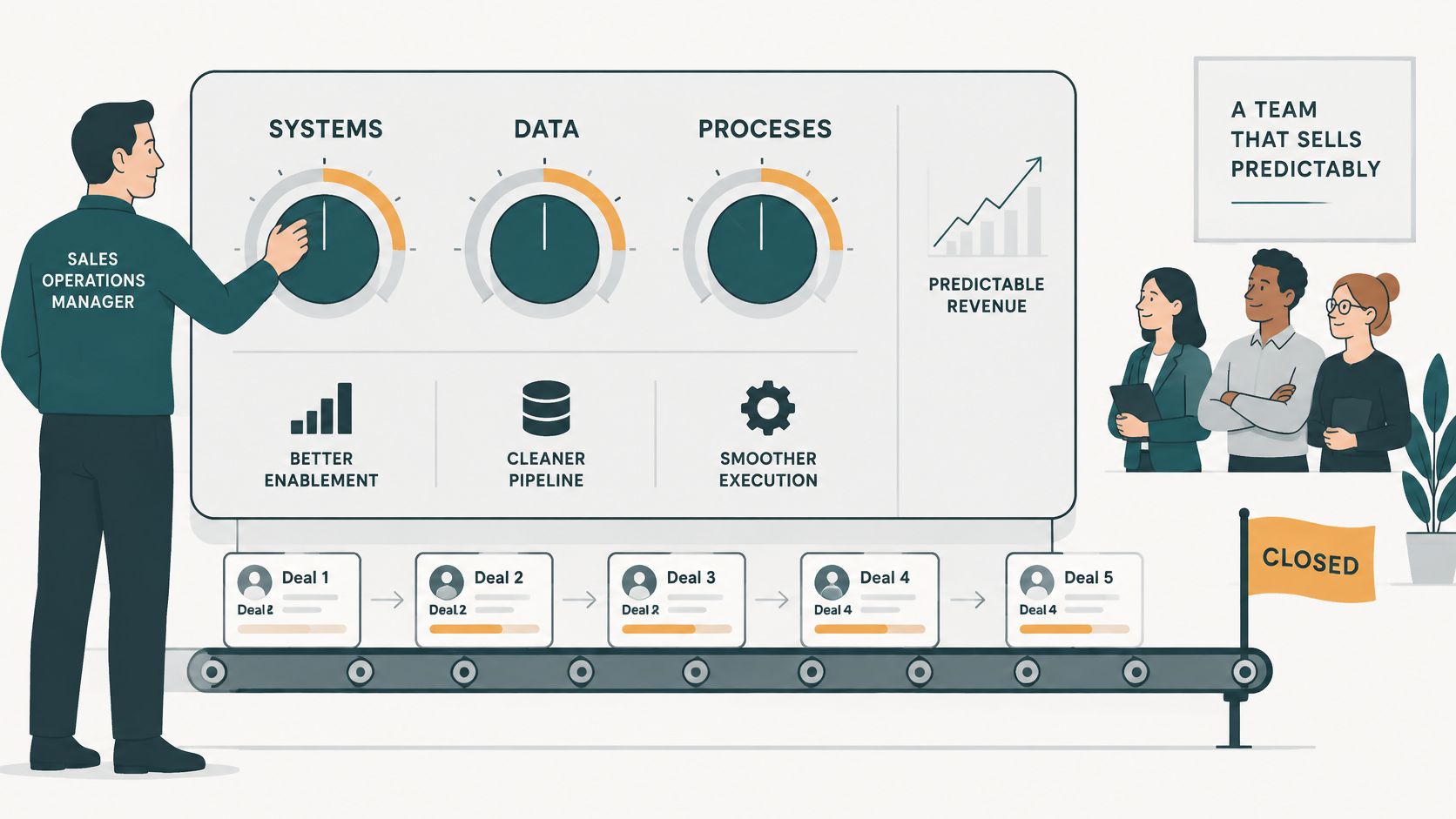
Sales operations management is the work of designing, running and measuring the systems, data and processes that let a sales team sell predictably. Think of the reps as the cooks on the line. Sales operations runs the kitchen: the stock orders, the timing of service, and the written record of what went out. Without that kitchen, more cooks just collide.
Table of Contents
- What Sales Operations Management Is
- Core Responsibilities Sales Operations Owns
- Data Quality as the Basis for Reliable Forecasts
- Metrics Sales Operations Tracks and Why They Matter
- The Quarterly Sales Operations Cycle
- Governing AI and Automation Without Losing Control
- Controls Before You Send Outreach
- Confirm Your Signal Data Before Your Next Campaign
What Sales Operations Management Is
The job is not a dashboard. It is the control system behind predictable selling: who is covered, which accounts deserve effort now, how a deal is allowed to move stage, and whether the forecast you show finance is something you can defend.
A peer-reviewed Marketing Science study from November 1996 tested that idea with an efficient-frontier model, rather than the usual bottom-up request for more headcount. It used data from two sales organisations, one selling manufacturing equipment and one selling business equipment, and looked at how district sales responded to sales-force size, selling effort, market potential and competitive activity. Profitability improvements came primarily from closing efficiency gaps in lower-performing districts, rather than increasing the total number of salespeople or reallocating territories.
Three levers, in that order
The same study named three practical levers, and the order matters.
Close the weak patches first. Underperforming districts, segments or reps usually leak more profit than a missing hire would add. Fix the way those people work before you copy the org chart.
Allocate the team you already have. Effort should follow current evidence of need, not an equal share of every name in the CRM. A company hiring for the problem you solve, issuing a tender, or putting a new decision-maker in seat is not the same prospect as a static firmographic match.
Change team size only when the numbers justify it. Headcount is the last lever, aimed at an economically sensible level, not a morale decision after a bad month.
Adding people does not repair a broken handoff, a stage that means something different to every rep, or a list with no owner. You hire into the same waste. Early teams feel this fastest, because one bad routing rule eats a whole week of selling time.
Who actually does this work
In a larger company the owner is a sales operations manager or a revenue operations analyst. In a team of two, it is often the founder, part time, with no title on the offer letter. The work still happens: CRM fields, pipeline stages, territory notes and a weekly forecast call. What fails is leaving those pieces unnamed, so marketing, finance and the sellers each assume someone else is keeping the record straight.
The function has a clear ownership map. Six areas either sit with sales operations or get coordinated by it, and a small team has to choose which two it will run this quarter.
Core Responsibilities Sales Operations Owns
Sales operations sits between sales, marketing, finance and customer success. No single rep can hold that seat. A rep can update a deal. They cannot also set the stage rules, the quota maths, the data dictionary and the tool runbook, then brief finance on Monday.
Use the table as the ownership map. Each row has an output you can point at in a meeting.
| Area | What the team owns | Typical output | Works most with |
|---|---|---|---|
| Territory and account design | Splitting regions, segments and accounts so coverage is even | Territory map and account assignments | Sales leadership |
| Forecasting | Forecast method, stage definitions and review rhythm | Weekly forecast pack | Finance and sales leaders |
| CRM and data | Field rules, deduplication and record ownership | Data dictionary and change audit log | Marketing and revenue operations |
| Compensation and quotas | Quota setting, plan mechanics and payout checks | Quota letters and payout reports | Finance and HR |
| Tools and workflow | Sales stack configuration, integrations and automation rules | Configured stack and admin runbook | IT and vendors |
| Enablement and onboarding | Playbooks, ramp plans and training schedules | Onboarding plan and playbook library | Sales managers and trainers |
What each row is for
Territory and account design stops two people working the same logo while a whole region sits untouched. The output is a map and named assignments, not a Slack thread.
Forecasting is the method, the stage meanings and the day you review them. The output is a weekly pack finance can read without a translator.
CRM and data is where most small teams bleed. Field rules, deduplication and a named record owner produce a data dictionary and a change audit log. Marketing cannot "own leads" in the abstract if nobody owns the fields.
Compensation and quotas turns the plan into quota letters and payout reports. Get the mechanics wrong and people chase the wrong deals for a whole quarter. Finance and HR have to see the same numbers the rep sees.
Tools and workflow is configuration, not a shopping list. A configured stack and an admin runbook beat another login nobody uses. Integrations that are not live yet should stay off the runbook. lemlist, HubSpot, Salesforce and Pipedrive, for example, are often talked about long before a connection exists. Say what is connected, and what is still coming.
Enablement and onboarding is the ramp plan and the playbook library. If a new seller's first month is "shadow someone", you do not have onboarding. You have hope.
How a team of four combines the rows
A founder with four sellers should not skip rows. They should stack them.
Territory, forecasting and data become one weekly habit: assignments checked, forecast pack updated, duplicates cleared before the call. Compensation goes to finance, with sales operations supplying the attainment figures and checking the plan still matches the motion. Tools stay thin. One CRM, one sending account, one place the audit log lives. Enablement can be a short written playbook plus a buddy for the first month, reviewed when ramp slips.
Practical rule: Start with the two areas that stop the most wasted effort. For almost every early team, that is data and forecasting. Territory design is close behind if two people keep colliding.
List which two areas you own this quarter, and write a name against each of the other four. A blank owner is how the row dies.
Data Quality as the Basis for Reliable Forecasts
Bad records break the forecast before a seller does. A Validity and Demand Metric study found that only slightly over one-third of organisations with poor-quality CRM data could claim accurate sales forecasts.
The chain is short. Missing or old fields weaken segmentation, so the "priority" view is a guess. Duplicate records send two sellers, or two campaigns, at one company. Invalid contact data raises bounces, wastes capacity and hides the true conversion rate, because failed sends sit in the denominator as if they were real attempts.
Field rules, not a completion score
Do not manage this with one "complete record" percentage. A record can be 100% filled and still be wrong. Set rules on the fields that change a decision.
Email. Check syntax and domain before the address is treated as a verified email. Label the result verified, catch-all, unknown or doubtful. A binary valid or invalid flag hides the awkward middle, and the middle is where sender reputation goes to die.
Phone. Check whether the number is reachable, not merely present. A mobile field full of switchboard numbers will not help a seller.
Company match. Match on company domain before every import. Name-only matching is how "Acme Ltd" and "Acme Limited" become two accounts and two owners.
Job and employment. Put a recency window on title and employment status. A champion who left six months ago is not a champion.
Buying signals. Keep the source, the observation date and a confidence state on each signal. A hiring note, a tender or a role change with no date will rank as if it happened this morning. It didn't. Recent evidence outranks an undated static match. Your lead list should stay private to your account, never pooled, resold or searchable by other customers, because provenance only works if you can trust who else has touched the file.
For a fuller pass on where those records should live, see how sales databases hold up once you start checking freshness rather than row count.
| Data problem | Effect on forecast or outreach | Control to put in place |
|---|---|---|
| Stale close dates | Forecast slips into later periods | Require a dated next step and flag deals past their close date |
| Duplicate accounts | Two sellers contact the same company | Match on company domain before every import |
| Unverified email addresses | Bounces and wasted send capacity | Verify before adding to a sequence and label catch-all and unknown results |
| Undated buying signals | Old evidence ranks as if it were current | Store the source and observation date with each record |
| Missing record owner | Nobody fixes the record | Assign a field-level owner and an escalation rule |
What to watch each month
Track freshness decay, duplicate rate, bounce rate, enrichment coverage, and the share of opportunities that still have a verified decision-maker. Each key field needs one owner, one freshness window and one escalation rule. Keep a separate audit log for data changes, so a quiet overwrite is visible later.
Approval of a message is a different log from a data change. Do not mix them. You want to know who edited the record and, separately, who allowed the note to leave the building.
Metrics Sales Operations Tracks and Why They Matter
A dashboard of totals is not a control system. Each metric needs a definition, an owner, a threshold and a decision rule. If a number moves and nobody is named to answer, you have a chart, not an operation.
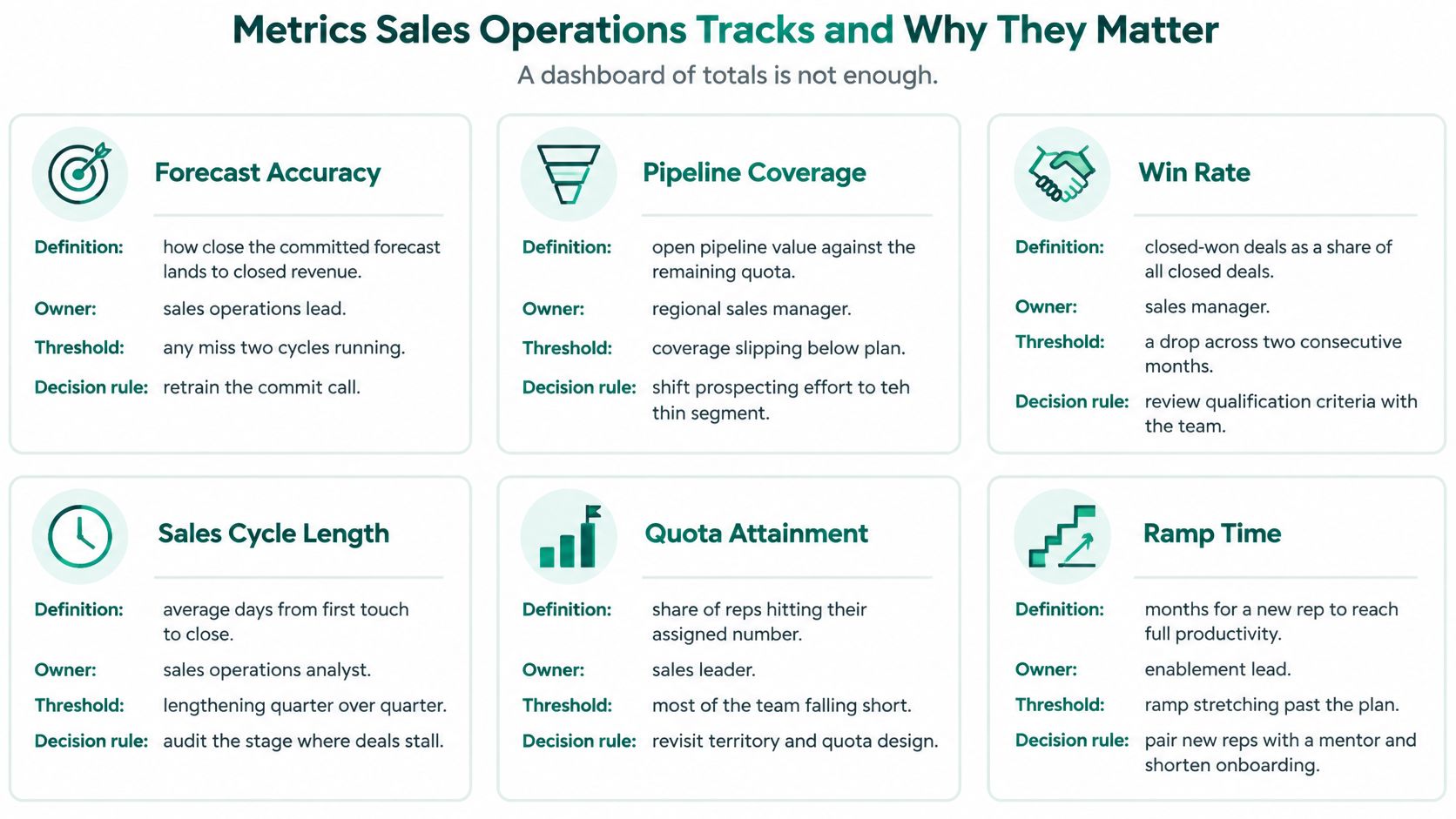
| Metric | What it reveals | How to calculate | Review cadence |
|---|---|---|---|
| Forecast accuracy | Gap between forecast and closed revenue | Closed revenue divided by forecast for the period | Weekly and monthly |
| Pipeline coverage | Whether open pipeline is enough for the target | Open pipeline divided by remaining target | Weekly |
| Stage conversion | Where deals stall between stages | Deals reaching the next stage divided by deals entering the stage | Monthly |
| Sales cycle length | How long deals take to close | Median days from creation to close | Monthly |
| Win rate | Share of qualified deals won | Won deals divided by closed deals | Monthly |
| Data freshness | Share of records updated within the agreed window | Records updated in window divided by total records | Monthly |
| Bounce rate | Share of outbound emails rejected | Bounced sends divided by total sends | Per campaign |
Read them as a set. Coverage can look healthy while stage conversion shows everything dying after the second meeting. Cycle length can stretch because legal sits on contracts, or because stage two has no exit rule and deals loiter. Bounce rate is an outreach metric sitting on the same page because bad contact data pretends to be pipeline.
Why one accuracy figure lies
Published benchmark summaries place median sales-forecast accuracy around 70–79%, while only about 7% of organisations reach at least 90% accuracy, according to Sales Growth's forecast accuracy benchmarks. Treat those as published benchmark summaries, not as one named study of your market.
A single aggregate hides the split that matters. New-business forecasts are often weaker than renewals. Segment by horizon, representative, segment and deal type before you coach anyone. Stage exit criteria should be observable buyer actions, not a rep's mood. Every forecastable opportunity needs a dated next step and a named economic buyer. Audit how long deals sit in each stage every week.
When the number misses, name the cause before you add pressure.
Prioritisation. The wrong accounts entered the commit.
Qualification. Stage two let in deals with no buyer action.
Execution delay. The next step aged in silence.
CRM hygiene. Close dates, duplicates or unverified values inflated the weighted pipe.
Pipeline movement has its own read, separate from the forecast call. Pipeline velocity shows whether deals are advancing, which a coverage ratio alone will not.
Choose three metrics for the next quarter. Write the formula for each in one line. Name the person who answers when the number moves. Three owned metrics beat seven orphan charts.
The Quarterly Sales Operations Cycle
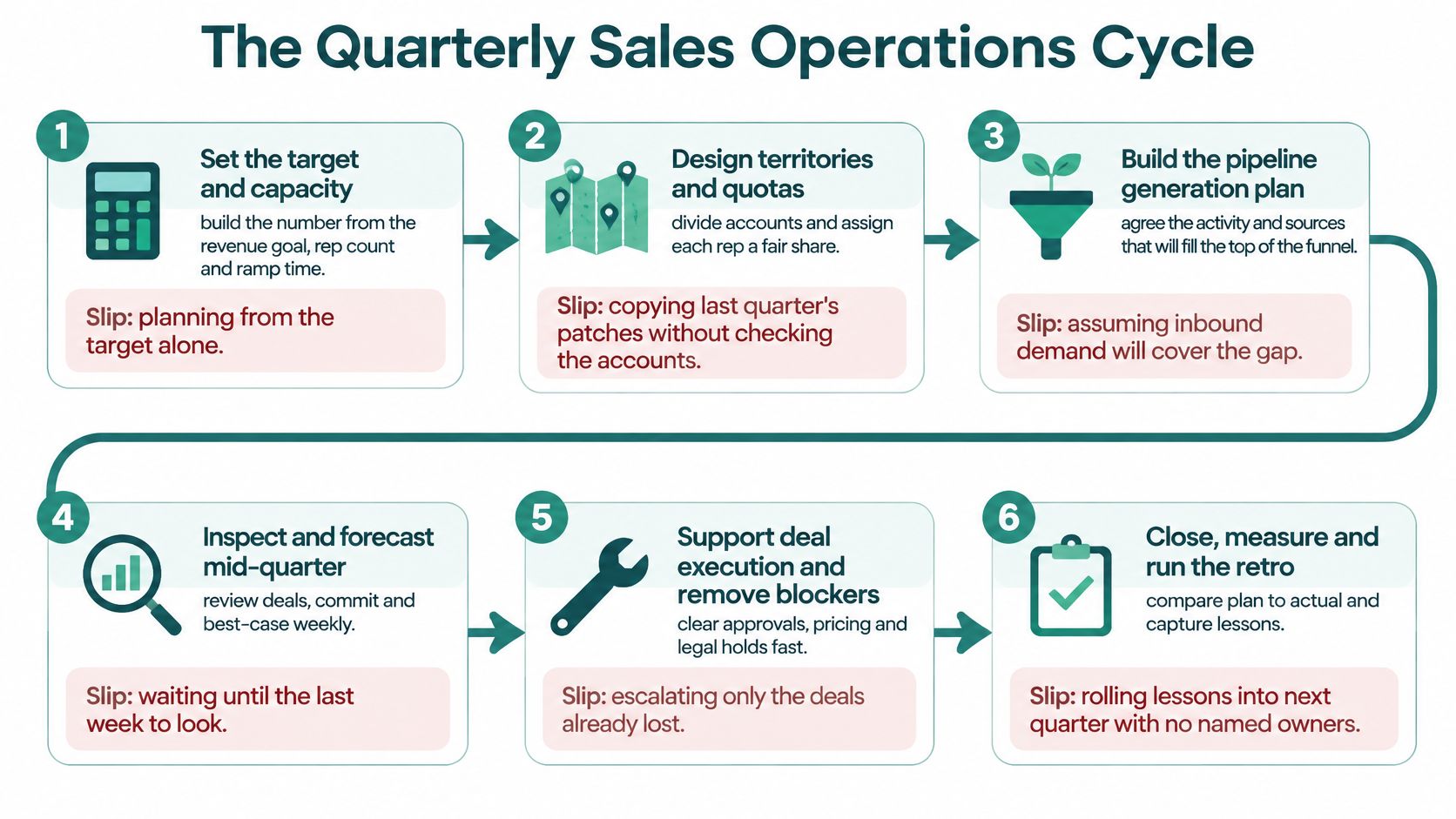
Run the quarter as six steps. Each step has a known way to slip. Name the slip in the plan, or you will rediscover it in week eleven.
The six steps
1. Set the target and the capacity. Build the number from the revenue goal, the rep count and ramp time. The slip is planning from the target alone, then discovering in month two that two of four sellers are still ramping.
2. Design territories and accounts. Split by region, segment or a defined set of current evidence, and write the assignments down. The slip is moving boundaries mid-quarter because a loud deal appeared in someone else's patch. Moves mid-quarter teach people to hoard accounts.
3. Write stage exit criteria as buyer actions. A signed mutual action plan, a confirmed economic buyer, a procurement step that occurred. The slip is renaming stages halfway through, which makes every historical conversion rate useless.
4. Fix the forecast method. One owner. One review day. The slip is gut feel dressed up as a commit. If the owner can change a number in the meeting with no reason code, you do not have a method.
5. Clean the pipe before the call, every week. Stale close dates and missing next steps get fixed first. The slip is silent ageing: deals that look late-stage because nobody has touched the date.
6. Compare forecast with actuals and change one variable. One. The slip is a retro that rewrites territory, stages, quota and messaging in the same afternoon. You will not know which change did anything.
A team of two can run steps 3, 4 and 5 as one standing meeting, and reopen steps 1, 2 and 6 only at the quarter boundary. That is combination, not skipping.
One quarter on paper
Say a founder and four sellers of B2B services work the UK and the US. Nothing here is a result. It is the sequence of controls.
Week one, they lock six stages and name the forecast owner. Stage names do not change again until the retro. Each stage has an exit the buyer can be seen doing.
Week four, anything past its close date is pulled out of the commit until it has a dated next step. Reps do not get to "leave it and see".
Week eight, new accounts enter only with a sourced, dated buying signal and a verified email. A person reads the first message and approves it before it is placed in their own Smartlead account. Drafting is not sending.
Week twelve, the weak segment is new business, not renewals. They change only the stage-two qualification question. Territories, quota and the other stages stay put, so the next quarter can tell whether that one question was the problem.
If you change two things, you learn nothing. If you change none, you repeat the quarter.
Governing AI and Automation Without Losing Control
Plenty of teams have switched a tool on and called it progress. Adoption is a poor success metric.
Two figures describe different things, so keep them apart. In 2025, 81% of sales teams surveyed in the B2B Sales Benchmark and Technology Report reported using AI in their processes. Separately, Nektar's note on sales operations trends describes a narrower gap: more than 60% of sales teams reportedly use generative AI, yet only about one-third report genuine productivity gains. One is broad AI use. The other is generative AI against a productivity claim. Do not add them together.

A checklist of tools is not governance
Forecasting helpers, call summaries, enrichment, routing and follow-up drafts are workflows. They are not a decision about which of those workflows may run. Isolated agents sitting on unprepared data make the miss faster. The record was wrong. The draft is confidently wrong.
Keep a use-case register with five columns for every workflow you allow.
Business purpose. What decision or task it is allowed to touch.
Owner. One person who can pause it this week.
Outcome metric. Conversion, forecast error, reply quality or opportunity creation. Not minutes saved, and not emails drafted.
Human approval step. Where a person must say yes before anything a buyer could see is released.
Audit trail. What evidence you keep: prompt context, source of the claim, who approved, when.
Time saved and commercial impact are different ledgers. Fewer admin minutes do not, by themselves, mean a better forecast or a cleaner customer experience. If you cannot show the second ledger, the workflow stays in trial.
An outreach draft can be written from what a prospect said or did. That is useful. It is not permission to send. SignalVan keeps two approvals in the path: one to build the campaign and one to start sending, and sending goes only through your own Smartlead account. Ranked prospects and drafts get judged on evidence quality, relevance, contact validity, reply quality and whether an opportunity appears later. Activity volume is the wrong score.
Before a workflow leaves trial, answer four questions in writing. What does it change? How will you measure that change? Who can stop it? What evidence do you keep if a buyer, or a regulator, asks why that person was contacted?
Controls Before You Send Outreach
Sales operations owns the gate between a draft and a send. A polished first line does not fix a domain, a missing opt-out, or a list that treats every address as the same kind of person.
Authentication and volume
From 1 February 2024, Gmail's sender requirements say senders must authenticate with SPF or DKIM, keep valid forward and reverse DNS, and follow Google's delivery guidance. A sender approaching 5,000 messages in a 24-hour period to personal Gmail accounts is classed as a bulk sender. Google then also expects SPF, DKIM and DMARC, a low spam rate, and a simple unsubscribe.
Google's bulk-sender rules count messages from the same primary domain together, and the From domain on direct mail to personal Gmail accounts must align with either the SPF or DKIM organisational domain. That is a reason to segment and to cap volume on purpose. One undifferentiated file, fired because the quarter looks thin, is how you trip the threshold with mail you did not need to send.
Rank the list. Send to suitable contacts. Leave the rest for a later review when the evidence is current. A verified email is necessary and still not sufficient. The domain and the campaign process need the same care.
The UK split, and personal data either way
Under the ICO's reading of PECR, electronic mail marketing to corporate subscribers, such as limited companies and limited liability partnerships, does not require consent under PECR, provided you do not disguise your identity and you supply a valid opt-out. Sole traders and some partnerships count as individual subscribers, so unsolicited marketing email generally needs specific consent or a valid soft opt-in. A company-domain contact at a limited company is not governed the same way as a sole trader. Store organisation type. Do not treat every verified address as identical.
PECR is not the end of it. The ICO's guidance on marketing and data protection is clear that personal data rules can still apply to B2B outreach. A named person's name or business phone needs a lawful basis, commonly consent or legitimate interests. Say who you are. Offer a way to opt out. Keep a suppression list and honour objections.
A buying signal can explain timing and relevance. It does not replace the lawful basis, and it does not replace suppression. Record why that person was selected, and keep the data to what you need.
The operating sequence is plain. Verify the address and label anything that is not confirmed. Cap the day's volume against the domain, not against one mailbox. Hold human approval before anything leaves through the user's own Smartlead account. Teams that want that gate written down can compare approval workflow tools against a habit of "someone will check it".
Confirm Your Signal Data Before Your Next Campaign
Before the next campaign, four checks decide whether you are running a system or a blast.
Source and date. Every buying signal has a source and an observation date. No date, no rank.
Contact status. Each email and mobile is marked verified, catch-all, unknown or doubtful. Only the confirmed ones go forward.
Message approval. A person approves the message. A draft sitting in a tool is not approval.
Stage and next step. Each prospect sits in a defined stage with a dated next step, or they are not in the forecast.
Signal-first prospecting is the same discipline applied to who you research first. You rank accounts by dated public evidence of a possible need, then decide which ones deserve a human review. You do not give every static match an equal slice of a small team's week. The point is paying customers you can reach while the evidence is still current, not a larger file.
Public signals that carry timing include a job post for the role you sell to, a funding round, someone asking for recommendations, a new decision-maker, and a tender. Company registers and public tender notices sit alongside posts, hiring and news. The source belongs on the row, or the row is just a name.
SignalVan runs that as four steps. Paste your website so the agent can read what you sell and who buys it, and you approve that summary. See ranked leads with the proof behind each one. Get the decision-maker's verified contact details for the leads you pick. Approve a message that goes out through your own Smartlead account. Nothing is sent until you approve the campaign and then approve sending, and it only goes out through that account.
Paste your website at signalvan.com to see who's ready to buy this week.
SignalVan ranks companies from dated public buying signals, checks decision-maker contact details, and drafts a first message you approve before anything is sent through your own Smartlead account. That is sales operations management applied to timing and provenance, not another list to blast. See who is showing evidence of a need this week at SignalVan.
Keep reading
B2B Sales Email Templates: 7 Signal-Based Examples
B2B Sales Email Templates: 7 Signal-Based Examples

Ideal Customer Profile: What to Write First
Ideal Customer Profile: What to Write First

How Much Is Been Verified? Plans and Pricing Factors
How Much Is Been Verified? Plans and Pricing Factors
Start with your website.
See your first leads, with the reason each one is there.