

Ideal Customer Profile: What to Write First
Ideal Customer Profile: What to Write First

An ideal customer profile describes the companies most likely to become paying customers, not a single person. Get that order right and every step downstream gets cheaper: shorter lists, fewer wasted sends, fewer calls with companies that were never going to buy.
They invert it. They write a buyer persona, pick a job title, buy a contact list, then wonder why replies are thin. Gartner's account of complex B2B purchases puts the buying group at 6 to 10 decision-makers, each arriving with four or five independently gathered pieces of information (B2B buying statistics). One contact was never the deal.
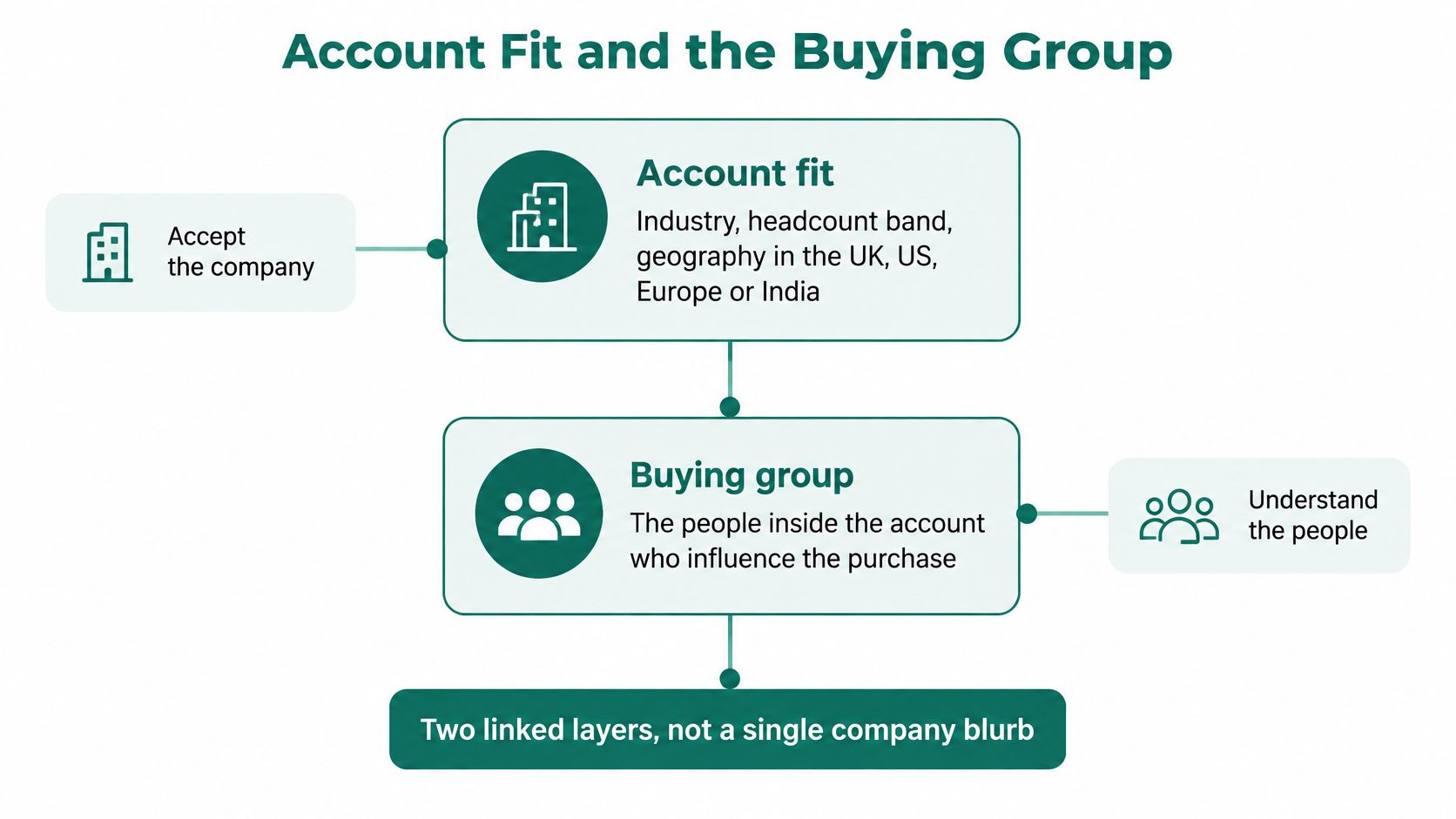
So treat the profile as two linked layers. Durable account fit names the kind of company that becomes a paying customer and stays one. A deliberately small buying group names the few roles inside that company who decide, evaluate, use and block. Then add the layer most templates skip: dated buying signals that show why this account deserves a conversation this week rather than next quarter.
Fit with no timing gives you a tidy list nobody needs yet.
Table of Contents
- What an Ideal Customer Profile Decides
- Account Fit and the Buying Group
- How to Write a Profile You Can Use
- Buying Signals That Show Timing
- Three Profiles You Can Copy and Adapt
- When to Change the Profile
- Approve the Profile Then Choose Who to Contact
What an Ideal Customer Profile Decides
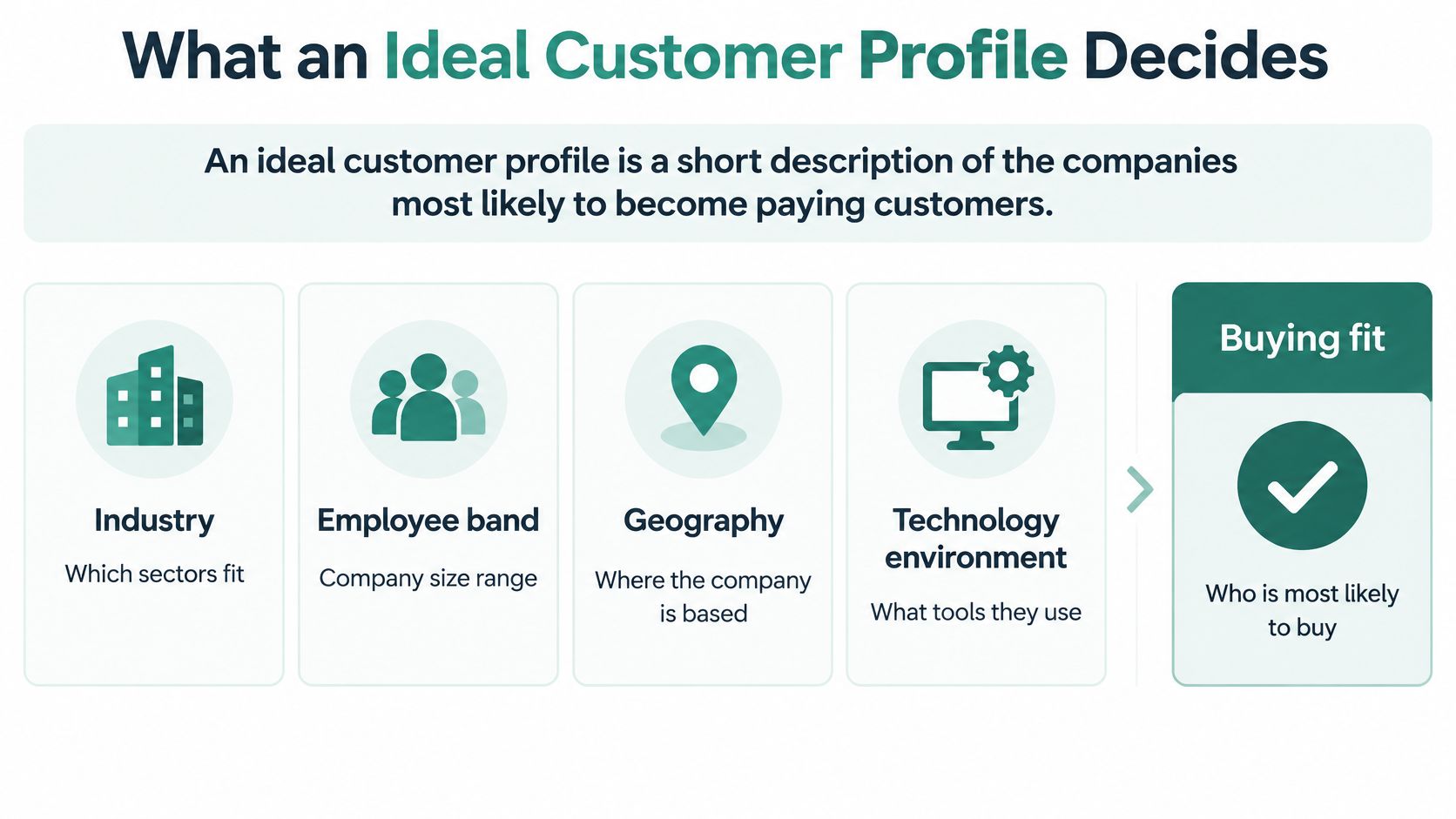
A working profile answers one question: which accounts deserve your week? It names the industry, employee band, geography, technology environment, growth stage and business problem that mark a company as a likely buyer, and it states them in fields you can check from outside the company.
A buyer persona answers something different: how does one role inside that company decide, object and talk? Blur the two and you get the standard failure. A founder writes a vivid persona for "VP Sales at a scaling SaaS company", then contacts every company employing that title, including the ones with no budget, no trigger and no reason to switch.
An ideal customer profile versus a buyer persona
| Question | Ideal customer profile | Buyer persona |
|---|---|---|
| What it describes | The company or account | One role inside that company |
| Main question | Which accounts can become paying customers | How that role decides and objects |
| Typical fields | Industry, size, geography, stack, stage, problem | Goals, pains, objections, language |
| When you use it | Before building or ranking a list | When drafting a message to a named role |
| What it leaves out | Personality and daily routine | Whether the company should be contacted |
| Common failure | Too broad to filter a market | A vivid person at the wrong company |
Read the last row twice. A profile that can't reject anyone wastes the one resource a small team has, which is attention. A persona so detailed it runs to three pages, applied to a company with no budget, is worse than no persona at all.
Here's the part that catches experienced sellers. A company can match every field on your list and still have no live need. Fit describes who could buy. It says nothing about who is buying now. That's why timing sits beside fit from day one, not after a six-week research project.
Buyers tell you the same thing. In 2024, 71% of B2B buyers and influencers said suppliers should spend more time understanding their needs and workplace challenges, according to dentsu's fourth annual Superpowers Index. Understanding needs starts with knowing which accounts have needs worth understanding.
Practical rule: write one sentence a colleague could use to accept or reject an account before researching a single person.
Something like: "We sell to UK B2B software companies with 20 to 200 staff and an in-house sales team of five or more, where a new revenue-operations hire has just inherited a messy CRM." Anyone on your team can apply that to ten companies this afternoon and say yes, maybe or no. That's the test.
Account Fit and the Buying Group
One company description is half a profile. The other half names the people inside the account who make the decision happen.
Complex B2B purchases pull in several people spread across multiple functions. A 2025 survey in the Demandbase State of the B2B Buyer Report found that 73% of purchases involve three or more departments. Treat that group as a room, and assume most of the room never replies to cold email.
The shape of the room is shifting too. G2's 2025 buyer research describes a move toward smaller 3 to 4 person software buying committees, with technical experts and end users picking up influence beyond the traditional C-suite. Fewer names, different names.
The roles worth naming
Skip the org chart. You need enough of the group to write a message each member would read.
| Role | What they care about | Evidence they need | Include when |
|---|---|---|---|
| Economic buyer | Outcome and budget | Cost of the unsolved problem and why now | Always |
| Technical evaluator | Integration and risk | Fit with the current stack | Software or tool purchases |
| End user | Daily work | What changes in their week | The user isn't the buyer |
| Procurement | Process and terms | A formal buying cycle | Deals that go through purchasing |
| Blocker | Adoption risk | The objection that stops rollout | Someone can veto without holding budget |
Two things go wrong at this layer. First, collecting every decision-maker you can find produces a list of twenty names and no message anyone wants to send. Second, naming one title you like and assuming the group matches it. If you cannot say who can stop the purchase, you have a market description rather than a profile you can prospect from.
Write the four cells for each role once, in plain sentences. "The finance lead needs the cost of the current manual process on one line, because the budget is already allocated this quarter." One sentence like that does more for reply rates than any clever subject line.
The two layers then work in sequence. Accept the company on durable fit, then decide which seats matter and what each one needs to hear. A dated signal tells you when that sequence is worth running; the account and the group tell you where to aim it. For the longer version of the second layer, the guide to who the decision-makers are inside a B2B deal walks through each seat in turn.
How to Write a Profile You Can Use
Skip the workshop. Open a spreadsheet and work through seven steps in this order. Each one removes a specific mistake, and the order matters because later steps depend on earlier ones.
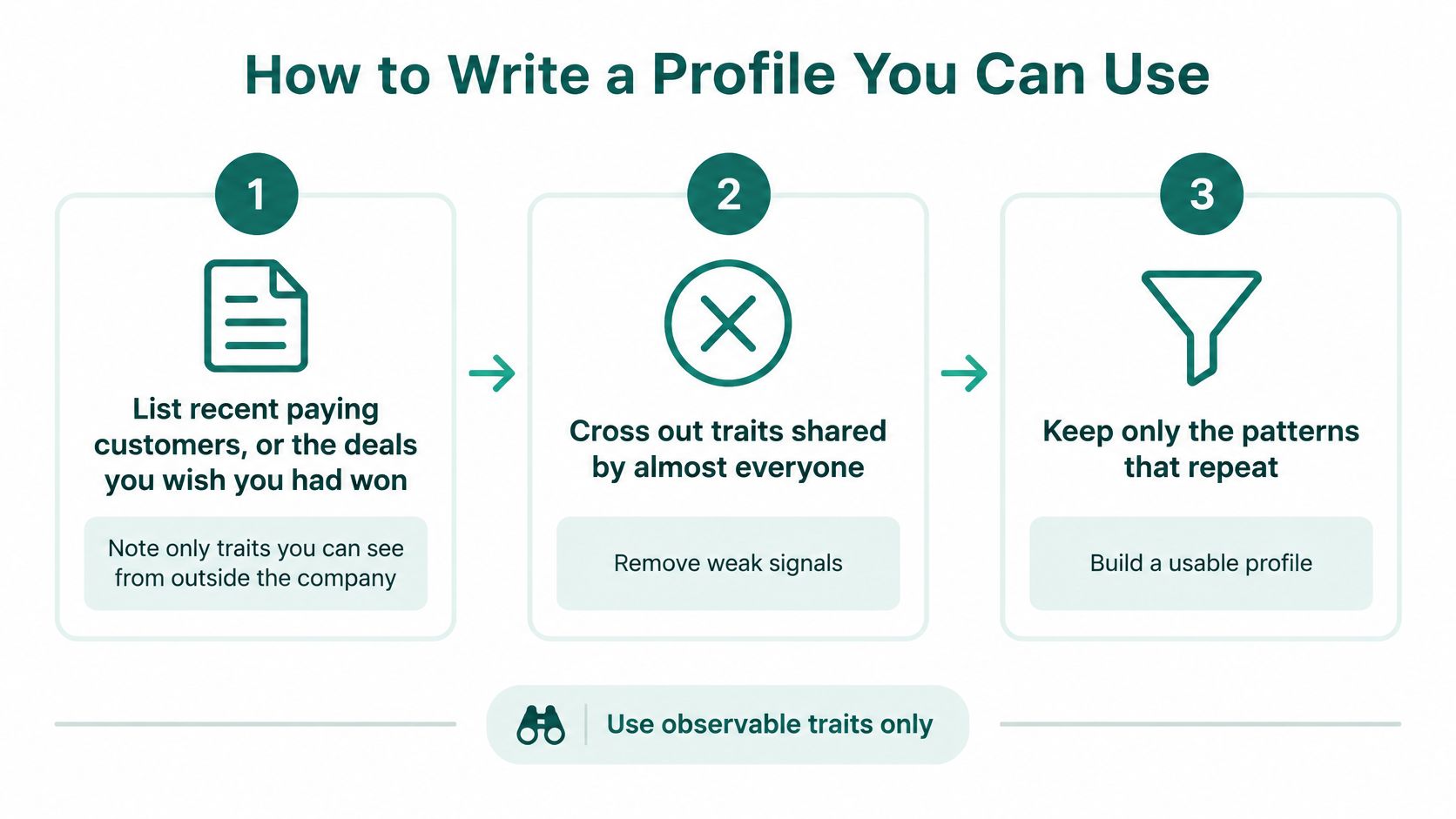
List recent paying customers, plus the deals you wish you'd won. Record only traits you can see from outside the company: sector, headcount, country, the tools on their site, the roles they were hiring. Interviews that never turn into an observable field can't be used on a list.
Cross out anything shared by almost every firm in your market. "Uses email" and "wants to grow" filter nobody. A trait only earns a place if it separates good accounts from bad ones.
Set bands you can check. Industry, employee range, country or region, current software. "Mid-market SaaS" sounds precise and tells a colleague nothing. "B2B software, 20 to 200 employees, UK or Ireland, HubSpot in the stack" is a filter.
Name the problem in the customer's words and the event that makes it urgent. Not "needs better pipeline" but "new operations hire inheriting a CRM nobody maintains". The event is what gives you a reason to write this week.
Attach three or four roles from the buying table. Not a full org chart. One job title treated as the whole purchase is how you end up with a great message to a person who can't sign anything.
Write your disqualifiers. Wrong size, wrong region, no budget owner identifiable, or a company type your sales motion can't serve. Agencies selling retainers should exclude companies that buy only project work, and say so in writing.
Mark each account strong fit, possible or out before you look up a person. A verified email fetched for the wrong company is the most expensive kind of accurate data.
The seven steps, the field and the mistake each one kills
| Step | What you record | Mistake it prevents |
|---|---|---|
| 1 | Traits of recent paying customers that an outsider can see | Interviews that never become a filter |
| 2 | Traits shared by almost every firm, crossed out | A profile too broad to reject anyone |
| 3 | Industry, employee band, country or region, and current tools | Vague labels such as mid-market SaaS |
| 4 | The problem in the customer's words and the event that makes it urgent | Fit with no reason to write this week |
| 5 | Three or four roles from the buying group, not a full chart | One job title treated as the whole purchase |
| 6 | Disqualifiers such as wrong size, wrong region, no budget owner, or a company type you can't serve | Accounts your motion can't win |
| 7 | Strong fit, possible, or out, marked before any person is researched | A verified email fetched for the wrong company |
Finished looks like one page. A colleague picks ten companies, applies your rule, rejects three and ranks the rest. If your page can't produce a rejection, it isn't a profile yet, it's a wish list with a logo on top.
A profile that accepts everything protects nobody's calendar.
Buying Signals That Show Timing
Static fit is necessary and never sufficient. Industry and headcount tell you a market is plausible. They tell you nothing about whether anyone inside those companies has a problem this quarter.
Forrester's 2026 State of Business Buying, based on nearly 18,000 business buyers surveyed in 2025, found that the average B2B decision involved 13 internal stakeholders and 9 external influencers, with procurement acting as a decision-maker in 53% of buying cycles, as reported in Kiin's B2B marketing research roundup. Thirteen internal stakeholders. A single well-crafted email to a generic inbox is not a campaign, it's a lottery ticket.
That's why a buying signal has to be tied to a role. A founder hiring their first operations lead is a completely different conversation from a procurement-led tender with published terms. Same account, different room, different evidence.
A buying signal is a public event with a source and a date. A job post for the role you sell to. A funding round. Someone asking for a recommendation in a community. A new decision-maker announced on the leadership page. Coverage of a new contract. An open tender. Each one is checkable, and each one expires.
The source and the date are the whole test
Keep both on the record. Six weeks later, a hiring post may be filled, a tender may be closed and a funding announcement is history. Without a date you can't tell a live opportunity from a stale note someone forgot to delete. Without a source you can't tell evidence from a hunch.
Rank accounts into strong fit, possible and out. Then work the strong matches whose signal still has a source and a date attached. For a closer look at what separates a warm signal from a cold one, this piece on high-intent leads breaks down the difference.
One rule that saves weeks: if you can't paste the link and the date into the record, don't rank the account higher.
Weak or old evidence stays uncertain. Resist the urge to convert a half-signal into a confident score, because a score hides its own weakness and you'll act on it anyway. A public signal explains why you might be relevant. It is not permission to email, and it isn't consent for any channel.
Three Profiles You Can Copy and Adapt
These are patterns, not case studies. Adapt the shape to your own customers and keep the parts that force a decision.
A UK B2B software founder selling to sales teams
Account rule: UK B2B software companies with 20 to 200 staff, an in-house sales team and a CRM in place.
Signal: a job post for a revenue-operations or sales-operations hire, dated and linked. Roles: the founder as economic buyer, the new hire as technical evaluator. The opening line references the vacancy and the reporting mess it implies, because that's what the new hire was hired to fix.
Why the email comes later: the account passes the rule first, then the mailbox-checked address is fetched for two named roles. Disqualifier: no in-house sales team, so there's nobody to inherit the problem.
A lead-gen agency selling to specialist B2B firms
Account rule: specialist B2B firms in the US or Europe with a marketing budget and one clear service line.
Signal: a public post asking for a recommendation, dated. Role: the person who asked, with a check on whether they can influence budget before you write a proposal. The message answers the request. It doesn't pitch a package.
Disqualifier: companies with an in-house team already covering the same function. The payoff: you arrive as a helpful reply rather than a cold pitch, which is the entire advantage of timing.
A consultant selling into larger European and Indian manufacturers
Account rule: manufacturers above a defined headcount in the EU or India, with a formal purchasing process.
Signal: an open tender, or a news item about a new plant or contract, with the date. Roles: procurement, the operational sponsor and a technical evaluator. Procurement is in the group from the start, so your evidence is written for a formal cycle rather than a chat.
Disqualifier: sole traders and partnerships below your delivery threshold, plus any company that can't run a formal purchase.
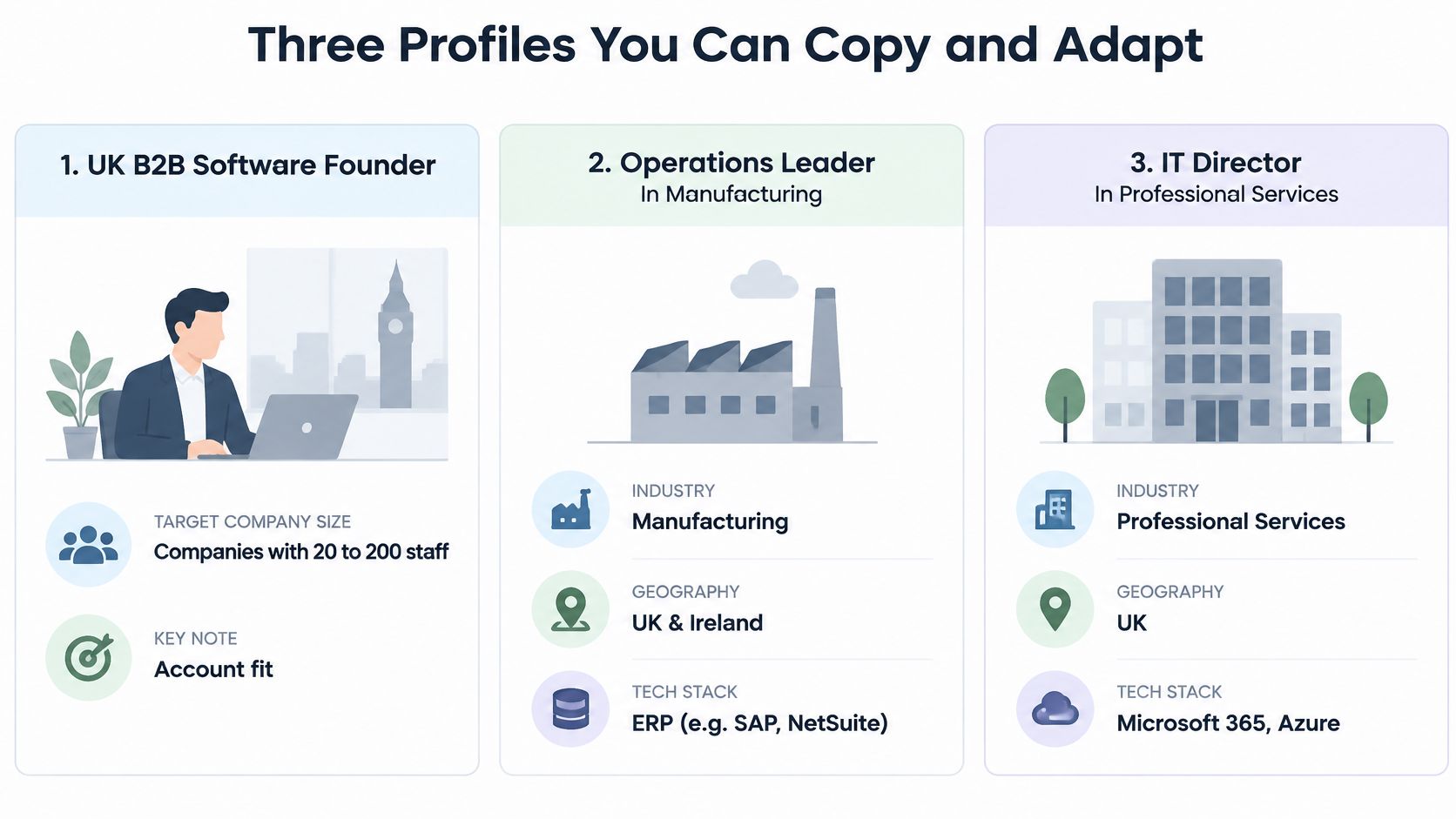
Notice what the three share. A one-sentence account rule, a signal with a date, two or three named roles, and at least one written rejection. The differences sit in who holds the budget and how formal the buying process is.
When to Change the Profile
A profile built in a one-off workshop is a profile that starts decaying on the day it's signed off. Teams change, budgets move, buying committees reorganise and priorities shift with the quarter.
G2's finding of smaller committees and more influence for technical experts and end users is a reason to revisit who you named, not a reason to add every title you can think of. The rewrite should sharpen the group, never inflate it.
Separate the durable from the perishable
Durable for at least a quarter: industry, business model, employee band, geography, core stack, the problem you solve, your disqualifiers. Don't touch these weekly. Fiddling with definitions makes your rankings incomparable month to month.
Perishable in weeks: hiring patterns, leadership appointments, tenders, competitor changes, company announcements, public requests for help. These belong on the account record with a date, not in the profile document.
Review the written profile every quarter, and earlier if wins and losses cluster in a segment you didn't predict. Raise an account's priority when a fresh signal appears. Lower it when the evidence is old, the budget owner has left, or the committee no longer matches roles you can serve.
Two fields that belong in every profile
For UK outreach, company type is a qualification field, not a footnote. The Information Commissioner's Office guidance on business-to-business marketing states that the PECR restriction on direct-marketing email does not apply to corporate subscribers, while sole traders and some partnerships are treated as individual subscribers, so marketing email to them generally needs specific consent or a valid soft opt-in. Consent has to be freely given, specific, informed and unambiguous, and withdrawing it must be as easy as giving it.
For US sending, the FTC's CAN-SPAM compliance guide sets out the mechanics: accurate From, To, Reply-To and routing information, no deceptive subject lines, a clear statement that the message is an advertisement, a valid physical postal address, and an opt-out that keeps working for at least 30 days after sending. Opt-out requests must be honoured within 10 business days.
Record the lawful basis, the sender identity and the unsubscribe route before anyone approves a send. A verified email is not a send-ready contact.
Approve the Profile Then Choose Who to Contact
Approve the profile in writing, then make every contact earn its place. Keep four lines in view: the one-sentence account rule, the disqualifiers, the three or four roles in the buying group, and the dated signals you will treat as timing.
That order matters. Fit decides which accounts are allowed in. Signals decide which of them are worth a message this week. SignalVan setup follows the same sequence: paste your website, the agents read it, propose what you sell and who buys it, and you approve the summary. No forms, no ICP worksheet, no onboarding call.
From there, use the ranking as triage rather than truth. Leads land in groups such as Ready to approach, Strong match and Partners, with the ready ones on top; how the prospect ranking is worked out shows why an account is sitting there. Open the record, check the signal source and date, then choose the person.
Verified email and mobile details are revealed only for the leads you pick, so you never pay for a name you will not use. Drafts wait for your edit and approval, and sending runs through your own Smartlead account. Your leads stay private to your account and are not pooled, resold or searchable by other customers.
The profile will not create demand. It stops you spending the week on companies that were never going to buy. Paste your website at SignalVan and see which accounts have a reason to talk now.
Keep reading
B2B Sales Email Templates: 7 Signal-Based Examples
B2B Sales Email Templates: 7 Signal-Based Examples

Sales Operations Management: What It Does for Revenue
Sales Operations Management: What It Does for Revenue
How Much Is Been Verified? Plans and Pricing Factors
How Much Is Been Verified? Plans and Pricing Factors
Start with your website.
See your first leads, with the reason each one is there.